


Fountain County, Indiana
2026 Land Sales Report
In Fountain County, Indiana, farmland values continued to rise through 2025, though the pace of appreciation has begun to slow compared to the rapid gains of recent years. As the market looks ahead to 2026, land prices appear to be stabilizing, influenced by a mix of commodity prices, interest rates, and buyer selectivity.
If you’d like to get specific land values on your own property or a Fountain county farm near you for 2026, please contact Johnny Klemme today at (765) 427-1619.
Average Price of Land*
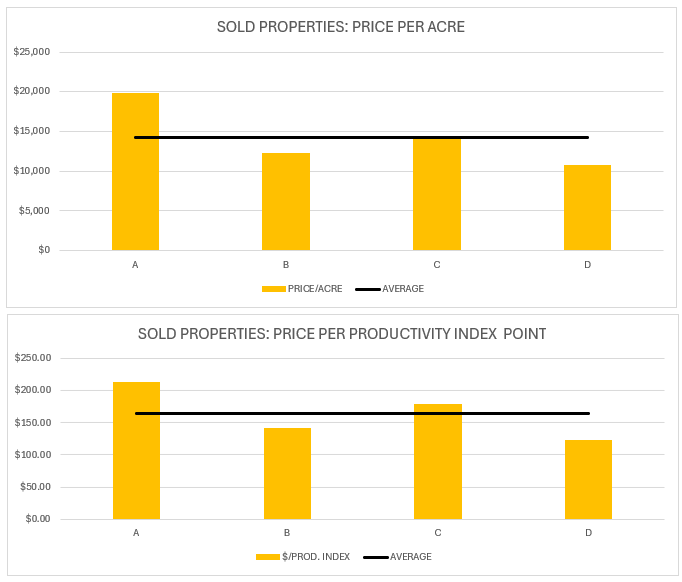
$14,220/acre
Jan. – Dec. 2025*
As high as $19,872/acre
in 2025*
Land Market Commentary & Local Trends
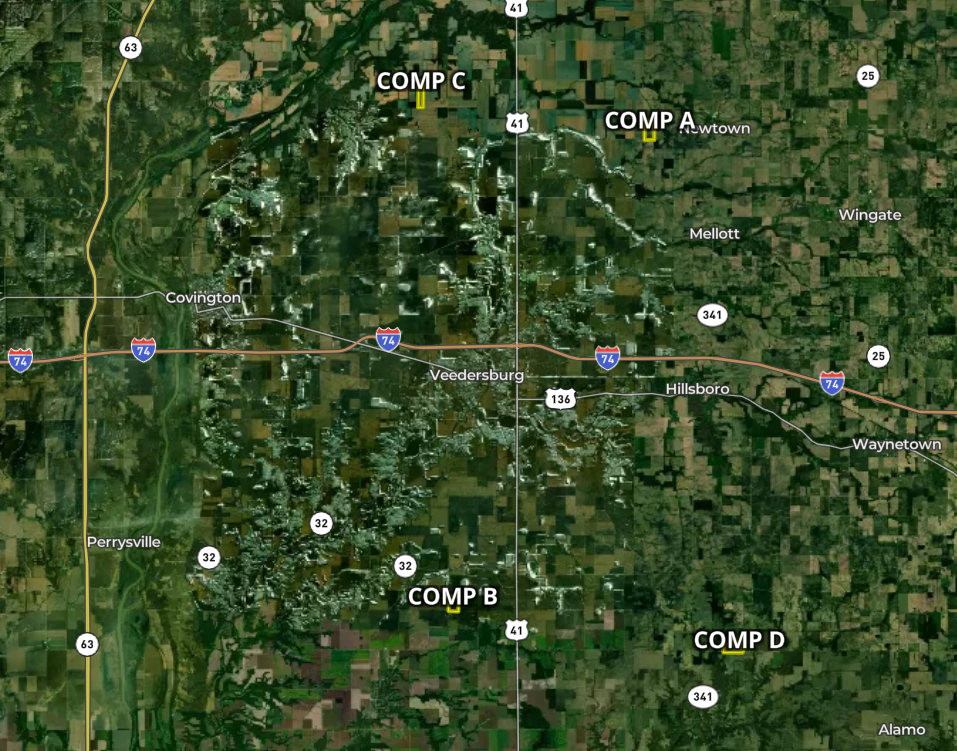
2025 still reflected a healthy but more discerning land market. Average farmland values in Fountain County settled at $14,220 per acre, equating to roughly $164.40 per productivity index point, reinforcing the idea that strong fundamentals are still supporting the market floor. However, the year’s strongest sales reached as high as $19,872 per acre – highlighting that while overall appreciation has cooled, well-located and highly productive farms continue to attract premium competition even in a more measured environment.
Since 1977, the Geswein Farm & Land Team has helped Indiana landowners make informed decisions about farmland, recreational land, wooded acreage, and rural real estate. In Fountain County, land value is influenced by more than a simple county average. Soil productivity, drainage, tillable acres, wooded acreage, road frontage, topography, buyer demand, and location all play an important role in determining what a property may be worth.
This Fountain County land values report is designed to provide a helpful starting point for understanding recent farmland sales and local market trends. However, every farm and rural property is unique. A farm with highly productive tillable soils may attract a different buyer pool than a mixed-use property with woods, pasture, creeks, hunting appeal, or potential homesites. Comparing your property to the right recent sales is essential to developing a more accurate opinion of value.
The data in this report can help provide a rough estimate of your property’s value, but the most reliable valuation comes from a property-specific review. That includes evaluating soil quality, farmability, access, drainage, income potential, conservation features, recreational appeal, and how your land compares to other recent Fountain County land sales.
Professionally marketed farms and rural properties sold through experienced land brokers, whether by auction or traditional listing, have continued to perform strongly compared to many private individual-to-individual transactions or properties marketed primarily through traditional residential real estate channels. In a selective land market, the right sale strategy, preparation, buyer exposure, and local land expertise can make a meaningful difference in the final outcome.
By The Numbers

What Changed in 2025?
Compared to 2024, the most notable shift in 2025 was not just pricing levels, but buyer behavior. Rather than broadly competing across the most available tracts, purchasers became significantly more selective, concentrating their activity on farms with clear productivity advantages and efficient layouts. Well-drained, highly productive farms with strong access and larger contiguous acreage continued to attract aggressive interest, while parcels with structural inefficiencies or weaker productivity saw more measured bidding and longer marketing timelines.
A key takeaway from 2025 is that the market has become more differentiated. Instead of uniform appreciation across all land types, value is increasingly being driven by farm specific characteristics – particularly soil quality, drainage, and operational efficiency. Heading into 2026, this suggests a market that is less about broad price escalation and more about performance-based valuation.
Market Activity & Pricing
According to Land.com, Fountain County has recently seen roughly $7 million in land actively marketed for sale, representing about 1,000 acres of rural and agricultural property. This level of inventory reflects a moderately active but still relatively tight market compared to larger agricultural counties in the region.
Within the county, Covington continues to show the highest concentration of listed land offerings. From an economic standpoint, manufacturing and related industries remain the primary employment drivers, helping support a steady base of rural land ownership and local operator demand.
Fountain County spans approximately 397 square miles, ranking it as the 50th largest county in Indiana, and sits within the western region of the state. Current listings average around 31 acres in size and are priced near $315,250, with a median price per acre of approximately $13,475. While these figures provide a useful baseline, actual sale prices continue to vary significantly based on soil productivity, access, and farm configuration.
Overview of Fountain County Agriculture
In Fountain County, farmland value differences are primarily driven by soil quality, drainage, field layout, and proximity to productive agricultural corridors. The highest-valued ground is typically well-drained, highly tillable farmland with strong soil productivity ratings, often found on flatter terrain where pattern tiling is effective and field efficiency is maximized. These farms generally support consistent corn and soybean production systems and tend to attract strong competition even in more measured market conditions.
Larger, contiguous tracts also continue to command a premium, as they provide operational efficiencies for operators seeking scale and reduced per-acre management costs.
In contrast, average or lower-tier ground is more commonly associated with heavier soils, inconsistent drainage, irregular field shapes, or transitional characteristics. These factors can increase production costs or reduce yield consistency, narrowing the buyer pool primarily to local operators rather than expansion-driven or investment-oriented buyers.
Geographically, these differences often emerge across varying terrain and drainage patterns throughout the county. As a result, Fountain County continues to exhibit a widening performance gap between premium and average land – where top-tier farms are still closely tied to strong row-crop fundamentals, while average ground is increasingly valued based on usability, access, and income potential rather than peak productivity.
Solar, Farmland Values, and Fountain County’s Future
How Large-Scale Projects Could Reshape the Market in 2026 and Beyond
Across Fountain County, the conversation about solar farms is no longer theoretical. Landowners are getting calls and letters. Developers are studying soil maps and transmission lines. County officials are being pressed to either welcome or restrict projects that could convert thousands of acres from corn and soybeans to panels and posts for the next 30 years or more. For farm families, investors, attorneys, and bankers, the natural follow‑up question is simple: what does this mean for farmland values in Fountain County?
This is not a one‑sided story. Utility‑scale solar brings a mix of opportunities and risks, and both are showing up in the way buyers, appraisers, and lenders look at land. My goal here is to help you frame the conversation in practical, financial terms while still honoring the family, legacy, and community ties that make rural Fountain County what it is.
A new “highest and best use” on the horizon
Historically, valuing farmland in Fountain County has been relatively straightforward. We look at soil productivity, drainage, tile, access, local competition for acres, and recent sales. We compare corn and soybean yields, cash‑rent levels, and interest rates. Most of the time, the “highest and best use” is continued agricultural production.
Solar projects shift that equation. When a solar developer signs a long‑term lease on a tract, the primary economic engine of that farm changes from crop production to energy production. Instead of cash rent or operating income tied to weather and commodity prices, the owner receives fixed payments, often with built‑in escalators, over a 25‑ to 40‑year term. That can make the farm feel less like a traditional agricultural investment and more like a bond backed by the creditworthiness of the solar operator.
For some buyers—particularly investors and certain lenders—that can increase the attractiveness of the asset. A predictable, long‑term income stream with limited operating variability is compelling. For others, especially operators and ag‑focused lenders, the loss of active agricultural use and the complexity of the lease can be a negative. The presence of a large‑scale solar lease can narrow, or at least change, the buyer pool, which affects how the market sets value.
The ripple effect on neighboring farmland
One of the most common questions I hear from farm families is, “What happens to my value if the farm next door goes to solar?” It’s an understandable concern, especially for multi‑generation families who have carefully assembled a contiguous operation.
The first effect is visual and emotional. A landscape that was once open fields and fence lines now includes fencing, panels, and access roads. Some buyers and tenants are turned off by that change and may factor it into what they are willing to pay. Others view it more pragmatically: the ground is still there, the soil is still good, and their own farm can continue to operate.
There are also practical considerations. Drainage patterns and tile outlets can change if construction is not carefully planned. Field access may be altered by new internal roads or fencing. Road use and maintenance may become an issue if construction traffic is heavy. These are all factors that attorneys and bankers are right to ask about during due diligence, and they can influence how an appraiser views the risk profile of nearby tracts.
At the same time, removing a large block of acres from row‑crop production can tighten the local rental market. For operators trying to grow, the remaining tillable acres may become more competitive. That can support stronger rent levels and, in some cases, stronger sale prices on the farms that remain in traditional production. In other words, while some neighbors may perceive a discount due to proximity to solar, others may see a premium due to increased demand for the limited acres still available to farm.
What the income stream means for value
For investors and lenders, the key question is how to translate solar lease payments into value. A solar lease typically offers:
-
A defined term, often 25–40 years
-
Base payments per acre, sometimes with escalators
-
Possible development or signing payments
-
Obligations for decommissioning and restoration at the end of the project
From a valuation standpoint, this invites a discounted cash‑flow approach: what is the present value of those lease payments, adjusted for risk, compared to the value of the land under continued agricultural use? The answer can vary widely depending on escalation clauses, the credit quality of the tenant, termination provisions, and local policy risk.
Bankers and attorneys will want to scrutinize:
-
Subordination and non‑disturbance language
-
How the lease affects collateral value and foreclosure rights
-
Environmental and decommissioning protections
-
Any restrictions on selling, subdividing, or refinancing during the lease term
For a family looking at retirement or estate planning, the question is more personal: does the lease help you meet your income needs and simplify operations, or does it complicate how your heirs will eventually divide and manage the property? A lease that looks favorable on paper may still not fit your goals if it locks your children and grandchildren into a structure they do not want.
Policy risk and local uncertainty
In Fountain County, one of the most important—yet underappreciated—drivers of value is policy risk. Local zoning boards and county commissioners control whether and how these projects are permitted, and those bodies can change over time. Permits can be granted, challenged, or even rescinded. Setbacks, height limits, and project caps can be tightened or loosened in response to public pressure.
This uncertainty matters because the market does not just price income—it prices the probability that income will actually materialize. If buyers, investors, and lenders believe there is a high risk that a project will be blocked, scaled back, or delayed, they will discount the value of a lease or option agreement accordingly. Conversely, if a project appears highly likely to proceed under stable rules, the lease income will be viewed as more dependable, and value will move accordingly.
For attorneys and bankers, this means staying current with county policy and understanding how changes might affect existing leases and options. For families and investors, it means recognizing that “paper value” based on a best‑case scenario may look different from a realistic market value that includes regulatory risk.
Practical guidance for different stakeholders
For farm families, the starting point is your goals. Are you using this asset for retirement, for paying off debt, for supporting the next generation of operators, or for creating a lasting legacy? Once those goals are clear, a solar proposal becomes one more tool to evaluate—not an automatic yes or no. You’ll want to stress‑test the lease economics against conservative crop income, think about how a long‑term easement fits your estate plan, and consider what kind of landscape you want your family to inherit.
For investors, the key is disciplined underwriting. Look beyond headline lease rates and calculate the risk‑adjusted value of the income stream. Understand the developer’s track record, the interconnection and transmission constraints, and the local political climate. Have a clear strategy for exit: will you sell to another investor, back to an operator after decommissioning, or to the developer if they decide to consolidate ownership?
For bankers, it is essential to develop internal guidelines for lending on land encumbered by solar leases. That includes consistent approaches to loan‑to‑value ratios, treatment of lease income in cash‑flow underwriting, and requirements for lease review. Working closely with appraisers who understand both agricultural and energy components of value will be increasingly important.
For attorneys, these projects raise a host of issues: title encumbrances, easements, mineral rights, decommissioning security, and the interaction between lease language and state or local regulations. Careful drafting and review can protect families from unintended consequences decades down the road, especially in blended situations where only part of a farm is under lease or where siblings and co‑owners have differing objectives.
Bringing it back to Fountain County
Fountain County is at a decision point. The choices made by individual landowners and by local officials will shape not just the tax base, but also the character of the countryside and the structure of the land market for a generation. Some acres have already transitioned to solar; others will remain in traditional tillage and tenancy patterns. Values will respond to both the certainty of lease income and the scarcity of high‑quality, unencumbered production ground.
In that kind of environment, what landowners, investors, attorneys, and bankers need most is clear, grounded guidance. If you own land in Fountain County—or if you advise clients who do—now is the time to review your specific situation: where your property sits relative to proposed projects, what offers or options you have received, how your financing is structured, and what your long‑term goals require.
History & Background of Fountain County, Indiana: Home of the Badlands Off Road Park
County Seat: Covington
Townships: Cain / Davis / Fulton / Jackson / Logan / Millcreek / Richland / Shawnee / Troy / Van Buren / Wabash
History: Named for Major Fountain of Kentucky, killed at Ft. Wayne
Population: 16,574
Cities & Towns: Attica / Cates / Covington / Fountain / Hillsboro / Kingman / Lake Holiday / Mellott / Newtown / Riverside / Rob Roy / Silverwood / Stone Bluff / Stringtown / Veedersburg / Wallace / Yeddo
Acreage: 253,226
Fountain County Agriculture Snapshot
Much of the foundational agricultural and demographic data for Fountain County comes from the USDA Census of Agriculture, which is updated every five years. Because of this update schedule, the data serves as a stable long-term benchmark rather than a reflection of annual market changes.
While the underlying structure of the county’s agricultural base remains relatively consistent between updates, this information is most valuable when viewed alongside current land market conditions, which reflect how buyers are actively pricing that long-term agricultural foundation.
The 2022 Ag Census for Fountain County, Indiana, reported the following crop statistics:
Number of farms: 440
Land in farms (acres): 192,752
Average farm size (acres): 438
Total market value of products sold: $175,818,000
Government payments: $1,223,000
Farm-related income: $9,058,000
Total farm production expenses: $116,810,000
Net cash farm income: $69,289,000
These figures reinforce Fountain County’s strong identity as a row-crop driven agricultural region, with corn and soybeans serving as the dominant production base supporting long-term land demand.
Hot Topics of Discussion in Fountain County
One of the biggest statewide conversations influencing counties like Fountain County involves renewable energy, infrastructure expansion, and the growing demand for power tied to future data center development. These discussions continue raising questions about land use, utilities, zoning, and the long-term impact on rural counties.
At the same time, producers remain focused on managing tighter margins as input costs, equipment expenses, and interest rates continue pressuring profitability. Crop conditions and planting progress throughout west-central Indiana have remained relatively positive, helping support overall confidence in the agricultural sector despite economic challenges.
Agricultural education, conservation practices, and long-term farm sustainability also remain important priorities throughout the county as producers continue adapting to changing market conditions while maintaining Fountain County’s strong agricultural foundation.
What Landowners Should Watch in 2026
Heading into 2026, Fountain County landowners should pay close attention to how interest rates, farm profitability, and buyer selectivity interact, as these factors are likely to shape both pricing strength and market activity.
Rather than a uniform appreciation environment, the market is increasingly defined by differentiation – where land quality and operational efficiency matter more than broad market momentum. Financing costs continue to influence buyer behavior, with well-capitalized local operators and long-term investors still driving most transactions, while more leveraged buyers remain cautious. At the same time, crop margins will play an important role in shaping bidding strength, particularly for average-quality tracts where returns are more sensitive to input costs.
2026 Market Scenarios
Looking ahead, Fountain County’s farmland market is likely to follow one of several paths depending on macroeconomic and agricultural conditions:
If interest rates begin to ease: Buyer competition could strengthen, particularly for premium farms, potentially supporting renewed upward pressure on top-tier land values.
If farm margins remain tight or weaken further: Price dispersion between premium and average ground is likely to widen, with stronger resistance in lower-quality tracts.
If inventory levels increase meaningfully: The market could experience short-term pricing pressure, especially in mid-tier farms, as buyers gain more negotiating leverage.
Overall, 2026 is expected to be less about rapid appreciation and more about positioning. High-quality, efficiently configured farms are likely to remain resilient, while the broader market settles into a more measured and selective pace of valuation growth.
Sources / Citations:
Source 1:
“United States Department of Agriculture.” USDA, www.nass.usda.gov/Statistics_by_State/Indiana/Publications/County_Estimates/index.php#:~:text=Access%20Quick%20Stats%20Lite,to%20NASS%20Surveys%20and%20Programs. Accessed 1 May 2026.
Source 2:
“USDA.” 2022 Census of Agriculture County Profile, www.nass.usda.gov/Publications/AgCensus/2022/Online_Resources/County_Profiles/Indiana/cp18045.pdf. Accessed 1 May 2026.
*The transaction and land sales data/information contained in this report was obtained from publicly available sources and sales disclosures deemed accurate and reliable but not guaranteed, no liability for accuracy, errors or omissions is assumed by Geswein Farm & Land Realty, LLC
Thinking About Selling?
Need Advice?
With our full-time experienced team, you’ll get our ‘boots on the ground’ work ethic paired with the latest in digital technology & national marketing reach – for best-in-class service and results.
Because you deserve more value.
Contact Us