


Warren County, Indiana
2026 Land Sales Report
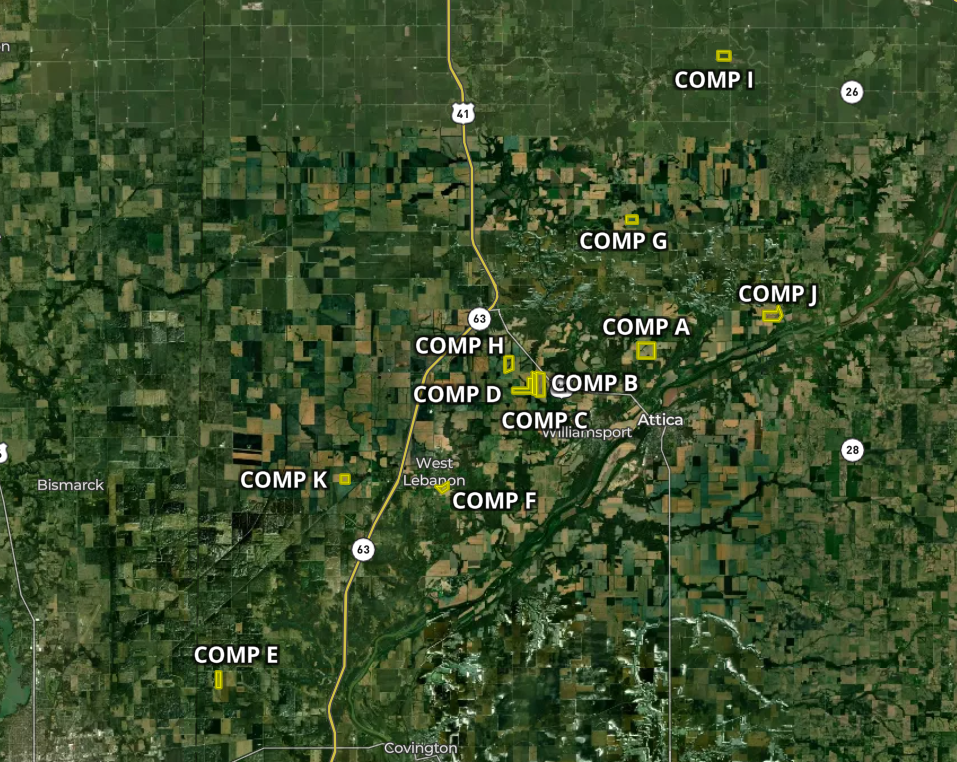
Warren County farmland values remained strong throughout 2025, driven by consistent demand for quality agricultural land. As 2026 carries on, the market appears to be shifting toward steadier pricing, with stabilization gradually replacing the sharp gains of recent years.
If you’d like to get specific land values report, or appraisal on your own property or a farm near you for 2026, please contact Johnny Klemme today at (765) 427-1619.
Average Price of Land*
$10,204/acre
Jan. – Dec. 2025*
As High as $15,935/acre
in 2025*
Land Market Commentary & Local Trends
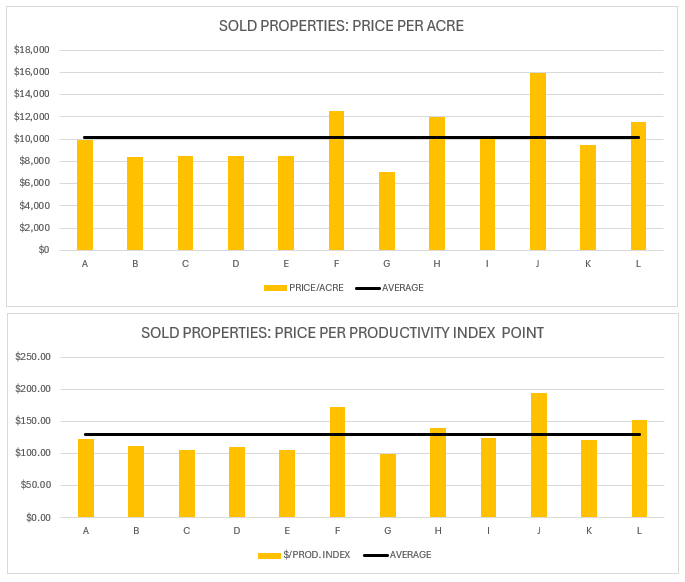
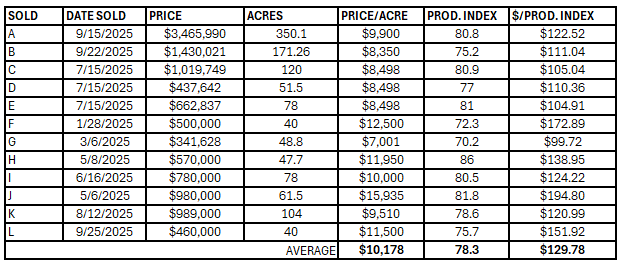
From January through December 2025, our sampled Warren County farmland sales showed an average value of $10,204 per acre, with buyers paying an average of $130.44 per productivity index. While these figures reflect the broader market across the county, premium tracts continued to command stronger prices, with top-end sales reaching as high as $15,935 per acre.
Since 1977, the Geswein Farm & Land Team has been advising landowners to be stewards of the land and make decisions based on most current, accurate, and relevant data. The information in this report can provide you with a rough estimate of your property’s value; however, understanding the specific characteristics of your property and how they compare to the other sales will provide the most accurate value of your property. Additionally, properties sold by land brokers via auctions or listings consistently outperformed individual to individual transactions and properties sold by traditional home realtors.
By The Numbers
Land Use: 2026 Hot Topics for Farmland, Recreational Land, and Real Estate
Warren County’s Master Plan Is Driving Local Land Use Conversations
One of the biggest land-use stories in Warren County, Indiana in 2026 is the countywide master plan update. This process is important because it helps guide future decisions around growth, zoning, infrastructure, transportation, housing, agriculture, and natural resource protection. For landowners, the master plan is more than a government document. It can influence how farmland is viewed, where development may be encouraged, and how rural areas are protected over time.
Future Growth Is Putting Edge-of-Town Farmland in Focus
As Warren County studies growth and future land use, farms near towns, highways, utilities, and development corridors may receive more attention. These properties can sometimes attract interest for residential, commercial, industrial, or mixed-use development. That does not mean every farm is headed for rezoning, but it does mean landowners should understand how future land-use maps, infrastructure planning, and zoning decisions may affect long-term value.
Prime Farmland Protection Is a Statewide Issue
Indiana Farm Bureau has made farmland preservation, local zoning control, and protection of prime agricultural soils key 2026 priorities. This matters in Warren County because the county’s agricultural base is one of its most valuable long-term assets. Productive farmland is not just open space. It supports farm families, tenants, rural businesses, local tax base, food production, and generational wealth.
Renewable Energy and Agrivoltaics Are Reshaping the Conversation
Solar, wind, and emerging agrivoltaic systems are among the hottest land-use topics across Indiana. Agrivoltaics refers to using land for both solar energy and agricultural production. Purdue’s 2026 Indiana Land Use Summit is focused on renewable energy and agrivoltaics, which shows how seriously local governments, planners, and conservation leaders are studying these issues. In Warren County, landowners may increasingly ask whether renewable energy creates opportunity, conflict, or both.
Data Centers and Industrial Projects Are Competing for Rural Land
Another major 2026 topic is the competition for rural land from data centers, energy projects, industrial users, and other large-scale developments. These projects can raise questions about water use, power demand, roads, tax revenue, drainage, neighboring land values, and local control. For farmers and landowners, the key question is not simply whether development is good or bad. The better question is whether the use fits the land, the neighborhood, and the long-term plan for the community.
Recreational Land Remains Part of the Value Story
Warren County’s natural features, timber, wildlife habitat, ravines, streams, and rural privacy continue to support demand for recreational land. Buyers may be looking for hunting, camping, weekend retreats, conservation opportunities, or a combination of income-producing farmland and outdoor enjoyment. As development pressure grows in parts of Indiana, high-quality recreational land can become even more meaningful to buyers who value privacy, wildlife, and legacy.
Key Takeaways for Warren County Landowners
The biggest lesson for 2026 is that land use is becoming more complex. Farmland value is still strongly tied to soil quality, productivity, drainage, access, and location, but future zoning, energy demand, conservation priorities, and public planning efforts are playing a larger role. Landowners should pay attention to the master plan process, understand where their property fits in the county’s future land-use vision, and carefully evaluate any outside offer before making a long-term decision.
Final Thought
In Warren County, land is more than an asset on a balance sheet. It is production, recreation, family history, and future opportunity. As 2026 unfolds, the landowners who stay informed will be best positioned to protect their options, preserve value, and make confident decisions.
If you own farmland or recreational land in Warren County and are thinking about your next step, now is the time to understand how land-use planning, buyer demand, and long-term market trends may affect your property.
Warren County, Indiana landowners are watching 2026 land-use issues closely, including the county master plan, farmland protection, renewable energy, data centers, recreational land demand, and future real estate value.
Shaping Warren County: Land, Life, and Local Momentum
Warren County’s local pulse is rooted less in large-scale expansion and more in the practical developments, community assets, and rural strengths that continue shaping daily life across the county.
Key developments and community watchpoints:
Williamsport Falls & Local Tourism Visibility
Williamsport – home to Indiana’s tallest waterfall – continues to serve as one of Warren County’s most recognizable destinations. Local tourism tied to Williamsport Falls, nearby outdoor recreation, and small-town events remains an important part of community identity and economic visibility.
Warren County’s Strong Agricultural Backbone
With farming continuing as the county’s dominant economic driver, local conversations often center around land stewardship, crop production, and preserving the county’s agricultural heritage.
Small-Town Community Sustainability
Communities like Williamsport, West Lebanon, and Pine Village remain central to county life, with attention on maintaining local businesses, schools, and services that support long-term rural vitality.
Outdoor Recreation & Conservation Appeal
From the Wabash River corridor to hunting land and recreational acreage, Warren County offers strong outdoor and conservation value that contributes to both local culture and landowner interest beyond traditional row-crop use.
In Warren County, the conversation is often less about rapid change and more about preserving what makes the county distinctive: productive farmland, natural assets, and close-knit rural communities.
What Changed since 2025?
In Warren County, Indiana, farmland values in 2025 continued to reflect the strength of western Indiana’s agricultural base, though the county’s market increasingly showed signs of stabilization rather than the aggressive appreciation seen during the strongest years of the recent land cycle. While buyer demand remained fundamentally tied to productive row-crop agriculture, the pace of market movement became more selective as financing costs, operating margins, and farm-specific characteristics played a larger role in transaction outcomes.
Average farmland figures suggest that while Warren County remains more affordable than some neighboring premium counties, its farmland market continues to be supported by consistent agricultural demand and long-term production value. Notably, the county’s strongest sales reinforce that high-quality farms with superior soils, strong drainage, and efficient layouts can still command significant premiums even within a more measured market.
Compared to 2024, one of the clearest shifts in Warren County was the increasing separation between broadly average farmland and truly premium agricultural tracts. Rather than widespread bidding strength across nearly all available land, 2025 increasingly rewarded properties with operational efficiency, productivity, and strong local demand. Heading into 2026, Warren County appears to be transitioning into a market where value growth is likely to depend less on broad appreciation and more on land-specific quality, local inventory levels, and broader economic conditions.
Market Activity & Pricing
Data suggests Warren County remains a relatively smaller but active land market, with nearly 1,000 acres currently listed for sale and approximately $7 million in active rural land inventory, per Land.com. Compared to larger neighboring counties, Warren County’s available inventory remains modest, which can contribute to pricing stability when quality farms are limited in supply.
Williamsport currently represents the county’s most concentrated area for active land listings, reflecting its role as the county seat and central market hub. Warren County spans approximately 366 square miles, ranking it among Indiana’s smaller counties by size, but its agricultural footprint remains significant due to its strong crop-oriented economy and rural land base.
Current market activity suggests a county where land values are still heavily influenced by agricultural productivity rather than broader development pressures. While listing volumes are not as large as some regional peers, the limited supply of productive farmland can help maintain competition for desirable tracts, particularly when local operators seek expansion opportunities.
Overview of Warren County Agriculture
Warren County’s farmland market is deeply rooted in traditional agricultural production, with row-crop farming serving as the dominant driver of land demand. Premium farmland in the county is typically defined by productive soils, reliable drainage, efficient field configuration, and strong corn and soybean production potential. Farms that combine high tillable percentages with good access and larger contiguous acreage often command the strongest market attention, particularly from local operators focused on long-term efficiency.
Since Warren County is less influenced by urban expansion or large-scale development pressures than some neighboring counties, agricultural fundamentals tend to play an even larger role in determining land value. This often creates a market where soil productivity, drainage quality, and operational practicality are especially important.
Average or lower-tier farmland may include tracts with heavier soils, reduced drainage consistency, fragmented acreage, or parcels with lower operational efficiency. In these cases, pricing is often more conservative, reflecting narrower buyer pools and more cautious return expectations. As a result, Warren County’s land market in 2025 increasingly reflected a “quality-first” structure – where premium farms remained resilient, while average ground required stronger value justification.
History & Background of Warren County, Indiana: Home to Indiana’s Highest Waterfall
County Seat: Williamsport
Townships: Adams / Jordan / Kent / Liberty / Medina / Mound / Pike / Pine / Prairie / Steuben / Warren / Washington
History: Warren County is named for Dr. Joseph Warren: a Revolutionary war Commander killed at the Battle of Bunker Hill in 1775
Population: 8,461
Cities & Towns: Pine Village / State Line City / West Lebanon / Williamsport
Acreage: 234,413
Warren County Agriculture Snapshot
Much of the foundational agricultural and demographic data for Warren Cuonty comes from the USDA Census of Agriculture, which is updated on a five-year cycle. While this data does not change annually, it provides valuable long-term context for understanding the county’s agricultural structure and how that structure supports farmland demand over time.
Warren County recorded 421 farms in the most recent Census of Agriculture, reinforcing its identity as a deeply agricultural county where crop production remains central to both the economy and land market. Farming continues to generate millions in annual economic activity, much of it tied directly to row-crop production.
This long-term agricultural consistency helps explain why Warren County’s farmland market remains closely connected to productivity fundamentals, even as broader financial conditions or commodity cycles fluctuate.
The 2022 Ag Census for Warren County, Indiana, reported the following crop statistics:
Number of farms: 421
Land in farms (acres): 204,198
Average farm size (acres): 485
Total market value of products sold: $216,652,000
Government payments: $1,820,000
Farm-related income: $11,007,000
Total farm production expenses: $145,290,000
Net cash farm income: $84,189,000
What Landowners Should Watch in 2026
As Warren County moves into 2026, landowners should focus on several core variables that are likely to shape market performance: interest rates, crop profitability, inventory levels, and buyer composition. Warren County’s market is more heavily tied to production agriculture than transitional or development demand, so farm-level profitability may play an especially important role in determining transaction strength.
Interest rates will remain a key influence, particularly for leveraged buyers, while crop margins could significantly impact how aggressively local operators pursue expansion. Premium farmland with strong productivity and efficient configurations is likely to remain relatively resilient, but average or operationally challenged tracts may face greater pricing sensitivity if margins tighten.
2026 Market Scenarios
Looking ahead, Warren County’s farmland market may follow several possible paths:
If interest rates ease: Buyer competition could strengthen, particularly for premium farms with strong productivity and limited supply.
If crop margins remain pressured: Buyers may continue prioritizing only the highest-performing tracts, widening the pricing gap between premium and average ground.
If more inventory enters the market: Increased listing volume could create additional negotiating leverage for buyers, especially in lower-tier land categories.
If local farm profitability improves: Stronger producer confidence could help stabilize or modestly lift land values.
Overall, 2026 is expected to be less about dramatic value acceleration and more about strategic positioning. In Warren County, farms that combine productivity, efficiency, and strong agricultural fundamentals are likely to remain best positioned, while broader market performance may increasingly depend on economic discipline rather than momentum alone.
Sources / Citations:
Source 1:
“United States Department of Agriculture.” USDA, www.nass.usda.gov/Statistics_by_State/Indiana/Publications/County_Estimates/index.php#:~:text=Access%20Quick%20Stats%20Lite,to%20NASS%20Surveys%20and%20Programs. Accessed 11 May 2026.
Source 2:
“USDA.” 2022 Census of Agriculture County Profile, www.nass.usda.gov/Publications/AgCensus/2022/Online_Resources/County_Profiles/Indiana/cp18171.pdf. Accessed 11 May 2026.
*The transaction and land sales data/information contained in this report was obtained from publicly available sources and sales disclosures deemed accurate and reliable but not guaranteed, no liability for accuracy, errors or omissions is assumed by Geswein Farm & Land Realty, LLC
Thinking About Selling?
Need Advice?
With our full-time experienced team, you’ll get our ‘boots on the ground’ work ethic paired with the latest in digital technology & national marketing reach – for best-in-class service and results.
Because you deserve more value.
Contact Us