


Branch County, Michigan
2026 Land Sales Report
Branch County’s farmland market carried positive momentum through 2025, with productive tracts continuing to draw attention. As 2026 unfolds, buyers and sellers may see a more disciplined market with less aggressive price growth.
If you’d like to get specific land values on your own property or a farm near you for 2026, please contact Jason Cackley at (269) 240-3196.
Request a Land Values ReportAverage Price of Land*
$6,468/acre
Jan. – Dec. 2025*
As high as $7,239/acre
in 2025*
Land Market Commentary & Local Trends
A review of 2025 sales shows Branch County farmland maintaining an average value of $6,468 per acre, while buyers paid an average of $113.18 per productivity index point. One of the stronger sales of the year topped out at $7,239 per acre.
Since 1977, the Geswein Farm & Land Team has been advising landowners to be stewards of the land and make decisions based on most current, accurate, and relevant data. The information in this report can provide you with a rough estimate of your property’s value; however, understanding the specific characteristics of your property and how they compare to the other sales will provide the most accurate value of your property. Additionally, properties sold by land brokers via auctions or listings consistently outperformed individual to individual transactions and properties sold by traditional home realtors.
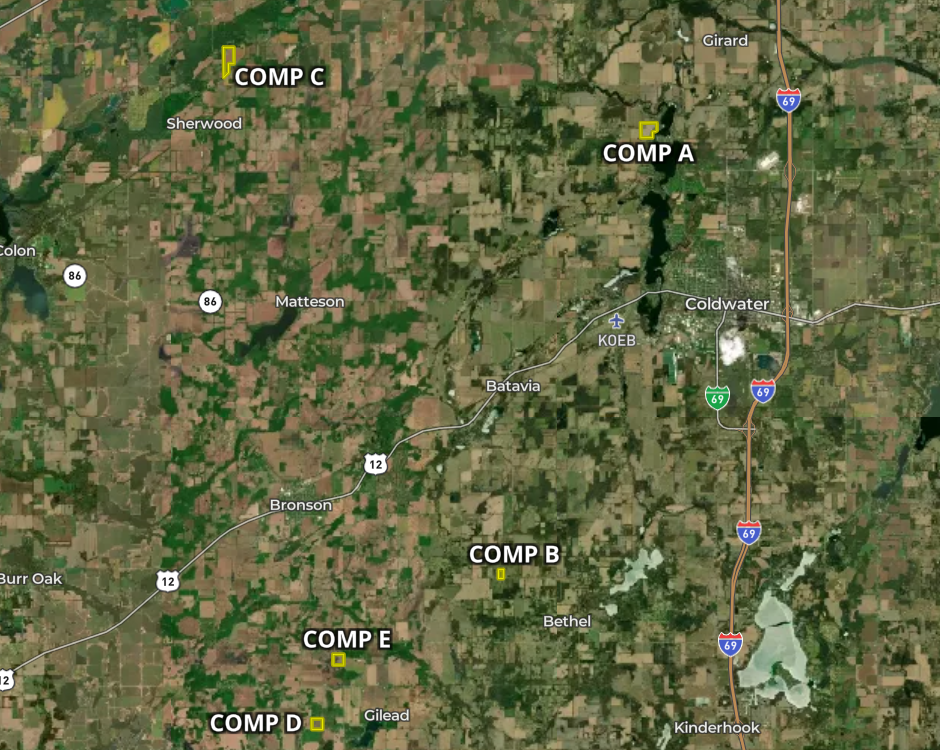
By The Numbers
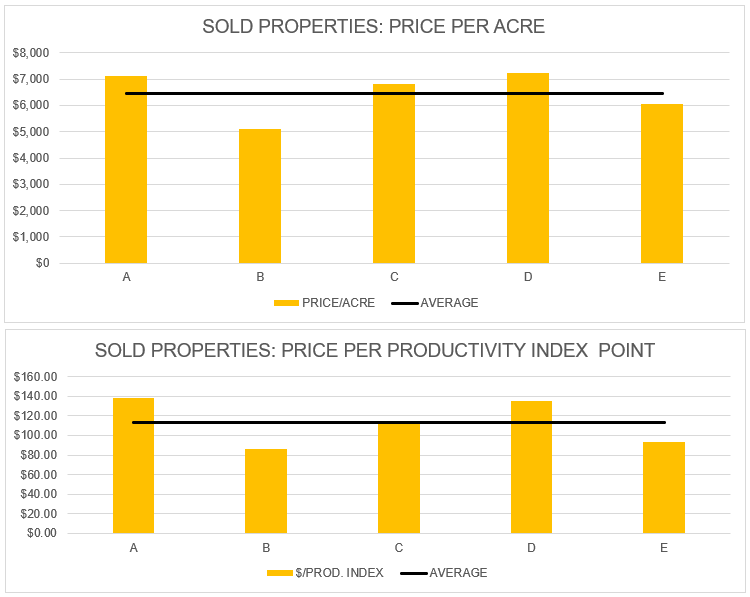
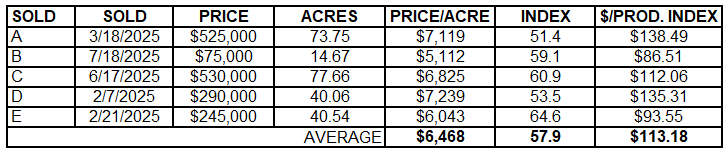
Branch County in 2025: A Market Built on Farm Utility, Not Flash
Branch County’s farmland market in 2025 reflected a county where agricultural value is still driven primarily by usefulness in the field. This is not a market led by heavy development pressure or one-off speculative sales. Instead, Branch County continues to behave like a working agricultural county – one where land is judged by productivity, farmability, layout, and how well a tract fits into an operator’s long-term plans.
That practical foundation gave the 2025 market a steady tone, but not a flat one. Buyer interest remained present, particularly for farms that offered clean tillable acreage, dependable access, and the kind of efficiency that matters to working operators. At the same time, the market showed more discipline than it did during the most aggressive appreciation years. Buyers were still willing to compete, but they were increasingly selective about what they were competing for.
For landowners, that matters. Branch County still has a solid agricultural land market, but 2025 reinforced that not every acre moves on equal footing. Farms with strong utility and fewer operational drawbacks continued to stand out, while average tracts were more likely to be priced and judged on their practical strengths and weaknesses rather than on broad market momentum alone.
Branch County Agriculture Is Ground in Traditional Production Agriculture
Branch County’s agricultural identity is rooted in the kind of production agriculture that continues to shape much of southern Michigan: corn, soybeans, wheat, forage ground, and livestock-related agriculture all remain part of the county’s working farm economy. Unlike counties where land value is influenced heavily by specialty crops, vineyards, or large-scale development pressure, Branch County’s farmland market is still tied closely to what the land can produce and how efficiently it can be operated.
That gives the county a relatively straightforward agricultural backbone, but it does not make the market simple. Farms in Branch County are still evaluated through several practical lenses: the quality of the soils, the amount of usable tillable acreage, drainage and field conditions, road access, and whether a tract fits smoothly into a local operation. In a county with both crop ground and livestock influence, some buyers may also look at support acreage, feed potential, or how a farm functions beyond straight row-crop production.
In other words, Branch County may be more traditional than some Michigan counties, but it is still a county where the details of the farm matter.
According to the USDA National Agricultural Statistics Service (NASS), the following crop statistics have been reported for Branch County, Michigan.
The 2022 Ag Census for Branch County, Michigan, reported the following crop statistics:
Number of farms: 758
Land in farms (acres): 222,892
Average farm size (acres): 294
Total market value of products sold: $277,955,000
Government payments: $2,426,000
Farm-related income: $7,310,000
Total farm production expenses: $199,934,000
Net cash farm income: $87,758,000
What Separated Strong Farms from Average Farms in 2025
One of the clearest themes in Branch County during 2025 was the importance of clean, workable acreage.
The farms that continued to draw the strongest attention were generally those with a high percentage of usable tillable ground, straightforward field layouts, and enough scale to fit efficiently into a modern operation. In a market like Branch County, buyers are often looking for land that can be folded into existing crop plans without a long list of complications. Good access, fewer odd corners, solid drainage, and a layout that reduces inefficiency all continue to matter.
Average farms faced a more selective audience. Parcels with fragmented fields, heavier non-tillable influence, inconsistent drainage, awkward access, or a layout that made them harder to farm did not disappear from the market – but they were less likely to command the same level of confidence as top-tier tracts. Buyers still showed interest in these farms, particularly when they fit a neighboring operation or offered value in other ways, but 2025 made it increasingly clear that the market was rewarding functionality first.
That is an important distinction for landowners heading into 2026. In Branch County, the difference between a premium farm and an average one is often less about appearance and more about how easy the farm is to operate, manage, and justify economically.
A County Where Geography Still Shapes the Land Market
Branch County’s position in south-central Michigan helps explain some of the way its farmland market behaves. The county sits near the Indiana line and within reach of multiple regional ag markets, giving it a farm economy that is tied not just to local demand, but also to the broader agricultural activity of southern Michigan and northern Indiana.
Even so, Branch County does not carry the same kind of development overlay seen in faster-growing suburban counties. That is one reason the farmland market here often feels more grounded in agricultural fundamentals than in outside speculation. Landowners and buyers are generally looking at the tract itself – its soils, usability, access, and fit within the farm economy – rather than treating it as a pure future-development play.
That said, location still matters inside the county. A tract with stronger road frontage, better access to grain movement, or a cleaner layout near established agricultural corridors may attract a different level of interest than a farm with more mixed land uses or more operational limitations. Branch County is still a county where local knowledge matters, and where two farms with similar acre counts may not be viewed the same way at all.
History & Background of Branch County, Michigan
County Seat: Coldwater
Townships: Algansee / Batavia / Bethel / Bronson / Butler / California / Coldwater / Gilead / Girard / Kinderhook /Matteson / Noble / Ovid / Quincy / Sherwood / Union
History: Established in 1829; Named after John Branch, U.S. Secretary of the Navy under President Andrew Jackson.
Population: 46,187
Cities & Towns: Coldwater / Bronson / Quincy / Sherwood / Union City / Batavia Center / Canada Shores / Crystal Beach / East Gilead / Girard / Hodunk / Lockwood / Pearl Beach / Ray / Sans Souci Beach / South Butler / West Kinderhook
Acreage: 323,680
Branch County’s Strength Is Its Working Farm Base
One of Branch County’s biggest advantages is that it remains a county with a real working farm base behind its land market. That may sound simple, but it matters. Counties where farmland is still being actively farmed by local operators, neighboring producers, and long-term agricultural owners often maintain a steadier underlying demand than counties where land values rely more heavily on outside capital or future development expectations.
Branch County fits that more practical model. Its farmland market benefits from the presence of operators who understand the county, know the soils, and are often evaluating tracts based on how they perform inside an actual operation rather than just on paper. That tends to create a market where quality still matters, but where local fit matters just as much.
For landowners, that means the strongest buyers are often not looking for a flashy property. They are looking for a farm that works – one that can be planted, harvested, managed, and integrated efficiently into a business. In many ways, that has always been the backbone of Branch County land values, and 2025 did little to change it.
Farmland Transition and Competing Land Uses Are Worth Watching
Even in a county where agriculture remains central, landowners should not ignore the broader land-use conversation. Across Michigan, farmland loss and farmland transition have become increasingly visible topics, and Branch County is part of that conversation as well. As farm ownership changes over time, the question is not just what land is worth today, but what uses it may be competing with tomorrow.
That does not mean Branch County is suddenly turning into a high-pressure development county. It does mean that agricultural land is no longer insulated from every outside influence. Renewable energy discussions, rural residential demand, and generational transitions in ownership all have the potential to shape how certain tracts are viewed and marketed – especially when a farm is not a perfect fit for large-scale production agriculture.
For a county like Branch, that makes farmland value a little more layered than it may have been a generation ago. The best farms will still trade primarily on agricultural strength, but other properties may increasingly be shaped by who the likely buyer is and what they want the land to become.
What Early 2026 Is Suggesting So Far
The first quarter of 2026 suggests that many of Branch County’s 2025 themes are still in place. Demand for workable agricultural ground appears intact, but the market remains selective. Buyers are still interested in productive farmland, yet they continue to place a premium on usability, layout, and whether a tract fits their long-term operational goals.
At the same time, broader conversations around farmland preservation and rural land competition are becoming harder to ignore across Michigan. Branch County is not immune to those pressures, even if they do not define every sale. For landowners, that means 2026 is shaping up as a year where the quality and purpose of a tract may matter even more than countywide averages alone.
Early 2026 also reinforces a pattern that has been building for some time: the farms that tend to hold the most attention are the ones that are easy to understand and easy to operate. Clean cropland, manageable layouts, and land that fits directly into a farming business are still the safest part of the market. More mixed-use or less efficient properties may still sell, but they are more likely to be influenced by buyer type, pricing strategy, and how clearly the property’s strengths are presented.
What Branch County Landowners Should Watch in 2026
For Branch County landowners, the rest of 2026 is likely to be less about dramatic market swings and more about how individual farms line up with buyer priorities.
First, watch the continued separation between premium utility and average utility.
Farms with strong tillable percentages, efficient layouts, and dependable access should continue to outperform. In a practical farm market like Branch County, the land that is easiest to use is often the land that attracts the strongest bidding.
Second, pay attention to how local farm economics shape demand.
Branch County remains tied closely to production agriculture, which means crop margins, livestock economics, and neighboring operator demand all still matter. Buyers may be disciplined, but they are still motivated by land that improves efficiency or strengthens their operating footprint.
Third, keep an eye on land-use competition and ownership transitions.
Not every tract in Branch County will face the same pressures, but rural residential demand, renewable energy conversations, and generational turnover can all influence how land is marketed and who is willing to buy it.
Finally, watch inventory.
In a county where many farms are tightly held, the number and quality of listings can have an outsized impact on how competitive the market feels. When a clean, productive farm comes to market, there may still be limited direct substitutes available.
Final Thoughts
Branch County’s farmland market in 2025 was defined by practical agricultural value. It remained a market where the strongest farms were rewarded for being productive, efficient, and easy to operate, while average tracts were evaluated more carefully on their specific strengths and limitations.
That may not make Branch County the flashiest farmland market in Michigan, but it does make it one of the steadier ones. The county’s land values continue to be supported by a real working farm base, a strong connection to traditional production agriculture, and a buyer pool that still understands the long-term value of usable rural ground.
As 2026 unfolds, that steady agricultural foundation should continue to matter. In Branch County, the farms that tend to stand out are not necessarily the ones with the loudest story – they are the ones that make the most sense on the ground.
Sources / Citations:
Source 1:
“United States Department of Agriculture.” USDA, www.nass.usda.gov/Statistics_by_State/Michigan/Publications/County_Estimates/index.php#:~:text=Access%20Quick%20Stats%20Lite,to%20NASS%20Surveys%20and%20Programs. Accessed 22 June 2026.
Source 2:
“USDA.” 2022 Census of Agriculture County Profile, www.nass.usda.gov/Publications/AgCensus/2022/Online_Resources/County_Profiles/michigan/cp26023.pdf. Accessed 22 June 2026.
*The transaction and land sales data/information contained in this report was obtained from publicly available sources and sales disclosures deemed accurate and reliable but not guaranteed, no liability for accuracy, errors or omissions is assumed by Geswein Farm & Land Realty, LLC
Thinking About Selling?
Need Advice?
Get the guidance, service, and professional expertise you deserve.
- Family Farm Advisory for Succession Planning
- Undivided Interests & Tenants in Common
- Farmland Management Decisions
- Auctions & Listing
With our full-time experienced team, you’ll get our ‘boots on the ground’ work ethic paired with the latest in digital technology & national marketing reach – for best-in-class service and results.
Because you deserve more value.
Contact Us