


Cass County, Michigan
2026 Land Sales Report
Buyer demand helped keep Cass County land values resilient in 2025, even as the pace of appreciation began to slow. Looking into 2026, the market is showing signs of becoming more balanced after several years of growth.
If you’d like to get specific land values on your own property or a farm near you for 2026, please contact Jason Cackley at (269) 240-3196.
Request a Land Values ReportAverage Price of Land*
$10,828/acre
Jan. – Dec. 2025*
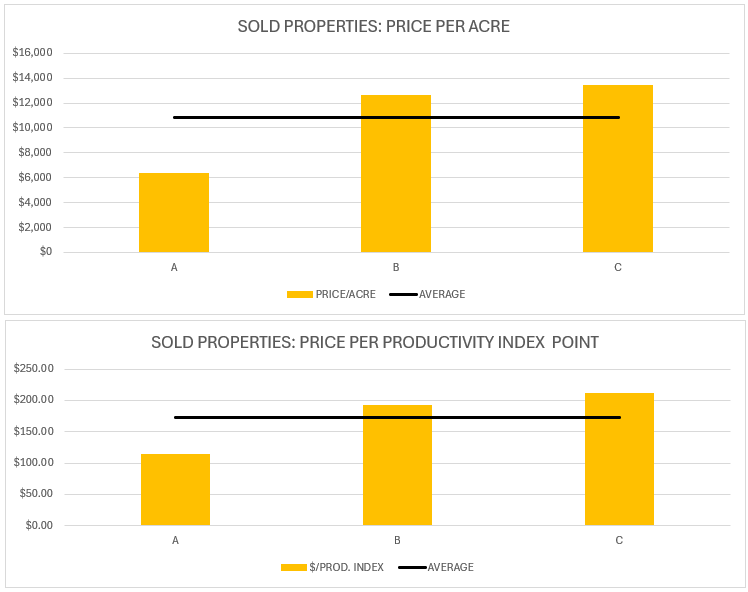
As high as $13,488/acre
in 2025*
Land Market Commentary & Local Trends
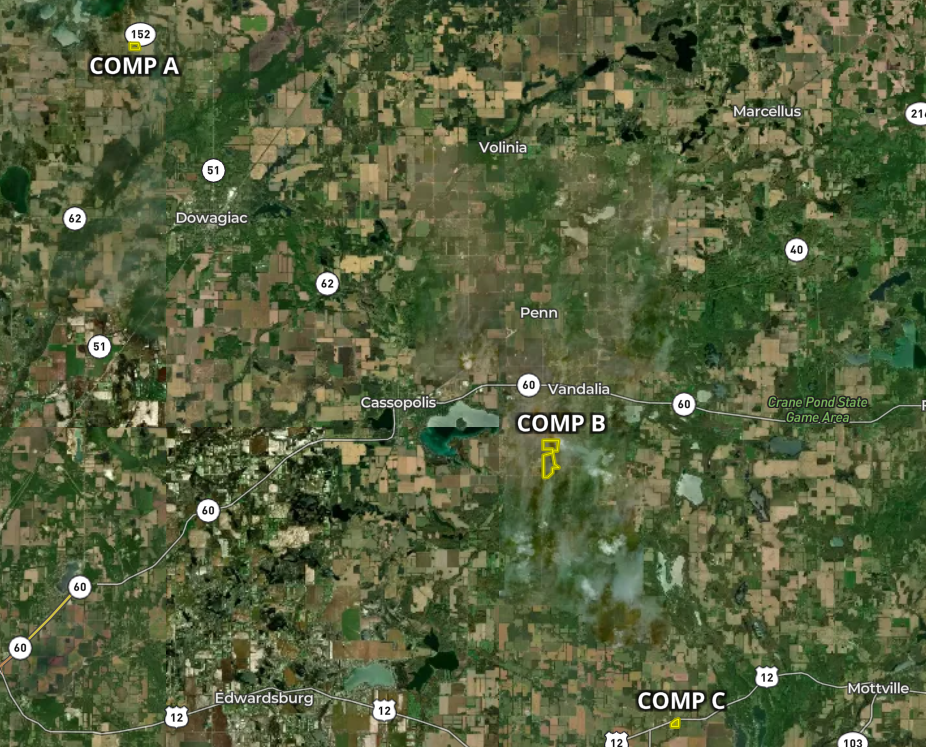
In 2025, buyers paid an average of $10,828 per acre for Cass County farmland, equating to $173.16 per productivity index point. One of the stronger sales recorded during the year climbed to $13,488 per acre.
Since 1977, the Geswein Farm & Land Team has been advising landowners to be stewards of the land and make decisions based on most current, accurate, and relevant data. The information in this report can provide you with a rough estimate of your property’s value; however, understanding the specific characteristics of your property and how they compare to the other sales will provide the most accurate value of your property. Additionally, properties sold by land brokers via auctions or listings consistently outperformed individual to individual transactions and properties sold by traditional home realtors.
By The Numbers

Cass County in 2025: A Farmland Market with Strong Farm Fundamentals and a More Layered Outlook
Cass County’s farmland market in 2025 reflected a county with a deep agricultural base and a buyer pool that still understands the long-term value of productive land. But unlike a purely one-dimensional row-crop market, Cass County’s land story is becoming a little more layered. Farm utility remains the backbone of value, yet broader questions around land preservation, energy development, and long-term land use are beginning to sit closer to the farmland conversation than they did a few years ago.
That does not mean the market lost its agricultural footing. Quite the opposite. Cass County remains a working farm county where productive acreage, strong field utility, and local operator demand still matter most. The difference in 2025 was that buyers were increasingly disciplined about where they were willing to stretch. Good farms continued to command attention, but the market showed a clearer preference for tracts that fit efficiently into real farming operations rather than land that simply benefited from broad market optimism.
For landowners, that makes Cass County worth watching. It remains an agricultural market first, but one where the surrounding conversation is widening. The farms that perform best are still the ones that make sense on the ground, yet the county’s location and evolving land-use questions are adding a second layer to how some acres may be viewed going forward.
Cass County Agriculture Has More Range Than a Straight Grain Story
Cass County is often thought of as a traditional southern Michigan farm county, and there is truth to that. Corn, soybeans, wheat, and hay remain central to the county’s agricultural profile, and the local land market is still closely tied to production agriculture. But Cass County is broader than a simple grain-only story.
Regional agricultural reporting continues to show Cass County as an important crop and livestock county within southwest Michigan, with a particularly strong grain and hog presence and a notable role in snap bean production. That mix matters because it gives the county a slightly different feel than neighboring areas that lean more heavily into fruit, vineyards, or direct-market specialty agriculture. Cass County’s market is still driven by farm performance, but it is supported by more than one kind of farm operation.
That diversity shows up in the way land is valued. Some tracts are judged almost entirely on row-crop productivity and operating efficiency. Others are attractive because they support feed production, livestock systems, or a broader mix of agricultural uses. In practical terms, Cass County farmland is still largely evaluated through a production-ag lens – but it is a county where versatility can add value when the acreage fits the right buyer.
According to the USDA National Agricultural Statistics Service (NASS), the following crop statistics have been reported for Cass County, Michigan.
The 2022 Ag Census for Cass County, Michigan, reported the following crop statistics:
Number of farms: 651
Land in farms (acres): 193,125
Average farm size (acres): 297
Total market value of products sold: $223,186,000
Government payments: $2,381,000
Farm-related income: $9,095,000
Total farm production expenses: $173,338,000
Net cash farm income: $61,324,000
What Separated Strong Farms from Average Farms in 2025
The biggest dividing line in Cass County during 2025 was not acreage alone. It was usability.
The farms that continued to stand out were typically those with a high percentage of workable tillable ground, dependable access, and layouts that fit efficiently into an operator’s existing system. In a county where farming is still the primary driver of value, buyers paid close attention to whether a tract could be planted, managed, and harvested without unnecessary inefficiencies. Clean field shapes, good drainage, and a straightforward operating footprint still carried weight.
Average tracts saw a different response. Farms with more fragmentation, less consistent drainage, awkward field boundaries, or a lower percentage of productive acreage still had a market, but they did not always command the same confidence as the county’s best ground. In a more selective environment, buyers became more willing to distinguish between land that was merely available and land that was truly useful.
That gap matters heading into 2026. Cass County is still a county where local operators can recognize value quickly, but 2025 reinforced that the market is not treating every acre equally. Functionality is playing a larger role in price support than broad market momentum alone.
Cass County’s Strength Is Its Working Agricultural Base
One of the clearest advantages in Cass County’s farmland market is the depth of its working farm economy. This is still a county where family farms, local operators, and neighboring producers are a major force behind land demand. That kind of buyer base tends to create a steadier market than one driven mainly by outside speculation, because the strongest interest often comes from people who know the land, know the soils, and know how a tract fits into a real operation.
That local farm base also helps explain why the market in Cass County often feels more practical than flashy. Buyers are not simply chasing acres for the sake of owning more land; they are usually evaluating whether a tract improves efficiency, adds scale, strengthens feed supply, or fits a longer-term farm plan. That kind of demand can be less dramatic than development-driven buying, but it is often more durable.
For landowners, this is an important part of the county’s value story. Cass County farmland is still supported by people who want the land to work, not just sit on a balance sheet. In years where broader economic conditions become less certain, that kind of buyer foundation can matter a great deal.
History & Background of Cass County, Michigan
County Seat: Cassopolis
Townships: Calvin / Howard / Jefferson / LaGrange / Marcellus / Mason / Milton / Newberg / Ontwa / Penn / Pokagon / Porter / Silver Creek / Volinia / Wayne
History: Established in 1829; Named after Lewis Cass, the second Territorial Governor of Michigan.
Population: 51,550
Cities & Towns: Dowagiac / Niles / Cassopolis / Edwardsburg / Marcellus / Vandalia
Acreage: 313,600
Southwest Michigan Location Adds a Second Layer to the Story
Cass County sits in a part of Michigan where agriculture remains central, but where land-use conversations are not standing still. Its southwest Michigan location places it near transportation corridors, regional employment centers, and communities that are increasingly thinking about economic development, land preservation, and infrastructure expansion. That does not mean Cass County farmland is suddenly a suburban development market – but it does mean the county is not insulated from broader pressures.
In 2026, local leaders have already spent time publicly discussing potential data center development and its possible impacts on the county, a reminder that large-scale land users beyond agriculture are at least part of the conversation. At the same time, Michigan’s broader farmland preservation and renewable-energy debates continue to create questions about how productive acres will be used over the next decade.
For Cass County landowners, that does not change the fact that farming still drives most farmland value. It simply means the county’s land market may increasingly be shaped by two conversations at once: one rooted in agricultural productivity, and another rooted in what else rural land may be asked to support.
Land Preservation and Transition Are Becoming More Relevant
A recurring theme across Michigan is the challenge of keeping farmland in active agricultural use as ownership changes and outside pressures grow. Cass County fits into that broader trend, even if the pace looks different here than it does in faster-growing parts of the state.
This matters because farmland value is no longer only a question of current productivity. In some cases, it is also a question of long-term land control. If a tract sits in an area where future development, energy infrastructure, or non-farm rural demand becomes more realistic, that can affect how buyers think about it – even if the land is still farmed today.
For a county like Cass, this does not erase the importance of crop returns, drainage, or field quality. It simply adds another layer to the market. The best agricultural farms should still trade primarily on their farm value, but some parcels may increasingly be judged by their optionality as much as their current use.
What Early 2026 Is Suggesting So Far
The first part of 2026 suggests that Cass County is carrying many of the same themes forward rather than entering a dramatically different market. Productive farmland still appears to be holding attention, and the buyer pool remains strongest where farms offer a clear agricultural purpose and practical operating value. In that sense, the county’s core story has not changed: good farmland still matters, and local agricultural demand is still real.
What has changed is the amount of outside conversation now sitting around the market. Cass County leaders have already been discussing potential data center impacts, while statewide farmland preservation and energy-development questions continue to grow louder. None of that replaces the role of production agriculture, but it does mean landowners are entering 2026 with more than one variable to watch.
The result is a market that still feels grounded, but slightly more complex. Farms that are clearly productive and easy to operate should remain the strongest part of the market. More mixed-use tracts, or farms in areas where alternative land uses may gain traction, could be influenced by a wider set of buyer motivations than in the past.
What Cass County Landowners Should Watch in 2026
As 2026 progresses, Cass County landowners will likely find that the market is being shaped by a combination of familiar agricultural fundamentals and a few emerging influences. Productive, well-maintained farms should continue to attract the strongest interest, particularly where soils, drainage, and field efficiency support long-term profitability. Buyers remain willing to compete for quality farmland, but they are placing greater emphasis on operational value than they did during the rapid appreciation seen just a few years ago.
Landowners should also keep an eye on broader changes occurring throughout the county. Discussions surrounding economic development, renewable energy, and other large-scale land uses may not affect every property, but they have the potential to influence buyer interest and long-term perceptions of rural land. Combined with generational ownership transitions and relatively limited farmland inventory, these factors could shape both opportunities and expectations as the market continues to evolve.
Final Thoughts
Cass County’s farmland market in 2025 was built on a strong agricultural foundation, but it also showed signs of becoming more layered in how land is viewed and valued. Productive ground, efficient layouts, and operator demand remain at the heart of the market, and that is unlikely to change anytime soon. At the same time, the county’s southwest Michigan location and growing land-use conversations mean that farmland is increasingly part of a bigger discussion than farm returns alone.
That combination is what makes Cass County worth watching. It is still very much a working agricultural county, and the farms that tend to stand out are the ones that perform well in the field and fit cleanly into an operation. But as 2026 unfolds, landowners may find that understanding the Cass County market means watching not just what farmland produces, but also what the county may ask of its land next.
Sources / Citations:
Source 1:
“United States Department of Agriculture.” USDA, www.nass.usda.gov/Statistics_by_State/Michigan/Publications/County_Estimates/index.php#:~:text=Access%20Quick%20Stats%20Lite,to%20NASS%20Surveys%20and%20Programs. Accessed 23 June 2026.
Source 2:
“USDA.” 2022 Census of Agriculture County Profile, www.nass.usda.gov/Publications/AgCensus/2022/Online_Resources/County_Profiles/michigan/cp26027.pdf. Accessed 23 June 2026.
*The transaction and land sales data/information contained in this report was obtained from publicly available sources and sales disclosures deemed accurate and reliable but not guaranteed, no liability for accuracy, errors or omissions is assumed by Geswein Farm & Land Realty, LLC
Thinking About Selling?
Need Advice?
Get the guidance, service, and professional expertise you deserve.
- Family Farm Advisory for Succession Planning
- Undivided Interests & Tenants in Common
- Farmland Management Decisions
- Auctions & Listing
With our full-time experienced team, you’ll get our ‘boots on the ground’ work ethic paired with the latest in digital technology & national marketing reach – for best-in-class service and results.
Because you deserve more value.
Contact Us