


Kalamazoo County, Michigan
2026 Land Sales Report
The Kalamazoo County farmland market continued to perform well in 2025, with quality tracts maintaining strong buyer interest. Looking toward 2026, early indicators suggest a gradually moderating market with values beginning to level off.
If you’d like to get specific land values on your own property or a farm near you for 2026, please contact Jason Cackley at (269) 240-3196.
Request a Land Values ReportAverage Price of Land*
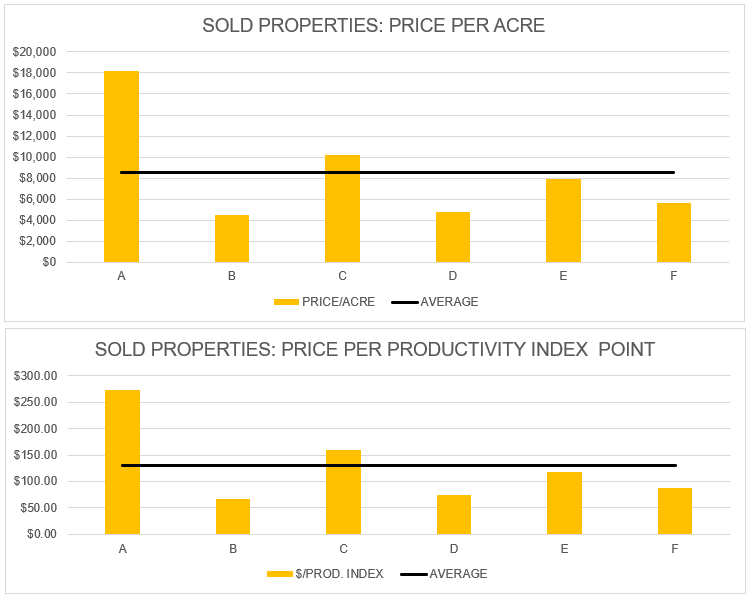
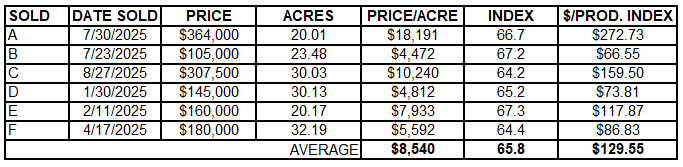
$8,540/acre
Jan. – Dec. 2025*
As high as $18,191/acre
in 2025*
Land Market Commentary & Local Trends
Farmland sales across Kalamazoo County averaged $8,540 per acre in 2025, while productivity-adjusted values averaged $129.55 per point. High-demand properties continued to attract premium pricing, peaking at $18,191 per acre.
Since 1977, the Geswein Farm & Land Team has been advising landowners to be stewards of the land and make decisions based on most current, accurate, and relevant data. The information in this report can provide you with a rough estimate of your property’s value; however, understanding the specific characteristics of your property and how they compare to the other sales will provide the most accurate value of your property. Additionally, properties sold by land brokers via auctions or listings consistently outperformed individual to individual transactions and properties sold by traditional home realtors.
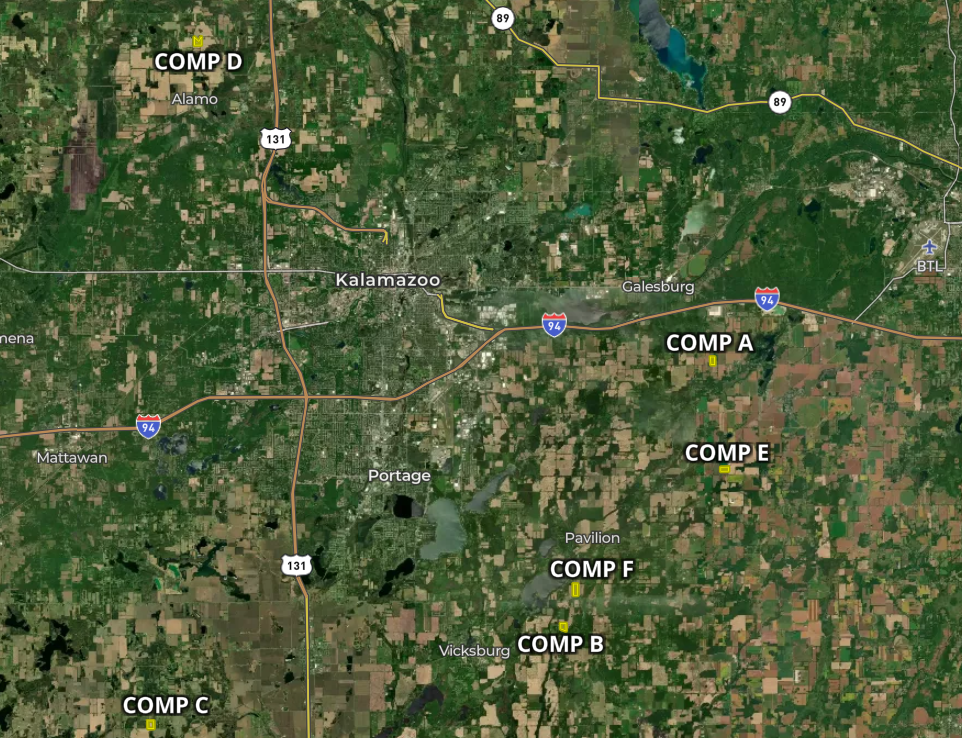
By The Numbers
More Than a Growing Community: Kalamazoo County’s Agricultural Story
When many people think of Kalamazoo County, they often picture its universities, healthcare industry, and expanding commercial development. While those sectors certainly contribute to the local economy, agriculture continues to play an equally important role in shaping the county’s landscape. Productive farmland remains one of Kalamazoo County’s most valuable long-term assets, supporting both traditional farming operations and a remarkably diverse agricultural industry.
The farmland market throughout 2025 reflected this balance. Buyers remained interested in quality agricultural ground, but purchasing decisions became increasingly deliberate. Rather than broad competition across every available tract, the strongest interest centered on farms that offered long-term production value, efficient layouts, and the flexibility to support multiple types of agricultural enterprises. As the market moves into 2026, this emphasis on quality over quantity is expected to remain an important theme.
A Diverse Agricultural Economy Sets Kalamazoo County Apart
Unlike many counties where corn and soybeans dominate nearly every acre, Kalamazoo County benefits from one of southwest Michigan’s more diversified agricultural economies. Row crops remain an important component of local production, but they share the landscape with vegetable farms, fruit production, greenhouse operations, nursery crops, specialty seed production, forage, and livestock agriculture.
This diversity creates a farmland market that is influenced by more than commodity grain prices alone. Different agricultural sectors often respond differently to economic conditions, allowing the county’s farming community to remain adaptable through changing market cycles. As a result, demand for farmland is often supported by a wider variety of buyers, each evaluating properties based on their own production needs.
For landowners, this means that two farms with similar acreages may appeal to very different buyers depending on soil characteristics, irrigation potential, field configuration, or existing agricultural improvements.
Not Every Acre Competes the Same
One of the most noticeable characteristics of Kalamazoo County’s farmland market during 2025 was the continued distinction between highly productive agricultural tracts and properties with more limited farming potential.
The farms generating the strongest interest generally shared several characteristics: productive soils, efficient field layouts, dependable drainage, and good accessibility. Properties that could easily integrate into existing farming operations or support multiple agricultural uses continued to attract attention from both local producers and expanding operations.
Meanwhile, parcels with fragmented acreage, heavier wooded areas, irregular field configurations, or greater non-tillable influence often appealed to a narrower buyer pool. These properties still held value, but buyers became increasingly focused on how efficiently a farm could contribute to long-term agricultural production rather than simply adding acreage.
This growing emphasis on operational efficiency reflects a broader trend that has emerged across many agricultural markets, but it is especially noticeable in a county as agriculturally diverse as Kalamazoo.
According to the USDA National Agricultural Statistics Service (NASS), the following crop statistics have been reported for Kalamazoo County, Michigan.
The 2022 Ag Census for Kalamazoo County, Michigan, reported the following crop statistics:
Number of farms: 607
Land in farms (acres): 145,225
Average farm size (acres): 239
Total market value of products sold: $340,333,000
Government payments: $1,410,000
Farm-related income: $9,294,000
Total farm production expenses: $277,249,000
Net cash farm income: $73,788,000
Agriculture and Growth Continue to Share the Landscape
One characteristic that distinguishes Kalamazoo County from many rural farming counties is the ongoing interaction between agriculture and community growth. While farming remains a significant land use throughout the county, portions of the area continue to experience residential, commercial, and industrial expansion.
This dynamic creates a unique environment for farmland owners. In most areas of the county, agricultural productivity remains the primary driver of land value. However, certain locations may also attract interest because of their proximity to transportation corridors, expanding communities, or future development opportunities.
That does not mean development pressure defines the entire county. Rather, it creates localized differences where location becomes another consideration alongside soil productivity and farm utility. Understanding those local influences has become increasingly important when evaluating agricultural property.
Innovation Continues to Influence Local Agriculture
Kalamazoo County also benefits from being part of one of Michigan’s most innovative agricultural regions. Research institutions, agricultural education programs, seed development, and advancing production practices all contribute to an environment where farming continues to evolve alongside new technology.
Many producers throughout the county continue investing in improved drainage, precision agriculture, conservation practices, and equipment efficiency. These investments not only strengthen day-to-day farm operations but also contribute to the long-term competitiveness of local agriculture.
For buyers, farms that already support modern production practices may continue to command greater attention as operating efficiency becomes increasingly valuable.
History & Background of Kalamazoo County, Michigan
County Seat: Kalamazoo
Townships: Kalamazoo / Portage / Oshtemo / Cooper / Comstock / Alamo / Brady / Charleston / Climax / Pavilion / Prairie / Ronde / Richland / Ross / Schoolcraft / Wakeshma
History: Established in 1830; Named after the Kalamazoo River, which runs through it.
Population: 264,780
Cities & Towns: Kalamazoo / Portage / Galesburg / Parchment / Augusta / Climax / Richland / Schoolcraft / Vicksburg / Westwood / Eastwood / Scotts / Comstock Northwest / South Gull Lake
Acreage: 371,200
Early 2026: Stability Through Diversity
The first few months of 2026 suggest many of the same themes that developed throughout the previous year are continuing. Productive farmland remains in demand, but buyers continue to approach acquisitions with careful financial analysis and long-term planning.
One advantage Kalamazoo County possesses is the diversity of its agricultural economy. Because multiple sectors contribute to local farming activity, the farmland market is not dependent upon a single crop or production system. That broader agricultural foundation helps support market stability, even as individual commodity markets fluctuate.
While buyers remain disciplined, quality farms continue to generate meaningful interest when they enter the market.
Looking Beyond the Numbers
For Kalamazoo County landowners, 2026 is shaping up to be another year where local conditions may matter more than statewide averages. Farms that are well-maintained, highly productive, and adaptable to modern agricultural practices should continue to perform well, particularly when they fit the needs of established local operators.
Landowners should also remain aware of broader influences beyond agriculture. Population growth, infrastructure investment, conservation initiatives, and continued discussions surrounding land use all have the potential to shape individual properties differently depending on where they are located within the county.
Perhaps the most important takeaway is that Kalamazoo County continues to benefit from diversity – not only in the crops that are grown, but also in the types of buyers participating in the market. That diversity has helped create a resilient farmland market capable of adapting as agriculture and surrounding communities continue to evolve.
Final Thoughts
Kalamazoo County remains one of southwest Michigan’s most dynamic agricultural regions. Its farmland market is supported by productive soils, a broad range of agricultural enterprises, and producers who continue investing in the future of their operations. At the same time, the county’s expanding economy and evolving land-use patterns create opportunities that are uncommon in many purely rural markets.
As 2026 unfolds, farmland values will likely continue to be shaped by the same principles that have defined the market in recent years: productivity, operational efficiency, location, and adaptability. For landowners, understanding how those factors intersect within Kalamazoo County provides valuable context for evaluating both current market conditions and future opportunities.
Sources / Citations:
Source 1:
“United States Department of Agriculture.” USDA, www.nass.usda.gov/Statistics_by_State/Michigan/Publications/County_Estimates/index.php#:~:text=Access%20Quick%20Stats%20Lite,to%20NASS%20Surveys%20and%20Programs. Accessed 24 June 2026.
Source 2:
“USDA.” 2022 Census of Agriculture County Profile, www.nass.usda.gov/Publications/AgCensus/2022/Online_Resources/County_Profiles/michigan/cp26077.pdf. Accessed 24 June 2026.
*The transaction and land sales data/information contained in this report was obtained from publicly available sources and sales disclosures deemed accurate and reliable but not guaranteed, no liability for accuracy, errors or omissions is assumed by Geswein Farm & Land Realty, LLC
Thinking About Selling?
Need Advice?
Get the guidance, service, and professional expertise you deserve.
- Family Farm Advisory for Succession Planning
- Undivided Interests & Tenants in Common
- Farmland Management Decisions
- Auctions & Listing
With our full-time experienced team, you’ll get our ‘boots on the ground’ work ethic paired with the latest in digital technology & national marketing reach – for best-in-class service and results.
Because you deserve more value.
Contact Us