


Hillsdale County, Michigan
2026 Land Sales Report
After several years of notable appreciation, Hillsdale County farmland entered 2025 with continued strength but a more cautious market tone. Early trends for 2026 suggest steady values supported by buyers who remain focused on quality farmland.
If you’d like to get specific land values on your own property or a farm near you for 2026, please contact Brock Solmos at (574) 360-5520.
Request a Land Values ReportAverage Price of Land*
$7,475/acre
Jan. – Dec. 2025*
As high as $9,359/acre
in 2025*
Land Market Commentary & Local Trends
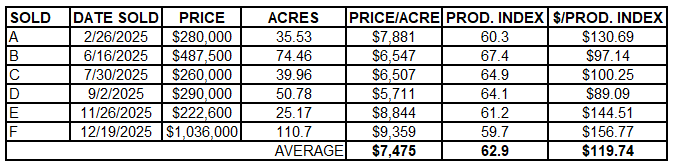
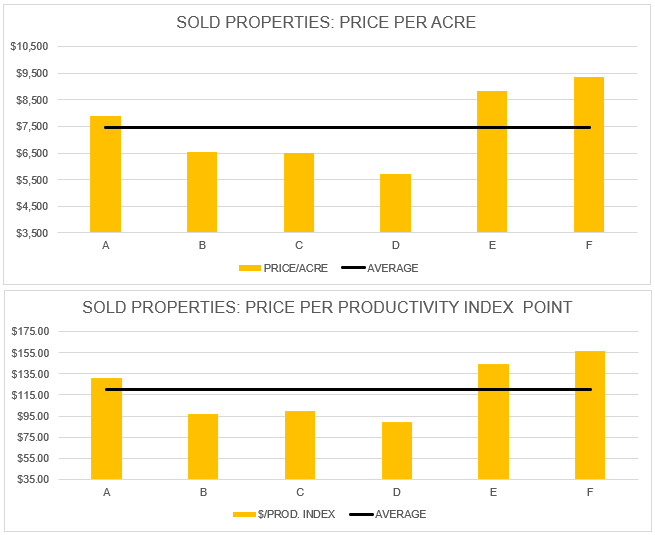
Hillsdale County landowners saw continued strength in farmland values during 2025, as sales averaged $7,475 per acre and $119.74 per productivity index point. Standout properties helped push the top of the market to $9,359 per acre.
Since 1977, the Geswein Farm & Land Team has been advising landowners to be stewards of the land and make decisions based on most current, accurate, and relevant data. The information in this report can provide you with a rough estimate of your property’s value; however, understanding the specific characteristics of your property and how they compare to the other sales will provide the most accurate value of your property. Additionally, properties sold by land brokers via auctions or listings consistently outperformed individual to individual transactions and properties sold by traditional home realtors.
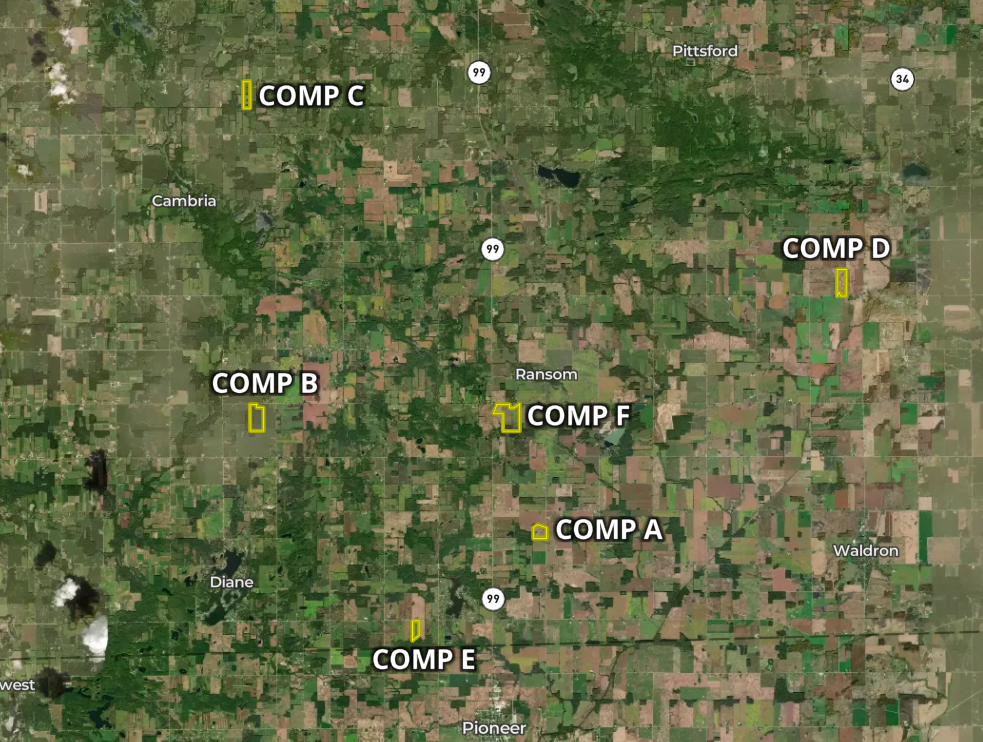
By The Numbers
Steady Demand in a County Built on Agricultural Tradition
Hillsdale County’s farmland market continues to reflect the strength of a community where agriculture has remained a cornerstone of the local economy for generations. While many land markets across the Midwest have become increasingly influenced by development or recreational demand, Hillsdale County remains largely driven by the needs of working farms and long-term agricultural ownership.
Throughout 2025, farmland buyers continued to pursue productive acreage with proven performance. Competition remained strongest for farms offering dependable soils, established drainage, and efficient layouts, while buyers became increasingly selective when evaluating properties requiring additional investment or management improvements.
As the first half of 2026 has progressed, that disciplined approach has continued. Buyers remain active but purchasing decisions are increasingly centered on long-term farm performance, operational efficiency, and the overall quality of each tract.
According to the USDA National Agricultural Statistics Service (NASS), the following crop statistics have been reported for Hillsdale County, Michigan.
The 2022 Ag Census for Hillsdale County, Michigan, reported the following crop statistics:
Number of farms: 1,286
Land in farms (acres): 295,615
Average farm size (acres): 230
Total market value of products sold: $321,339,000
Government payments: $3,614,000
Farm-related income: $8,667,000
Total farm production expenses: $244,360,000
Net cash farm income: $89,260,000
A County with Diverse Agricultural Roots
Agriculture in Hillsdale County extends well beyond traditional row-crop production. While corn, soybeans, and wheat remain important commodities, the county also supports beef cattle, dairy operations, hay production, and forage crops that contribute to a well-rounded agricultural economy.
Unlike some areas dominated by large expanses of uniform farmland, Hillsdale County features gently rolling terrain, woodlots, pastureland, and diversified farming operations. This variety creates opportunities for different types of agricultural enterprises while also making individual farm characteristics especially important when determining value.
The county’s long history of family farming continues to shape today’s market, with many operations focused on preserving productive land for future generations.
Farm Quality Matters More Than Ever
One of the clearest trends emerging from the current market is the increasing emphasis buyers place on individual property characteristics.
Farms with productive soils, effective drainage, manageable field sizes, and strong accessibility continue to receive the greatest attention. These properties allow producers to operate efficiently while limiting the need for significant capital improvements after purchase.
Meanwhile, farms with more variable topography, irregular field configurations, or deferred maintenance continue to attract interest but often require buyers to carefully evaluate long-term management costs and productivity potential.
Rather than treating every acre equally, today’s buyers are placing greater value on how well each property supports efficient agricultural operations.
A Market Grounded in Local Ownership
Hillsdale County’s farmland market continues to be shaped primarily by local agricultural demand.
Neighboring farmers remain some of the most active purchasers whenever quality acreage becomes available, often seeking opportunities to improve operational efficiency or expand existing family farms. Because farmland turnover remains relatively limited, desirable properties frequently generate strong interest within the local agricultural community.
The county’s location near both Indiana and Ohio also provides producers with access to multiple grain markets, agricultural suppliers, and regional transportation corridors, strengthening the long-term outlook for farming throughout the area.
History & Background of Hillsdale County, Michigan
County Seat: Hillsdale
Townships: Adams / Allen / Amboy / Cambria / Camden / Fayette / Jefferson / Litchfield / Moscow / Pittsford / Ransom / Reading / Scipio / Somerset / Wheatland / Woodbridge / Wright
History: Officially established in 1829; Hillsdale’s name reflects the region’s topography – characterized by hills and valleys.
Population: 45,738
Cities & Towns: Allen / Camden / Cement City / Frontier / Hillsdale / Jerome / Jonesville / Litchfield / Moscow / Mosherville / North Adams / Osseo / Pittsford / Prattville / Reading / Somerset / Waldron
Acreage: 387,840
What We’ve Observed Through Mid-2026
The first half of 2026 has reinforced many of the trends that developed throughout the previous year.
Buyer interest has remained healthy, but purchasing activity has become increasingly selective. Farms that combine strong agricultural productivity with thoughtful stewardship continue to perform well, while buyers are taking more time to evaluate properties that present additional challenges.
Inventory has remained relatively limited, helping support demand for well-maintained farms when they reach the market. Local operators continue to represent the largest share of buyers, reflecting confidence in the county’s long-term agricultural outlook despite ongoing uncertainty surrounding interest rates and farm profitability.
Overall, the market continues to reward quality over quantity.
Factors to Watch During the Remainder of 2026
Several factors are expected to influence Hillsdale County’s farmland market through the remainder of the year.
Farm profitability will remain an important consideration as producers evaluate expansion opportunities and balance commodity prices with operating expenses. Interest rates are also likely to continue influencing financing decisions, particularly for buyers relying on borrowed capital.
Inventory levels will be equally important. Because quality farms are often held for many years, even modest increases in available listings could provide buyers with additional choices while reinforcing the importance of property-specific characteristics.
For landowners, maintaining productive soils, investing in drainage, and preserving overall farm condition will continue to position properties favorably in a market where buyers have become increasingly discerning.
County Connections
Diversified Agriculture Supports Long-Term Stability
Hillsdale County’s combination of row crops, livestock production, hay, and forage operations creates a balanced agricultural economy that is less dependent on any single commodity. This diversity has long contributed to the county’s resilience and remains one of its greatest strengths.
Family Farms Continue to Shape the Landscape
Many of the county’s farms have remained in the same families for generations, reflecting a strong tradition of agricultural stewardship and long-term investment in the land. This legacy continues to influence today’s farmland market and contributes to relatively limited turnover.
Rural Communities Continue Investing in the Future
Communities across Hillsdale County continue supporting rural infrastructure, local businesses, agricultural education, and workforce development. These ongoing investments help strengthen the county’s agricultural economy while preserving the character that has long defined the region.
Closing Thoughts
Hillsdale County continues to demonstrate that strong farmland markets are built on more than commodity prices alone. A diversified agricultural economy, experienced farm operators, and a long-standing commitment to stewardship have created a stable foundation that continues to attract buyer interest.
The first half of 2026 has shown a market where quality remains the defining characteristic. Buyers continue to seek farms that offer productive soils, efficient layouts, and long-term operational value, while carefully evaluating each property’s unique strengths.
As the year continues, Hillsdale County remains well positioned to support a healthy farmland market rooted in agricultural tradition, responsible land management, and confidence in the future of farming across southern Michigan.
Sources / Citations:
Source 1:
“United States Department of Agriculture.” USDA, www.nass.usda.gov/Statistics_by_State/Michigan/Publications/County_Estimates/index.php#:~:text=Access%20Quick%20Stats%20Lite,to%20NASS%20Surveys%20and%20Programs. Accessed 13 July 2026.
Source 2:
“USDA.” 2022 Census of Agriculture County Profile, www.nass.usda.gov/Publications/AgCensus/2022/Online_Resources/County_Profiles/michigan/cp26059.pdf. Accessed 13 July 2026.
*The transaction and land sales data/information contained in this report was obtained from publicly available sources and sales disclosures deemed accurate and reliable but not guaranteed, no liability for accuracy, errors or omissions is assumed by Geswein Farm & Land Realty, LLC
Thinking About Selling?
Need Advice?
Get the guidance, service, and professional expertise you deserve.
- Family Farm Advisory for Succession Planning
- Undivided Interests & Tenants in Common
- Farmland Management Decisions
- Auctions & Listing
With our full-time experienced team, you’ll get our ‘boots on the ground’ work ethic paired with the latest in digital technology & national marketing reach – for best-in-class service and results.
Because you deserve more value.
Contact Us