


Eaton County, Michigan
2026 Land Sales Report
Eaton County continued to see healthy farmland activity in 2025, with demand remaining strongest for productive, well-located acres. As 2026 unfolds, the market appears to be settling into a more sustainable pattern following several years of rapid appreciation.
If you’d like to get specific land values on your own property or a farm near you for 2026, please contact Brock Solmos at (574) 360-5520.
Request a Land Values ReportAverage Price of Land*
$6,233/acre
Jan. – Dec. 2025*
As high as $7,270/acre
in 2025*
Land Market Commentary & Local Trends
A review of Eaton County’s 2025 farmland sales shows an average value of $6,233 per acre, while productivity-adjusted values averaged $108.15 per point. The strongest tracts stood apart, selling for as much as $7,270 per acre.
Since 1977, the Geswein Farm & Land Team has been advising landowners to be stewards of the land and make decisions based on most current, accurate, and relevant data. The information in this report can provide you with a rough estimate of your property’s value; however, understanding the specific characteristics of your property and how they compare to the other sales will provide the most accurate value of your property. Additionally, properties sold by land brokers via auctions or listings consistently outperformed individual to individual transactions and properties sold by traditional home realtors.
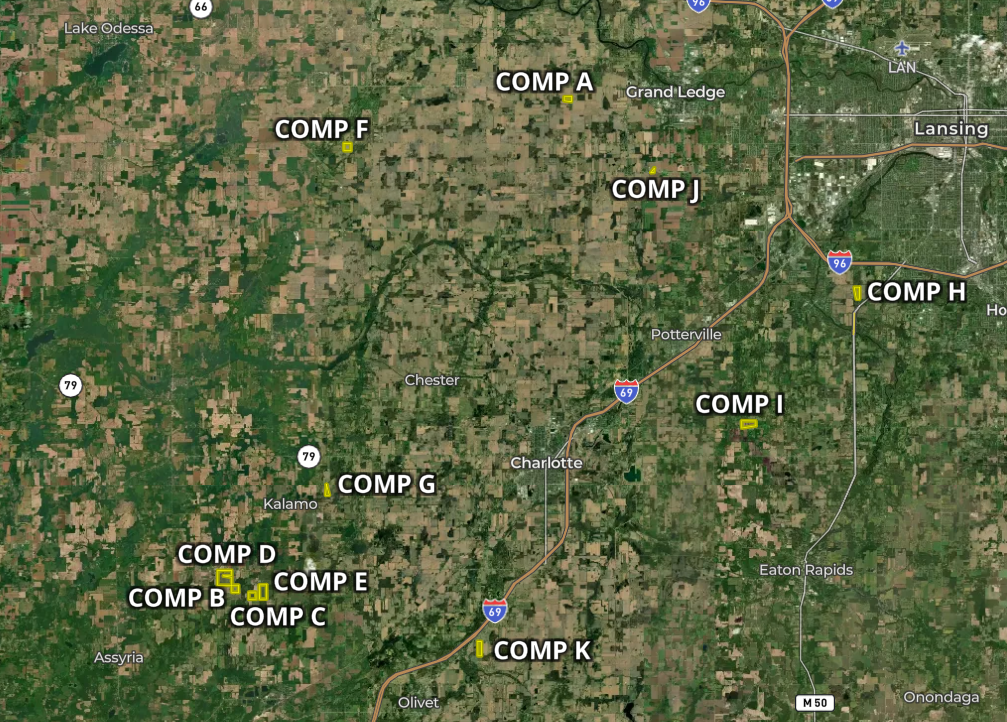
By The Numbers
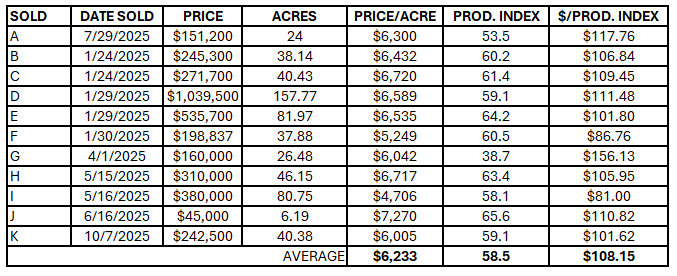
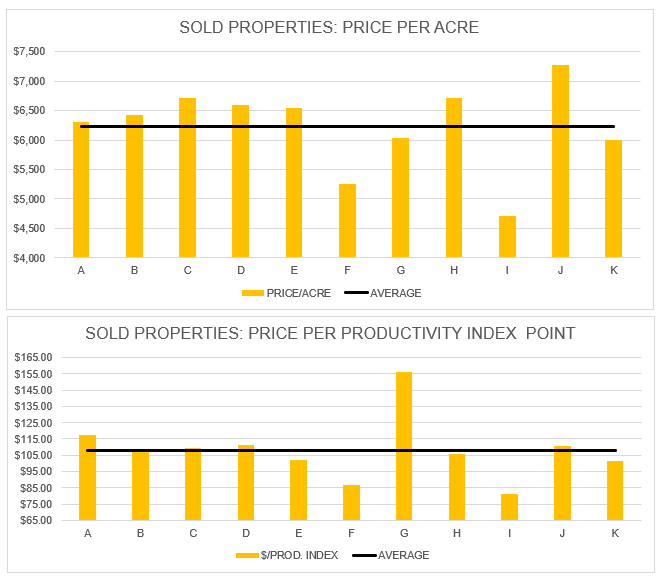
Agriculture Meets Opportunity in Mid-Michigan
Eaton County occupies a unique position within Michigan’s agricultural landscape. While farming remains one of the county’s defining industries, its proximity to the Lansing metropolitan area introduces additional influences that shape the rural land market. Even so, agriculture continues to be the primary driver of farmland demand throughout much of the county.
During 2025, buyers remained focused on acquiring productive farmland capable of supporting efficient operations for years to come. Rather than pursuing acreage at any cost, buyers increasingly evaluated soil quality, drainage, accessibility, and long-term management potential before making purchasing decisions.
That measured approach has carried into the first half of 2026. Activity remains steady, but today’s buyers are placing greater emphasis on operational value and property-specific characteristics than on broad market momentum.
A Strong Agricultural Foundation
Eaton County supports a diverse mix of agricultural enterprises that contribute to a stable and resilient farming economy. Corn, soybeans, wheat, and hay remain the county’s primary crops, while livestock operations, forage production, and specialty farms add further diversity to the agricultural landscape.
The county’s mix of productive farmland and established agricultural infrastructure has helped sustain farming across multiple generations. Grain handling facilities, agribusiness suppliers, equipment dealerships, and transportation corridors all contribute to an efficient production environment.
This broad agricultural base continues to support long-term confidence in farmland ownership and investment.
According to the USDA National Agricultural Statistics Service (NASS), the following crop statistics have been reported for Eaton County, Michigan.
The 2022 Ag Census for Eaton County, Michigan, reported the following crop statistics:
Number of farms: 953
Land in farms (acres): 199,560
Average farm size (acres): 209
Total market value of products sold: $129,652,000
Government payments: $1,468,000
Farm-related income: $6,304,000
Total farm production expenses: $104,933,000
Net cash farm income: $32,491,000
The Value of Well-Positioned Farmland
As the market has matured, buyers have become increasingly focused on the characteristics that separate exceptional farms from average ones.
Properties with dependable drainage, productive soils, efficient field configurations, and strong road access continue to generate the greatest interest. Farms that are well maintained and require minimal immediate investment often provide buyers with greater confidence when evaluating long-term returns.
Conversely, parcels with irregular field layouts, deferred improvements, or lower operational efficiency remain marketable but frequently receive more detailed scrutiny during the buying process.
The result is a market where preparation and stewardship continue to enhance long-term value.
Balancing Agriculture and Regional Growth
One characteristic that distinguishes Eaton County from many rural Michigan counties is its proximity to the Lansing area.
Communities such as Charlotte, Grand Ledge, and Delta Township benefit from regional economic activity while maintaining strong agricultural connections. Although most farmland transactions continue to be driven by agricultural buyers, certain properties located near expanding communities or major transportation routes may attract additional interest because of their location.
For landowners, understanding both agricultural value and local growth patterns can provide a more complete picture of market dynamics.
Mid-2026: A Market Focused on Fundamentals
The first half of 2026 has reinforced a trend toward disciplined buying activity.
Farm operators continue to seek opportunities to expand their operations, but they are doing so with careful attention to productivity, operating costs, and long-term performance. Well-managed farms remain highly competitive, particularly when they become available in areas with limited inventory.
Although financing costs continue to influence purchasing decisions, quality farmland has remained remarkably resilient. Buyers recognize that productive acreage remains a finite resource, and many continue to view farmland as a stable long-term investment.
Overall, the county’s market has remained balanced, with demand continuing to favor farms that demonstrate strong agricultural fundamentals.
What May Shape the Remainder of 2026
Several factors are expected to influence Eaton County’s farmland market through the balance of the year.
Farm profitability and commodity prices will continue guiding expansion decisions for local operators, while interest rates are likely to remain an important consideration for leveraged buyers.
Inventory will also be worth monitoring. If more farms become available during the second half of the year, buyers may have additional opportunities to compare properties, further emphasizing the importance of soil quality, drainage, and overall farm condition.
For many landowners, continued investment in stewardship practices and operational improvements will remain one of the best ways to preserve long-term value regardless of broader market conditions.
History & Background of Eaton County, Michigan
County Seat: Charlotte
Townships: Bellevue / Benton / Brookfield / Carmel / Chester / Delta / Eaton / Eaton Rapids / Hamlin / Kalamo / Oneida / Roxand / Sunfield / Vermontville / Walton / Windsor
History: Established in 1829 & organized in 1837; named after John H. Eaton, Secretary of War under President Andrew Jackson
Population: 109,581
Cities & Towns: Bellevue / Charlotte / Dimondale / Eaton Rapids / Grand Ledge / Lansing / Mulliken / Olivet / Potterville / Sunfield / Vermontville
Acreage: 370,560
County Highlights
Agriculture Continues to Evolve
Eaton County’s agricultural economy reflects both tradition and innovation. Alongside established row-crop operations, producers continue adopting precision agriculture, conservation practices, and modern equipment that improve efficiency and support long-term soil health.
Strong Connections to Regional Markets
The county’s location near Lansing provides convenient access to agricultural suppliers, processors, transportation corridors, and workforce resources while allowing much of the county to retain its rural agricultural identity.
Local Communities Continue Investing
Communities throughout Eaton County continue investing in infrastructure, economic development, and community improvements that strengthen the county’s overall economy while supporting both agricultural producers and rural residents.
Final Perspective
Eaton County’s farmland market continues to reflect the strength of productive agriculture combined with the advantages of its location in mid-Michigan. While nearby regional growth provides additional opportunities for certain properties, farming remains the foundation of long-term land value throughout much of the county.
The first half of 2026 has shown that buyers continue to reward quality. Farms offering productive soils, efficient layouts, and strong stewardship remain the most competitive, while buyers have become increasingly deliberate in evaluating every opportunity.
As the remainder of the year unfolds, Eaton County appears well positioned to maintain a healthy farmland market supported by experienced producers, diversified agriculture, and a continued commitment to responsible land management.
Sources / Citations:
Source 1:
“United States Department of Agriculture.” USDA, www.nass.usda.gov/Statistics_by_State/Michigan/Publications/County_Estimates/index.php#:~:text=Access%20Quick%20Stats%20Lite,to%20NASS%20Surveys%20and%20Programs. Accessed 13 July 2026.
Source 2:
“USDA.” 2022 Census of Agriculture County Profile, www.nass.usda.gov/Publications/AgCensus/2022/Online_Resources/County_Profiles/michigan/cp26045.pdf. Accessed 13 July 2026.
*The transaction and land sales data/information contained in this report was obtained from publicly available sources and sales disclosures deemed accurate and reliable but not guaranteed, no liability for accuracy, errors or omissions is assumed by Geswein Farm & Land Realty, LLC
Thinking About Selling?
Need Advice?
Get the guidance, service, and professional expertise you deserve.
- Family Farm Advisory for Succession Planning
- Undivided Interests & Tenants in Common
- Farmland Management Decisions
- Auctions & Listing
With our full-time experienced team, you’ll get our ‘boots on the ground’ work ethic paired with the latest in digital technology & national marketing reach – for best-in-class service and results.
Because you deserve more value.
Contact Us