


LaGrange County, Indiana
2026 Land Sales Report
LaGrange County’s farmland market showed continued strength in 2025, although buyers and sellers began to see a more measured pace of activity. Early 2026 trends point toward a healthy market with values supported by steady demand.
If you’d like to get specific land values on your own property or a farm near you for 2026, please contact Jacob Hogan today at (765) 366-6328.
Average Price of Land*
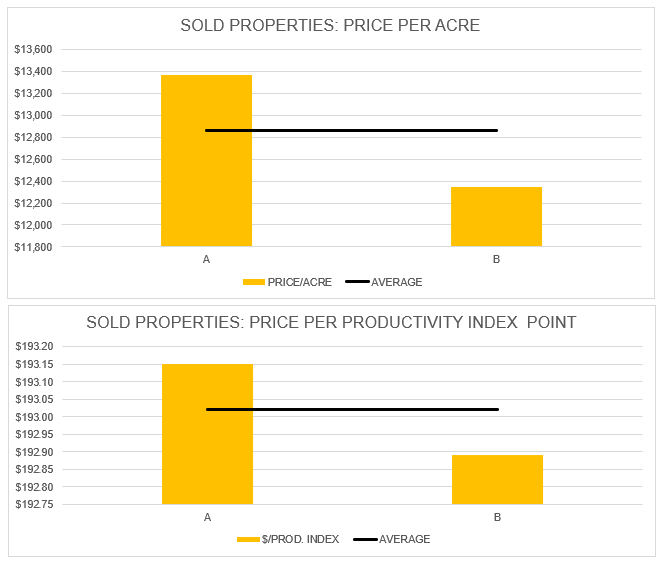
$12,856/acre
Jan. – Dec. 2025*
As high as $13,366/acre
in 2025*
Land Market Commentary & Local Trends
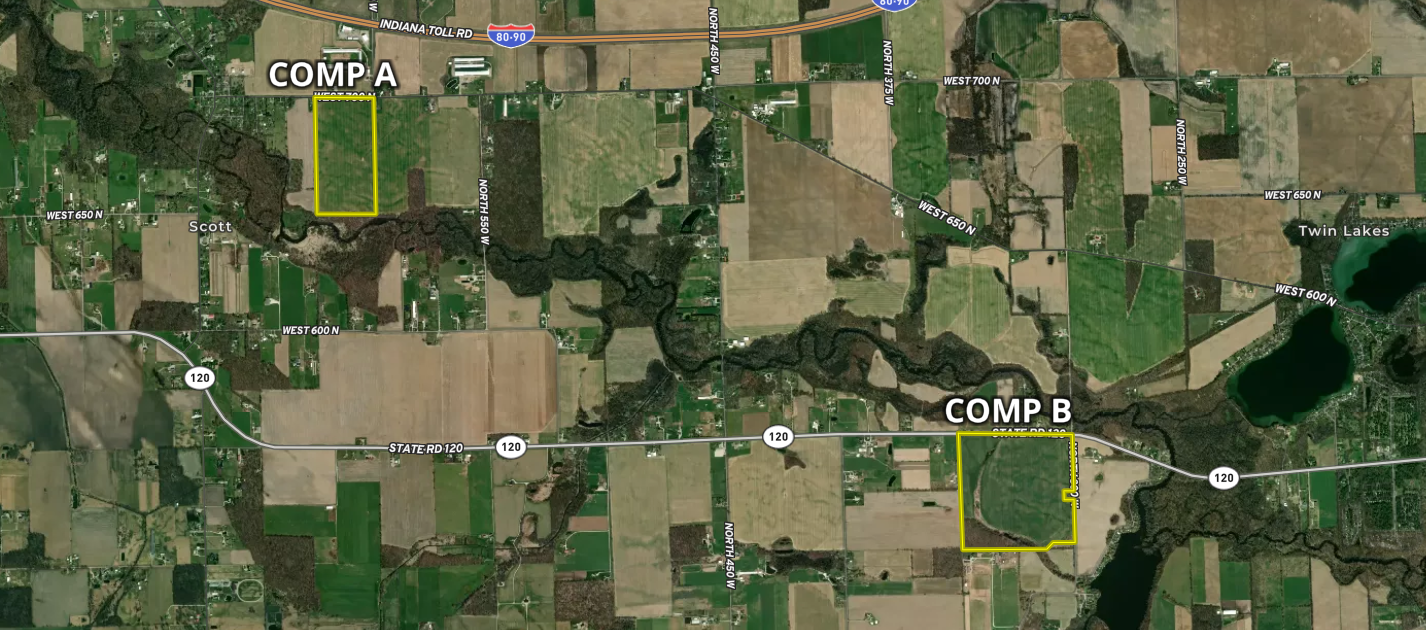
The 2025 LaGrange County farmland market showed continued strength, with average values reaching $12,856 per acre and $193.02 per productivity index point. Strong buyer interest in quality tracts helped push one of the top sales of the year to $13,366 per acre.
Since 1977, the Geswein Farm & Land Team has been advising landowners to be stewards of the land and make decisions based on most current, accurate, and relevant data. The information in this report can provide you with a rough estimate of your property’s value; however, understanding the specific characteristics of your property and how they compare to the other sales will provide the most accurate value of your property. Additionally, properties sold by land brokers via auctions or listings consistently outperformed individual to individual transactions and properties sold by traditional home realtors.
By The Numbers

A Farmland Market Shaped by Tradition, Diversity, and Long-Term Ownership
LaGrange County’s farmland market stands apart from many agricultural counties in Indiana. While row-crop production remains an important part of the local landscape, the county’s agricultural identity is also shaped by generations of diversified farming operations, livestock production, and a strong culture of family-owned farms.
Throughout 2025, the farmland market reflected this unique balance. Buyers continued to recognize the value of productive agricultural land, but the strongest demand was often connected to properties that supported efficient operations and long-term farm use. In a county where agriculture is deeply tied to the local community, farmland continues to represent more than an investment – it represents an opportunity to expand, preserve, and continue a way of life that has shaped the area for generations.
As 2026 progresses, LaGrange County remains a market where land quality, operational flexibility, and local demand continue to be the primary factors influencing buyer decisions.
History & Background of LaGrange County, Indiana
County Seat: LaGrange
Townships: Bloomfield / Clay / Clearspring / Eden / Greenfield / Johnson / Lima / Milford / Newbury / Springfield / Van Buren
History: Established in 1832 from parts of Elkhart and Allen counties; named after the French estate of the Marquis de Lafayette
Population: 40,400
Cities & Towns: Howe / LaGrange / Shipshewana / Topeka / Wolcottville
Acreage: 247,040
Agriculture in LaGrange County: More Than a Row-Crop Story
Unlike some Indiana counties where farmland values are driven almost exclusively by corn and soybean production, LaGrange County’s agricultural economy is more diversified. Row crops remain important, but livestock operations, dairy farms, hay production, and pasture-based agriculture also contribute significantly to the county’s rural landscape.
This diversity influences the farmland market because buyers are often evaluating properties based on more than yield potential alone. A farm with strong pasture, usable buildings, livestock infrastructure, or a layout suited for a diversified operation may appeal to a different group of buyers than a traditional grain farm.
The county’s agricultural strength comes from this variety. Different types of operations can find opportunities throughout LaGrange County, helping support consistent demand for farmland even when individual agricultural sectors experience changing market conditions.
According to the USDA National Agricultural Statistics Service (NASS), the following crop statistics have been reported for LaGrange County, Indiana.
The 2022 Ag Census for LaGrange County, Indiana, reported the following crop statistics:
Number of farms: 2,474
Land in farms (acres): 193,616
Average farm size (acres): 78
Total market value of products sold: $494,017,000
Government payments: $601,000
Farm-related income: $11,852,000
Total farm production expenses: $312,386,000
Net cash farm income: $194,084,000
Efficiency and Usability Continue to Define Value
During 2025, LaGrange County’s farmland market continued to demonstrate that not all acres compete equally. Buyers placed significant emphasis on properties that offered practical advantages for today’s agricultural operations.
The strongest farms were typically those with good soil productivity, manageable field layouts, reliable access, and the ability to support efficient farming practices. Larger tracts with strong tillable percentages remained attractive, but smaller properties with excellent usability and strong agricultural potential also maintained appeal.
Because of the county’s mix of farmland types, buyers often evaluated each property individually. A farm’s value was not determined solely by acreage or productivity – it was also influenced by how well the property fit the needs of the buyer.
This focus on functionality has become increasingly important as buyers continue to approach farmland purchases with careful financial planning.
The Role of Family Farms and Local Buyers
One of LaGrange County’s greatest strengths is the depth of its local agricultural community. Farming remains closely connected to family ownership, with many operations built around generations of experience and long-term land stewardship.
This creates a farmland market that is often driven by practical agricultural demand rather than outside speculation. Local operators understand the value of productive ground, know the characteristics of the county’s soils, and recognize how a property may contribute to an existing operation.
That local knowledge creates stability within the market. When quality farmland becomes available, buyers often understand exactly what makes a tract desirable and how it can strengthen their long-term plans.
Balancing Productivity with the County’s Unique Landscape
LaGrange County’s geography creates a farmland market that requires a more detailed look than simply comparing acreage. While portions of the county contain highly productive agricultural ground, other areas include rolling terrain, pasture, wooded acreage, and properties better suited for livestock or mixed agricultural uses.
This variation means farmland values can differ significantly depending on location and intended use. A highly productive row-crop farm may attract one type of buyer, while a diversified farm with pasture, buildings, or livestock potential may attract another.
For landowners, this reinforces the importance of understanding the specific strengths of their property. In LaGrange County, value is often tied to how well a farm fits into the broader agricultural landscape.
What We’ve Seen So Far in 2026
The first half of 2026 has continued to show many of the same themes that developed during 2025. Buyers remain active, but they are increasingly focused on properties that provide clear agricultural value and long-term usefulness.
Premium farms with strong productivity, good accessibility, and efficient layouts continue to generate the greatest interest. However, buyers have become more deliberate when evaluating properties that require additional improvements or offer less operational flexibility.
One advantage LaGrange County continues to benefit from is the strength of its agricultural community. Because demand is closely tied to active farming operations, the market has maintained a steady foundation despite continued uncertainty surrounding interest rates, commodity markets, and farm profitability.
Rather than a market defined by rapid appreciation, 2026 has been characterized by careful decision-making, strong local knowledge, and continued demand for farmland that truly performs.
Looking Ahead: What Could Shape the Rest of 2026
As the remainder of 2026 unfolds, LaGrange County landowners should continue watching how buyer priorities evolve. The market appears increasingly focused on quality, efficiency, and long-term agricultural usefulness.
Properties that offer strong production potential, practical layouts, and adaptability for different agricultural uses should remain well positioned. Farms that support livestock operations, diversified agriculture, or established farm expansion plans may continue to benefit from the county’s unique buyer base.
Ownership transitions will also remain an important factor. Like many agricultural counties, LaGrange County will continue to experience generational changes in farmland ownership. The availability of well-maintained farms entering the market could influence competition and create opportunities for both buyers and sellers.
Ultimately, the strongest farmland will likely continue to be the land that offers a clear purpose – whether that purpose is expanding an existing farm, supporting livestock production, or continuing a family agricultural legacy.
Final Thoughts
LaGrange County’s farmland market is defined by more than production numbers alone. Its agricultural identity is built on diversified farming operations, strong local ownership, and a community that continues to value land as a long-term resource.
While market conditions have become more selective compared to the rapid appreciation of previous years, demand for quality farmland remains supported by the county’s agricultural foundation. The farms that continue to stand out are those that combine productivity, usability, and the characteristics that allow them to remain successful for future generations.
As 2026 continues, LaGrange County remains a strong example of how farmland value is shaped not only by what the land produces, but also by the people, traditions, and agricultural systems that depend on it.
Sources / Citations:
Source 1:
“United States Department of Agriculture.” USDA, www.nass.usda.gov/Statistics_by_State/Indiana/Publications/County_Estimates/index.php#:~:text=Access%20Quick%20Stats%20Lite,to%20NASS%20Surveys%20and%20Programs. Accessed 8 July 2026.
Source 2:
“USDA.” 2022 Census of Agriculture County Profile, www.nass.usda.gov/Publications/AgCensus/2022/Online_Resources/County_Profiles/Indiana/cp18087.pdf. Accessed 8 July 2026.
*The transaction and land sales data/information contained in this report was obtained from publicly available sources and sales disclosures deemed accurate and reliable but not guaranteed, no liability for accuracy, errors or omissions is assumed by Geswein Farm & Land Realty, LLC
Thinking About Selling?
Need Advice?
Get the guidance, service, and professional expertise you deserve.
- Family Farm Advisory for Succession Planning
- Undivided Interests & Tenants in Common
- Farmland Management Decisions
- Auctions & Listing
With our full-time experienced team, you’ll get our ‘boots on the ground’ work ethic paired with the latest in digital technology & national marketing reach – for best-in-class service and results.
Because you deserve more value.
Contact Us