


Wabash County, Indiana
2026 Land Sales Report
Wabash County saw continued demand for farmland in 2025, though the market began to settle into a more predictable rhythm. Heading into 2026, values appear positioned for stability rather than the rapid increases experienced in prior years.
If you’d like to get specific land values on your own property or a farm near you for 2026, please contact Jacob Hogan today at (765) 366-6328.
Average Price of Land*
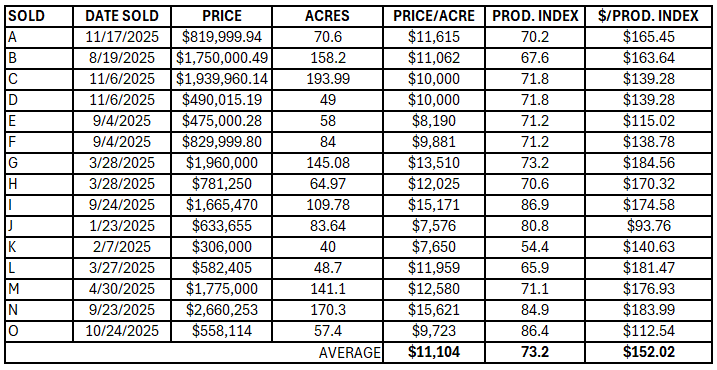
$11,104/acre
Jan. – Dec. 2025*
As high as $15,621/acre
in 2025*
Land Market Commentary & Local Trends
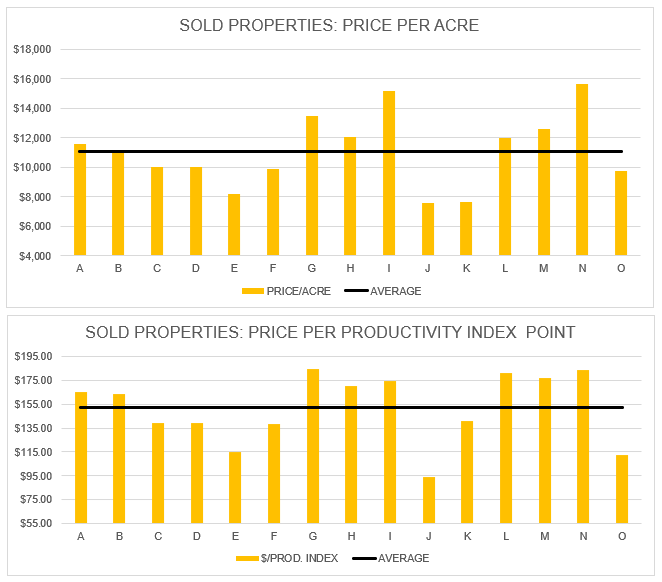
The 2025 farmland market in Wabash County reflected continued buyer interest, with average sales coming in at $11,104 per acre and $152.02 per productivity index point. The upper end of the market remained competitive, with select properties reaching $15,621 per acre.
Since 1977, the Geswein Farm & Land Team has been advising landowners to be stewards of the land and make decisions based on most current, accurate, and relevant data. The information in this report can provide you with a rough estimate of your property’s value; however, understanding the specific characteristics of your property and how they compare to the other sales will provide the most accurate value of your property. Additionally, properties sold by land brokers via auctions or listings consistently outperformed individual to individual transactions and properties sold by traditional home realtors.
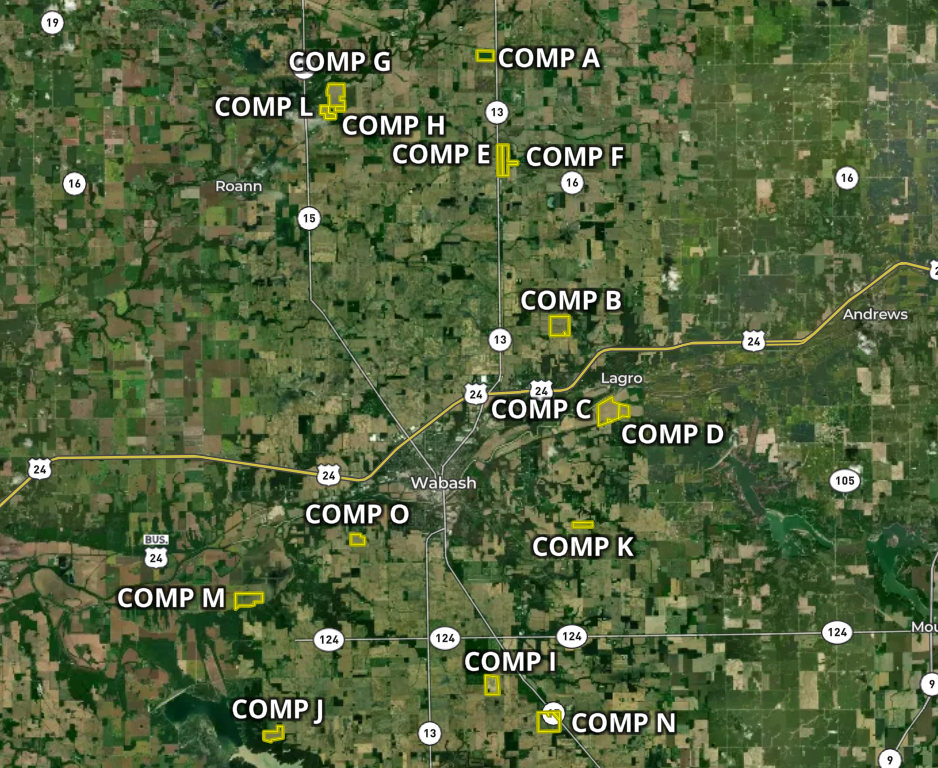
By The Numbers
A Farmland Market Built on Productivity and Stewardship
Wabash County has long been recognized for its productive farmland and strong agricultural heritage. Throughout 2025, the local land market reflected a growing emphasis on quality rather than quantity, as buyers increasingly focused on farms that could deliver reliable long-term performance. While overall demand remained healthy, competition was strongest for properties that combined productive soils with efficient layouts and well-maintained infrastructure.
As the market has moved through the first half of 2026, farmland in Wabash County continues to be viewed as a long-term investment. Buyers remain active but purchasing decisions have become more deliberate as they balance farm profitability, financing costs, and the long-term value of adding acreage to existing operations.
Agriculture Continues to Drive the Local Economy
Agriculture remains one of Wabash County’s most important industries, with corn and soybean production forming the backbone of the local farm economy. Livestock operations, forage production, and family-owned farms also contribute to the county’s agricultural diversity, creating a resilient farming community supported by grain elevators, equipment dealerships, input suppliers, and agricultural service businesses.
The county’s location along the Wabash River has helped shape generations of productive farming. Fertile river-bottom soils, combined with well-managed upland fields, provide opportunities for a wide range of agricultural operations. This diversity continues to support consistent demand for farmland from producers looking to expand or strengthen their operations.
Productive Farms Continue to Lead the Market
One trend became increasingly apparent throughout 2025: buyers were willing to compete for farms that required little additional investment before going into production.
Properties featuring productive soils, effective drainage systems, strong road access, and field layouts compatible with modern equipment consistently attracted the greatest interest. Buyers recognized that operational efficiency can have a meaningful impact on long-term profitability, making these characteristics increasingly valuable.
Conversely, farms with irregular field shapes, deferred maintenance, or acreage less suited to efficient production often required more careful evaluation. These properties continued to sell, but buyers were more selective in determining how each farm fit into their long-term business plans.
According to the USDA National Agricultural Statistics Service (NASS), the following crop statistics have been reported for Wabash County, Indiana.
The 2022 Ag Census for Wabash County, Indiana, reported the following crop statistics:
Number of farms: 635
Land in farms (acres): 186,071
Average farm size (acres): 293
Total market value of products sold: $394,401,000
Government payments: $2,048,000
Farm-related income: $11,448,000
Total farm production expenses: $286,235,000
Net cash farm income: $121,661,000
Stewardship Adds Lasting Value
In Wabash County, good farmland is often the result of decades of thoughtful management. Conservation practices, drainage improvements, erosion control, and responsible soil stewardship continue to influence how buyers evaluate agricultural properties.
The county’s mix of river-bottom ground and gently rolling upland acreage makes proper water management especially important. Farms that have been maintained with long-term productivity in mind frequently stand out in the marketplace because they offer dependable performance while helping reduce future management costs.
As operating margins remain an important consideration, buyers continue to recognize that stewardship is an investment that extends well beyond a single growing season.
History & Background of Wabash County, Indiana
County Seat: Wabash
Townships: Noble / Chester / Lagro / Liberty / Paw Paw / Pleasant / Waltz
History: Founded in January 1820 and officially organized in 1835; the name comes from the Wabash River.
Population: 30,976
Cities & Towns: La Fontaine / Lagro / Laketon / Liberty Mills / North Manchester / Roann / Servia
Acreage: 269,431
What We’ve Seen So Far in 2026
As the first half of 2026 has unfolded, Wabash County’s farmland market has remained steady despite a more measured agricultural economy. Buyer activity continues to be supported by local operators and long-term investors who recognize the value of productive farmland but purchasing decisions have become increasingly property-specific.
High-quality farms continue to generate the strongest competition, particularly when they offer strong productivity, efficient field configurations, and well-maintained improvements. At the same time, buyers are spending more time evaluating farms with physical limitations or deferred maintenance, reflecting a market that places greater emphasis on long-term return rather than short-term opportunity.
Limited inventory has also continued to support the market. Well-maintained farms do not become available frequently, and when they do, they often receive significant attention from neighboring operators seeking to expand their acreage.
Overall, the first half of 2026 suggests that Wabash County remains a stable agricultural market where disciplined buyers continue to compete for quality farmland.
Looking Ahead: What Could Shape the Rest of 2026
Several factors are likely to influence Wabash County’s farmland market during the remainder of the year.
Farm profitability will continue to shape purchasing decisions, particularly as producers evaluate commodity prices alongside input and borrowing costs. Even so, quality farmland is expected to remain in demand because opportunities to acquire productive acreage remain relatively limited.
Landowners may also benefit from continued investment in stewardship. Farms with strong drainage, conservation improvements, accessible field entrances, and efficient layouts are likely to remain attractive as buyers continue to prioritize operational performance.
Finally, the county’s strong base of family-owned farms and established agricultural businesses provides an important source of market stability. As ownership transitions occur and expansion opportunities arise, local demand is expected to remain a key driver of farmland activity.
Local Pulse: What’s Happening in Wabash County?
Downtown Wabash Continues to Build Momentum
Investment in downtown Wabash continues to strengthen the county’s economic outlook through redevelopment projects, small business growth, and community revitalization. While these investments are centered in the city, they contribute to the overall vitality of the county and reinforce confidence in the local economy.
Strong Manufacturing Supports Rural Communities
Wabash County continues to benefit from a diverse manufacturing sector, providing employment opportunities that complement its agricultural economy. The combination of manufacturing and farming has long contributed to the county’s economic stability and supports demand for rural home sites and agricultural land.
Conservation and Water Quality Remain Priorities
Local conservation efforts continue to encourage responsible soil health, drainage management, and watershed protection throughout the county. These initiatives help preserve the long-term productivity of Wabash County farmland while supporting sustainable agricultural practices for future generations.
Final Thoughts
Wabash County’s farmland market continues to reflect the values that have defined the area for generations: productive land, responsible stewardship, and a strong agricultural community. While buyers have become more selective than they were during the period of rapid appreciation seen several years ago, the first half of 2026 has demonstrated that demand for quality farmland remains resilient.
Looking ahead, the county is well positioned to maintain a stable market supported by productive soils, experienced farm operators, and long-term confidence in agriculture. Farms that combine strong productivity with thoughtful management are expected to remain among the most desirable properties as the year continues.
Sources / Citations:
Source 1:
“United States Department of Agriculture.” USDA, www.nass.usda.gov/Statistics_by_State/Indiana/Publications/County_Estimates/index.php#:~:text=Access%20Quick%20Stats%20Lite,to%20NASS%20Surveys%20and%20Programs. Accessed 10 July 2026.
Source 2:
“USDA.” 2022 Census of Agriculture County Profile, www.nass.usda.gov/Publications/AgCensus/2022/Online_Resources/County_Profiles/Indiana/cp18169.pdf. Accessed 10 July 2026.
*The transaction and land sales data/information contained in this report was obtained from publicly available sources and sales disclosures deemed accurate and reliable but not guaranteed, no liability for accuracy, errors or omissions is assumed by Geswein Farm & Land Realty, LLC
Thinking About Selling?
Need Advice?
Get the guidance, service, and professional expertise you deserve.
- Family Farm Advisory for Succession Planning
- Undivided Interests & Tenants in Common
- Farmland Management Decisions
- Auctions & Listing
With our full-time experienced team, you’ll get our ‘boots on the ground’ work ethic paired with the latest in digital technology & national marketing reach – for best-in-class service and results.
Because you deserve more value.
Contact Us