


Whitley County, Indiana
2026 Land Sales Report
The Whitley County farmland market maintained solid momentum in 2025, with productive acres continuing to hold strong appeal. Looking ahead to 2026, conditions suggest a more balanced market as price growth begins to moderate.
If you’d like to get specific land values on your own property or a farm near you for 2026, please contact Jacob Hogan today at (765) 366-6328.
Average Price of Land*
$12,376/acre
Jan. – Dec. 2025*
As high as $15,000/acre
in 2025*
Land Market Commentary & Local Trends
Whitley County landowners saw solid farmland values in 2025, as sales averaged $12,376 per acre and $191.67 per productivity index point. The best-performing properties continued to command premium prices, with sales reaching $15,000 per acre.
Since 1977, the Geswein Farm & Land Team has been advising landowners to be stewards of the land and make decisions based on most current, accurate, and relevant data. The information in this report can provide you with a rough estimate of your property’s value; however, understanding the specific characteristics of your property and how they compare to the other sales will provide the most accurate value of your property. Additionally, properties sold by land brokers via auctions or listings consistently outperformed individual to individual transactions and properties sold by traditional home realtors.
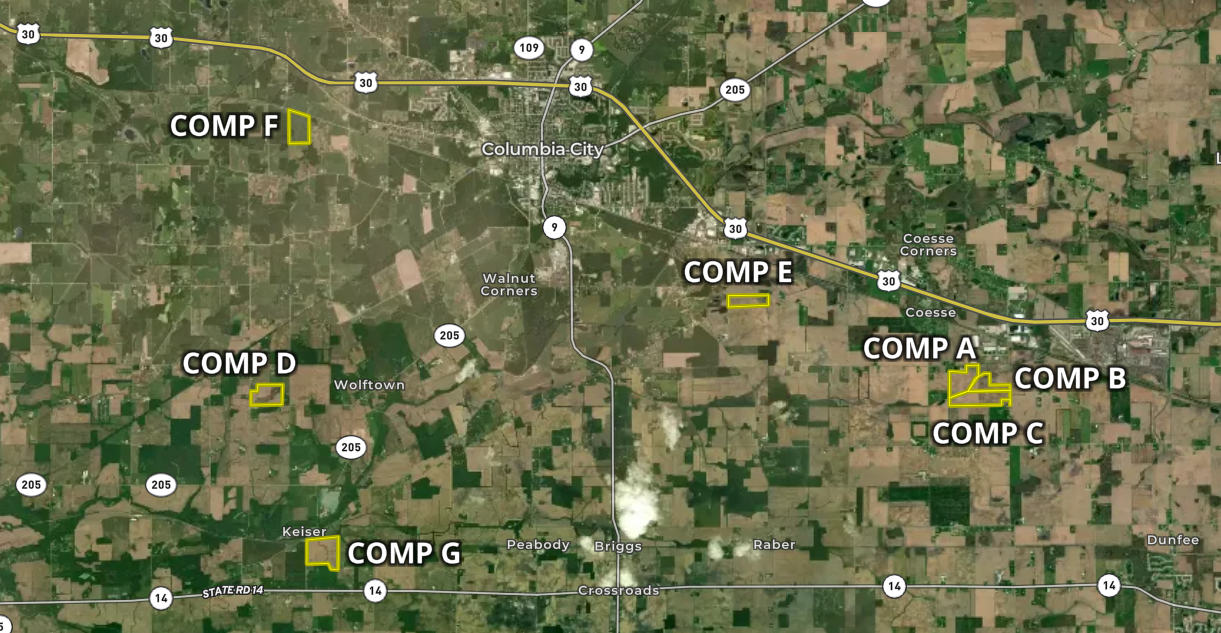
By The Numbers
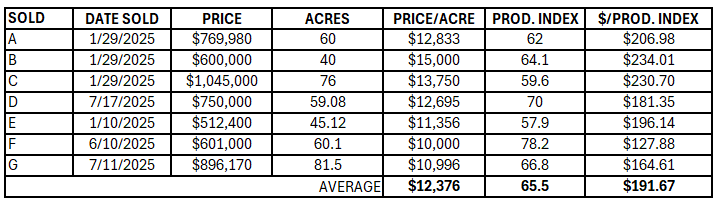
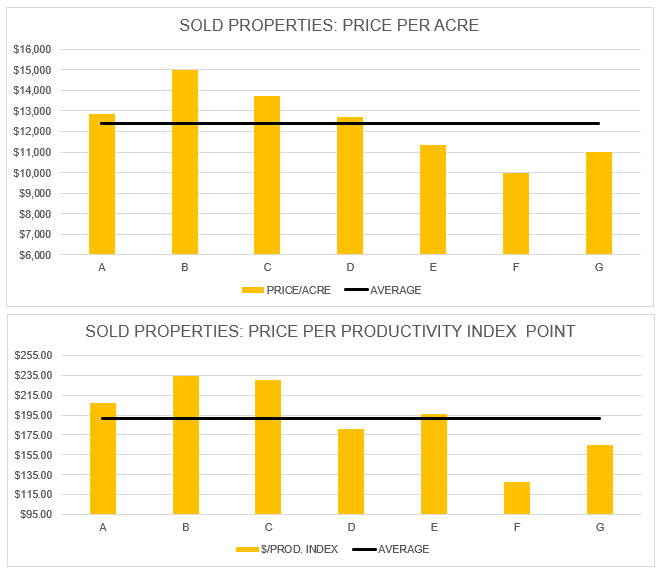
A Strong Agricultural Market with Growing Regional Influence
Whitley County’s farmland market reflects the balance between a long-standing agricultural community and the influence of being located near one of northeast Indiana’s growing economic centers. Agriculture remains a defining part of the county’s identity, but proximity to Fort Wayne and surrounding communities adds another layer of demand to the rural land market.
Throughout 2025, buyers continued to place strong emphasis on productive farmland, but the market became increasingly focused on identifying properties with long-term value. Well-maintained farms with strong soils, efficient layouts, and reliable access remained the most competitive, while buyers became more selective when evaluating properties with limitations or additional improvement needs.
As 2026 progresses, Whitley County continues to demonstrate that farmland value is shaped by more than production alone. Agricultural productivity remains the foundation, but location, accessibility, and future flexibility are becoming increasingly important considerations.
Agriculture Remains the Foundation of Whitley County
Whitley County continues to be supported by a strong agricultural economy built around corn and soybean production, livestock operations, and generations of family-owned farms. The county’s farming community benefits from a network of agricultural businesses and services that support producers throughout the region.
The combination of productive soils, established operators, and a strong agricultural tradition helps maintain steady demand for farmland. Many buyers are not simply looking for additional acreage – they are looking for properties that can improve efficiency, strengthen an existing operation, or provide long-term stability for future generations.
This local agricultural foundation remains one of Whitley County’s greatest strengths in supporting farmland values.
According to the USDA National Agricultural Statistics Service (NASS), the following crop statistics have been reported for Whitley County, Indiana.
The 2022 Ag Census for Whitley County, Indiana, reported the following crop statistics:
Number of farms: 647
Land in farms (acres): 162,338
Average farm size (acres): 251
Total market value of products sold: $187,697,000
Government payments: $1,299,000
Farm-related income: $6,497,000
Total farm production expenses: $132,430,000
Net cash farm income: $63,063,000
Quality and Location Continue to Separate the Market
One of the most noticeable trends in Whitley County’s farmland market is the growing importance of property-specific characteristics.
Farms with strong productivity, good drainage, manageable field shapes, and convenient access continue to attract the greatest attention from agricultural buyers. These properties provide immediate operational value and allow farmers to maximize efficiency in an environment where input costs and margins remain important considerations.
At the same time, Whitley County’s location near Fort Wayne creates additional demand for certain rural properties. Parcels with desirable road frontage, proximity to growing communities, or potential future flexibility may appeal to buyers beyond traditional agricultural operators.
This creates a market where farmland can have different levels of appeal depending on its location and characteristics.
History & Background of Whitley County, Indiana
County Seat: Columbia City
Townships: Cleveland / Columbia / Etna-Troy / Jefferson / Richland / Smith / Thorncreek / Union / Washington
History: Founded in 1835; named for Colonel William Whitley, who died at the Battle of the Thames in the War of 1812
Population: 34,191
Cities & Towns: Churubusco / Columbia City / Larwill / South Whitley
Acreage: 216,261
The Influence of Growth and Rural Land Demand
Unlike counties that are primarily driven by agricultural expansion alone, Whitley County experiences some influence from regional growth. Its proximity to Fort Wayne provides access to employment centers, infrastructure, and expanding communities, which can impact demand for certain rural properties.
While the majority of farmland remains focused on agricultural production, some parcels may receive additional interest due to their potential for rural residential use or future transition. This does not replace agricultural demand, but it does create additional considerations when evaluating land value.
For landowners, understanding how their property fits within the broader landscape is increasingly important. A farm’s value may be influenced not only by what it produces today, but also by how its location positions it for future opportunities.
Stewardship and Farm Improvements Continue to Matter
As buyers become more selective, well-managed farms continue to stand out. Drainage improvements, conservation practices, maintained access points, and efficient field layouts all contribute to the overall appeal of a property.
Whitley County’s agricultural success has been built over generations, and many of the most desirable farms reflect years of thoughtful ownership and management. Buyers recognize that land quality is not just determined by soil type – it is also shaped by the investments made by previous owners.
In a market where buyers are carefully evaluating returns, farms that require fewer immediate improvements often hold a competitive advantage.
What We’ve Seen So Far in 2026
The first half of 2026 has continued to reinforce many of the trends that emerged during 2025. Buyer interest remains strongest for farms that offer a combination of productivity, usability, and long-term value.
Rather than seeing broad competition across every available property, the market has become more segmented. High-quality farmland continues to attract attention, while properties with lower productivity, unusual layouts, or additional challenges require more careful evaluation from buyers.
Whitley County’s strong agricultural base has helped provide stability during this transition. Local operators remain an important source of demand, and the limited availability of desirable farmland continues to support buyer interest when quality properties become available.
At the same time, the influence of nearby population growth remains a factor to monitor. Properties with strong locations may continue to attract interest from both agricultural buyers and those looking for rural land opportunities.
Looking Ahead: What Could Shape the Rest of 2026
As Whitley County moves through the remainder of 2026, farmland values will likely continue to be influenced by three primary factors: agricultural profitability, available inventory, and location.
Productive farms that allow operators to improve efficiency should remain among the most sought-after properties. Local farm demand, combined with limited opportunities to purchase high-quality acreage, is expected to provide continued support for well-positioned farmland.
Landowners should also pay attention to changing land-use patterns. As northeast Indiana continues to grow, certain areas of Whitley County may experience increasing interest from buyers seeking rural residential opportunities or future development potential.
Ultimately, the strongest farmland will likely continue to be properties that offer flexibility – land that can support successful agricultural operations today while maintaining long-term appeal.
Local Pulse: What’s Happening in Whitley County?
Continued Connection to Fort Wayne Growth
Whitley County continues to benefit from its location near Fort Wayne, creating opportunities tied to regional economic growth while maintaining its rural character. This connection supports demand for housing, services, and land throughout the county.
Agriculture and Manufacturing Work Together
Whitley County’s economy continues to reflect a strong balance between agriculture and manufacturing. These industries provide a stable economic foundation and contribute to the county’s overall rural land demand.
Rural Communities Continue to Invest Locally
Communities throughout Whitley County continue to focus on maintaining local amenities, infrastructure, and quality of life. These investments help preserve the county’s appeal for both agricultural families and residents seeking a rural lifestyle.
Final Thoughts
Whitley County’s farmland market represents the intersection of productive agriculture and regional growth. While farming remains the foundation of land value, the county’s location near Fort Wayne creates additional influences that make each property unique.
The first half of 2026 has shown a market that is stable but increasingly selective. Buyers continue to recognize the value of quality farmland, but they are placing greater importance on productivity, efficiency, and long-term potential.
As the year continues, Whitley County’s strongest farmland will likely remain that which combines agricultural strength with thoughtful stewardship and strategic location – qualities that have supported the county’s land market for generations.
Sources / Citations:
Source 1:
“United States Department of Agriculture.” USDA, www.nass.usda.gov/Statistics_by_State/Indiana/Publications/County_Estimates/index.php#:~:text=Access%20Quick%20Stats%20Lite,to%20NASS%20Surveys%20and%20Programs. Accessed 10 July 2026.
Source 2:
“USDA.” 2022 Census of Agriculture County Profile, www.nass.usda.gov/Publications/AgCensus/2022/Online_Resources/County_Profiles/Indiana/cp18183.pdf. Accessed 10 July 2026.
*The transaction and land sales data/information contained in this report was obtained from publicly available sources and sales disclosures deemed accurate and reliable but not guaranteed, no liability for accuracy, errors or omissions is assumed by Geswein Farm & Land Realty, LLC
Thinking About Selling?
Need Advice?
Get the guidance, service, and professional expertise you deserve.
- Family Farm Advisory for Succession Planning
- Undivided Interests & Tenants in Common
- Farmland Management Decisions
- Auctions & Listing
With our full-time experienced team, you’ll get our ‘boots on the ground’ work ethic paired with the latest in digital technology & national marketing reach – for best-in-class service and results.
Because you deserve more value.
Contact Us