


St. Joseph County, Indiana
2026 Land Sales Report
Farmland in St. Joseph County continued to attract significant attention in 2025, with premium properties commanding strong prices. Heading into 2026, the market remains solid, though buyers and sellers are beginning to see a more balanced pricing environment.
If you’d like to get specific land values on your own property or a farm near you for 2026, please contact Jacob Hogan today at (765) 366-6328.
Average Price of Land*
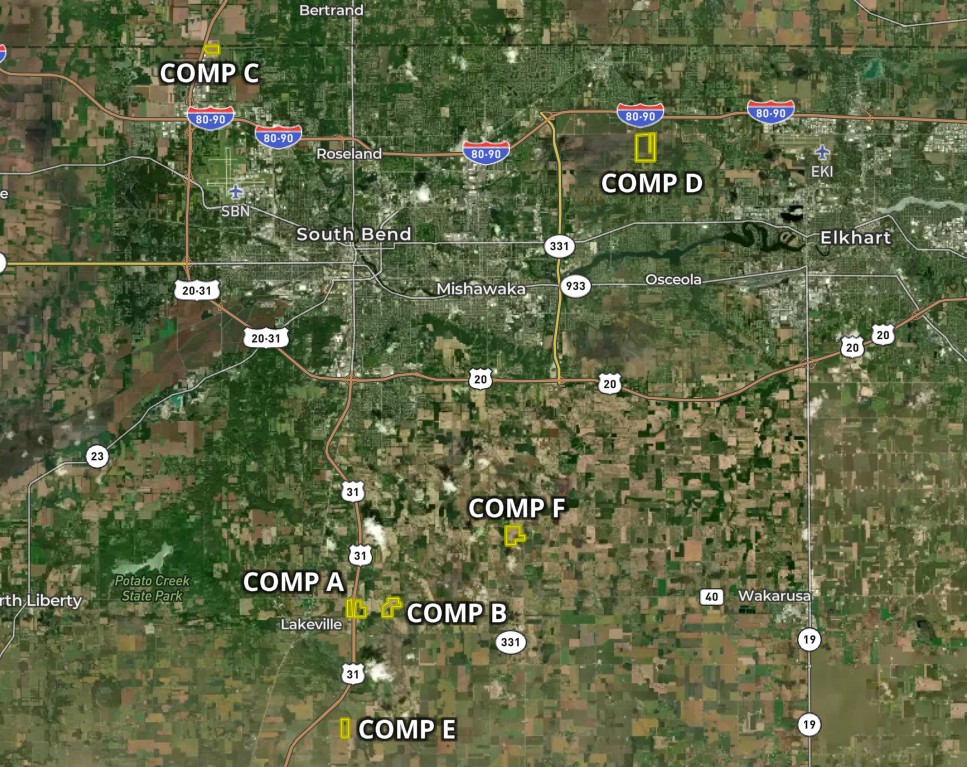
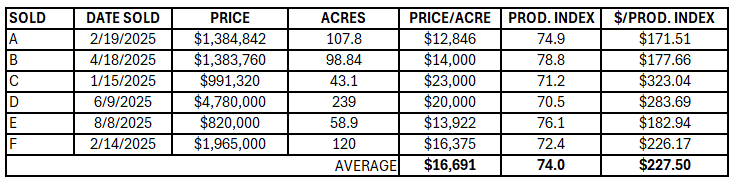
$16,691/acre
Jan. – Dec. 2025*
As high as $23,000/acre
in 2025*
Land Market Commentary & Local Trends
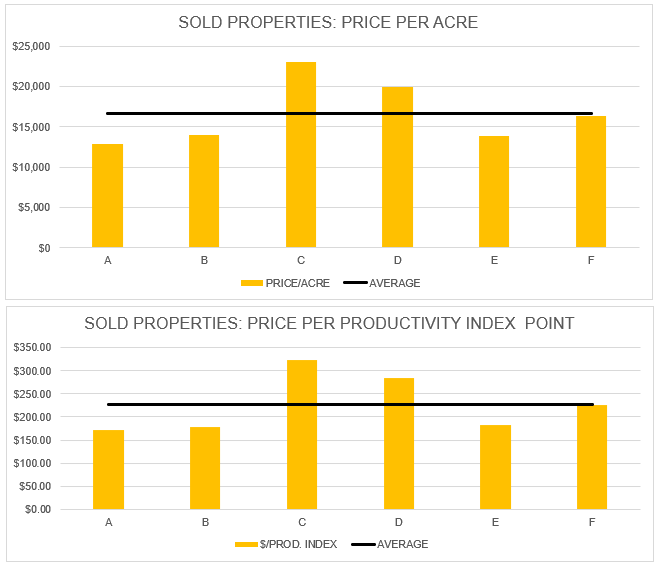
St. Joseph County landowners saw continued strength in the farmland market during 2025, as sales averaged $16,691 per acre and $227.50 per productivity index point. The best-performing properties commanded even greater attention, with sales reaching $23,000 per acre.
Since 1977, the Geswein Farm & Land Team has been advising landowners to be stewards of the land and make decisions based on most current, accurate, and relevant data. The information in this report can provide you with a rough estimate of your property’s value; however, understanding the specific characteristics of your property and how they compare to the other sales will provide the most accurate value of your property. Additionally, properties sold by land brokers via auctions or listings consistently outperformed individual to individual transactions and properties sold by traditional home realtors.
By The Numbers
A Competitive Farmland Market Influenced by Agriculture and Regional Growth
St. Joseph County’s farmland market continues to reflect the unique balance between a strong agricultural foundation and the influence of one of northern Indiana’s largest population centers. While farming remains an important part of the county’s identity, the presence of South Bend, Mishawaka, and surrounding communities creates additional factors that influence rural land demand.
Throughout 2025, farmland buyers continued to prioritize properties that offered strong agricultural fundamentals, including productive soils, efficient field layouts, and long-term operational value. However, the county’s location also contributed to increased interest in certain rural properties where accessibility, road frontage, and future flexibility added another layer of appeal.
As 2026 progresses, St. Joseph County’s farmland market has continued to show a more selective environment. Buyers remain active, but they are carefully evaluating how each property fits within their agricultural goals, investment plans, and long-term expectations.
History & Background of St. Joseph County, Indiana
County Seat: South Bend
Townships: Centre / Clay / German / Greene / Harris / Liberty / Lincoln / Madison / Olive / Penn / Portage / Union / Warren
History: Founded in 1830, named for the St. Joseph River
Population: 272,912
Cities & Towns: Indian Village / Lakeville / Mishawaka / New Carlisle / North Liberty / Osceola / Roseland / South Bend / Walkerton
Acreage: 295,040
Agriculture Remains a Foundation of St. Joseph County
Agriculture continues to play an important role throughout St. Joseph County, with corn and soybean production representing a significant portion of the county’s farmland landscape. The area also supports livestock operations, specialty agricultural uses, and generations of family-owned farms that contribute to the county’s rural character.
The county’s agricultural strength is supported by productive soils, established farming operations, and access to regional markets. Farmers benefit from proximity to transportation networks and nearby population centers, which provide connections to agricultural services, suppliers, and end markets.
This combination of productivity and accessibility has helped maintain consistent interest in quality farmland throughout the county.
Quality Ground Continues to Separate Itself
One of the strongest themes in St. Joseph County’s farmland market has been the increasing difference between highly desirable farms and average-quality properties.
The most competitive properties are typically those with strong soil productivity, good drainage, manageable field layouts, and the ability to support efficient farming practices. These farms appeal to operators looking to expand and improve their long-term production capacity.
In contrast, properties with challenges such as irregular acreage, drainage concerns, development influences, or limited access may require a more targeted buyer pool. While these properties can still attract interest, buyers are increasingly considering how improvements, costs, and future returns factor into the purchase decision.
The result is a market where farmland characteristics matter more than ever.
According to the USDA National Agricultural Statistics Service (NASS), the following crop statistics have been reported for St. Joseph County, Indiana.
The 2022 Ag Census for St. Joseph County, Indiana, reported the following crop statistics:
Number of farms: 547
Land in farms (acres): 153,034
Average farm size (acres): 280
Total market value of products sold: $162,244,000
Government payments: $824,000
Farm-related income: $4,147,000
Total farm production expenses: $121,990,000
Net cash farm income: $45,225,000
The Impact of Location and Regional Growth
Unlike more rural agricultural counties, St. Joseph County benefits from its connection to a growing regional economy. The influence of South Bend and Mishawaka creates additional demand for certain rural properties, particularly those near transportation routes, expanding communities, or areas experiencing changing land-use patterns.
While agriculture remains the primary driver for most farmland transactions, some properties carry additional appeal because of their location and future possibilities. This can create added competition among buyers and contribute to differences in value between otherwise similar parcels.
For landowners, understanding the relationship between agricultural productivity and surrounding land uses is increasingly important. A property’s value may be influenced not only by what it produces today, but also by how it fits into the county’s broader growth pattern.
Stewardship and Efficiency Remain Key Buyer Priorities
As farmland buyers continue to approach purchases carefully, well-managed farms remain the properties that attract the strongest attention.
Drainage improvements, conservation practices, maintained access, and efficient field configurations all contribute to a farm’s long-term appeal. In a market where operating costs and profitability remain major considerations, buyers recognize the advantage of acquiring land that can perform immediately.
Many of St. Joseph County’s most desirable farms reflect years of thoughtful ownership and management. These properties demonstrate that farmland value is built not only through natural productivity, but also through continued investment and stewardship.
What We’ve Seen So Far in 2026
The first half of 2026 has continued to reinforce the market shift toward careful, property-specific decision-making.
Demand remains strongest for farms that combine productivity with practical advantages. High-quality agricultural tracts continue to attract attention from local operators and long-term buyers, while properties with additional challenges are receiving more detailed evaluation.
One factor supporting the market has been limited availability of desirable farmland. When well-maintained farms become available, buyers understand that opportunities to acquire quality acreage can be limited. This has helped maintain competition among buyers despite continued uncertainty surrounding interest rates and agricultural profitability.
At the same time, the county’s location continues to influence rural land demand. Properties with strong access, favorable locations, or potential future flexibility may attract interest from a broader range of buyers than traditional agricultural purchasers alone.
Overall, 2026 has reflected a stable but selective farmland market where quality, location, and long-term usefulness remain the primary drivers.
Looking Ahead: What Could Shape the Rest of 2026
Moving through the remainder of 2026, several factors will likely continue shaping St. Joseph County’s farmland market.
Farm profitability and financing conditions will remain important considerations for agricultural buyers. However, the limited supply of high-quality farmland is expected to continue supporting demand for properties that offer strong production potential.
Landowners should also pay attention to how regional growth affects rural property interest. While not every farm will experience development pressure, properties located near expanding communities or major transportation routes may continue to attract attention from buyers with different goals.
Ultimately, farms that provide flexibility will likely remain the most desirable. Properties that combine strong agricultural performance with accessibility and long-term potential should continue to stand out in the marketplace.
Local Pulse: What’s Happening in St. Joseph County?
Continued Growth Around South Bend and Mishawaka
Regional growth continues to influence St. Joseph County’s economy and land-use patterns. Expansion in residential, commercial, and infrastructure projects around South Bend and Mishawaka creates additional demand considerations for nearby rural properties.
Agricultural Land Remains an Important Resource
Despite surrounding growth, agriculture continues to play a significant role in the county’s identity. Maintaining productive farmland remains an important consideration as the county balances economic development with preservation of its agricultural landscape.
Transportation and Access Support Economic Activity
St. Joseph County’s transportation network provides important connections for both agriculture and industry. Access to major routes helps support farming operations, businesses, and overall economic activity throughout the region.
Final Thoughts
St. Joseph County’s farmland market is shaped by the intersection of agriculture, location, and regional growth. While productive farmland remains the foundation of value, the county’s connection to a larger metropolitan area creates additional influences that make each property unique.
The first half of 2026 has shown a market that continues to reward quality. Buyers remain interested in well-managed farms with strong production characteristics, but they are also carefully considering access, location, and long-term potential.
As the year continues, St. Joseph County’s most desirable farmland will likely remain properties that combine agricultural strength with the advantages of being located in one of northern Indiana’s most connected regions.
Sources / Citations:
Source 1:
“United States Department of Agriculture.” USDA, www.nass.usda.gov/Statistics_by_State/Indiana/Publications/County_Estimates/index.php#:~:text=Access%20Quick%20Stats%20Lite,to%20NASS%20Surveys%20and%20Programs. Accessed 10 July 2026.
Source 2:
“USDA.” 2022 Census of Agriculture County Profile, www.nass.usda.gov/Publications/AgCensus/2022/Online_Resources/County_Profiles/Indiana/cp18141.pdf. Accessed 10 July 2026.
*The transaction and land sales data/information contained in this report was obtained from publicly available sources and sales disclosures deemed accurate and reliable but not guaranteed, no liability for accuracy, errors or omissions is assumed by Geswein Farm & Land Realty, LLC
Thinking About Selling?
Need Advice?
Get the guidance, service, and professional expertise you deserve.
- Family Farm Advisory for Succession Planning
- Undivided Interests & Tenants in Common
- Farmland Management Decisions
- Auctions & Listing
With our full-time experienced team, you’ll get our ‘boots on the ground’ work ethic paired with the latest in digital technology & national marketing reach – for best-in-class service and results.
Because you deserve more value.
Contact Us