


Elkhart County, Indiana
2026 Land Sales Report
Elkhart County’s farmland market stayed strong in 2025, with top-quality farms continuing to generate competitive interest. As 2026 begins, the market appears to be finding a more sustainable pace while maintaining the strong values built over recent years.
If you’d like to get specific land values on your own property or a farm near you for 2026, please contact Jacob Hogan today at (765) 366-6328.
Average Price of Land*
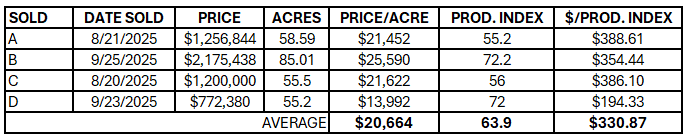
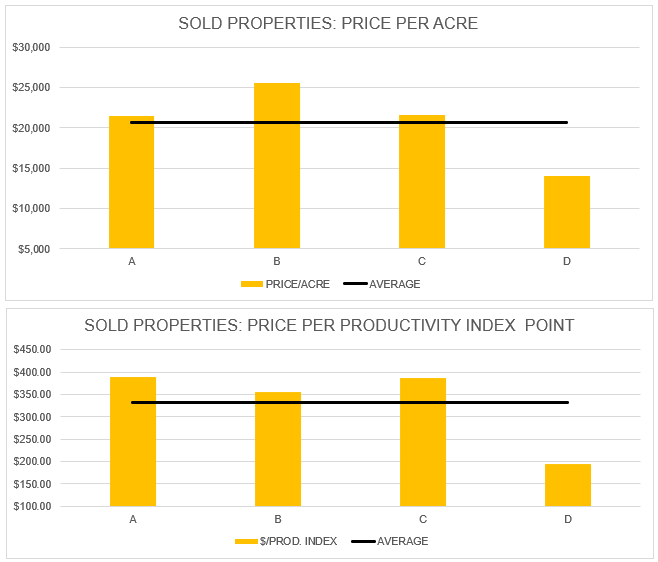
$20,664/acre
Jan. – Dec. 2025*
As high as $25,590/acre
in 2025*
Land Market Commentary & Local Trends
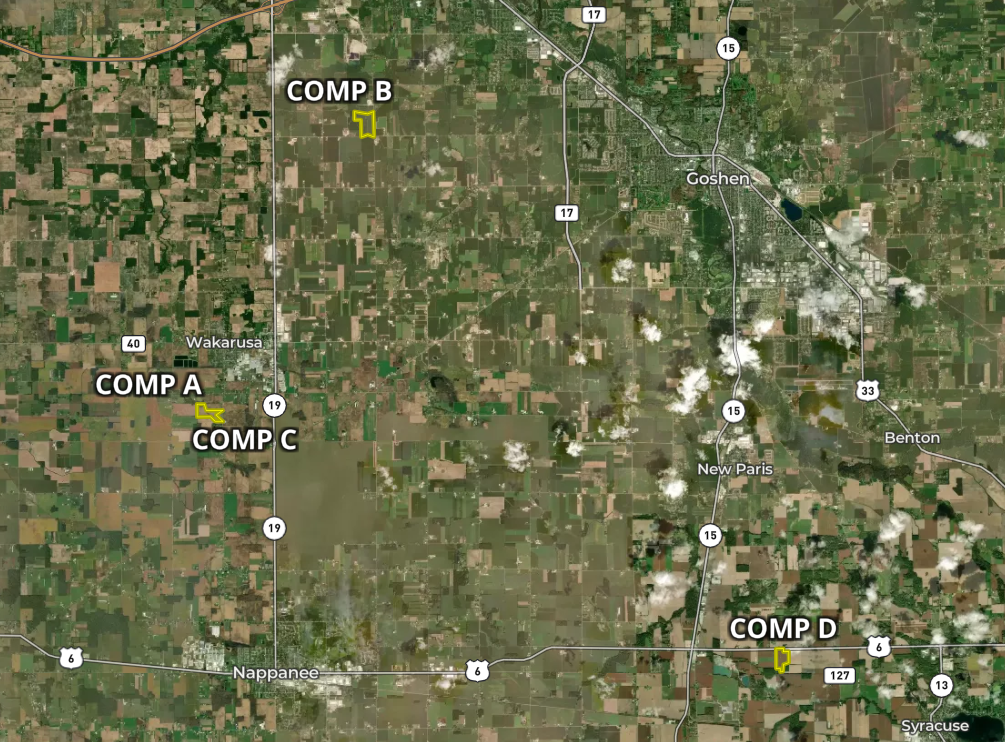
The 2025 Elkhart County farmland market told a story of strong demand and premium values. Average sales reached $20,664 per acre and $330.87 per productivity index point, with standout farms pushing values as high as $25,590 per acre.
Since 1977, the Geswein Farm & Land Team has been advising landowners to be stewards of the land and make decisions based on most current, accurate, and relevant data. The information in this report can provide you with a rough estimate of your property’s value; however, understanding the specific characteristics of your property and how they compare to the other sales will provide the most accurate value of your property. Additionally, properties sold by land brokers via auctions or listings consistently outperformed individual to individual transactions and properties sold by traditional home realtors.
By The Numbers
A Premium Farmland Market Shaped by Agriculture, Industry, and Location
Elkhart County represents one of northern Indiana’s most unique farmland markets. While agriculture remains a vital part of the county’s identity, the local land market is also influenced by a strong manufacturing base, growing communities, and access to major transportation networks.
Throughout 2025, farmland demand remained focused on properties that provided strong agricultural fundamentals. Buyers continued to place significant value on productive soils, efficient field layouts, and farms capable of supporting modern agricultural operations. However, Elkhart County’s broader economic strength also created additional layers of demand for certain rural properties.
As the market moved into 2026, buyers continued to approach farmland purchases carefully. Quality remained the primary driver, with the strongest interest centered around farms that combined productivity, accessibility, and long-term potential.
History & Background of Elkhart County, Indiana
County Seat: Goshen
Townships: Baugo / Benton / Cleveland / Clinton / Concord / Elkhart / Harrison / Jackson / Jefferson / Locke / Middlebury / Olive / Osolo / Union / Washington / York
History: Established in 1830, the name “Elkhart” is believed to be derived from a Shawnee Indiana chief.
Population: 207,047
Cities & Towns: Bristol / Elkhart / Goshen / Middlebury / Millersburg / Nappanee / Wakarusa
Acreage: 299,909
Agriculture Remains a Cornerstone of Elkhart County
Despite its well-known manufacturing presence, Elkhart County continues to have a strong agricultural foundation. Corn and soybean production remain important components of the local farming landscape, supported by established farm families, agricultural businesses, and generations of land stewardship.
The county’s agricultural operations benefit from productive soils, favorable access to markets, and proximity to a strong network of agricultural services. Local producers continue to invest in their farms, and neighboring operators remain some of the most important buyers when quality farmland becomes available.
This combination of productive ground and experienced operators continues to support a resilient farmland market.
Why Quality Farmland Continues to Command Attention
One of the clearest trends throughout 2025 was the continued separation between highly desirable farmland and average-quality properties.
The most competitive farms were those offering strong productivity, good drainage, accessible field entrances, and layouts that allowed operators to maximize efficiency. In an environment where input costs and profitability remain closely monitored, buyers have increasingly focused on properties that can provide dependable long-term performance.
Lower-quality or more challenging tracts have continued to attract interest, but buyers are approaching these properties with more detailed evaluations. Factors such as field shape, drainage needs, access, and potential improvement costs are playing a larger role in purchase decisions.
The result is a market where the characteristics of the individual farm matter more than ever.
When Agriculture Meets Regional Growth
Elkhart County’s farmland market is unique because agriculture exists alongside significant economic and population growth.
Communities such as Elkhart, Goshen, and Middlebury have experienced continued economic activity supported by manufacturing, healthcare, and small business growth. The county’s nationally recognized recreational vehicle industry has also played an important role in shaping the local economy.
For farmland owners, this creates additional considerations. While agricultural productivity remains the primary factor behind most farmland transactions, certain properties may receive additional attention because of location, road frontage, proximity to communities, or future flexibility.
This does not change the importance of farming – it simply adds another layer to how rural properties are evaluated.
According to the USDA National Agricultural Statistics Service (NASS), the following crop statistics have been reported for Elkhart County, Indiana.
The 2022 Ag Census for Elkhart County, Indiana, reported the following crop statistics:
Number of farms: 1,809
Land in farms (acres): 195,094
Average farm size (acres): 108
Total market value of products sold: $497,787,000
Government payments: $810,000
Farm-related income: $11,865,000
Total farm production expenses: $332,752,000
Net cash farm income: $177,710,000
Stewardship Continues to Influence Long-Term Value
Well-managed farmland continues to stand out in Elkhart County’s market.
Buyers recognize the value of farms that have benefited from years of thoughtful ownership, including drainage improvements, conservation practices, soil management, and consistent maintenance. These factors contribute to both current productivity and future performance.
As buyers become more selective, properties that are ready to operate with minimal additional investment often have a competitive advantage.
In many ways, farmland value reflects both the natural characteristics of the soil and the decisions made by previous generations of landowners.
The First Half of 2026: A More Selective Market Emerges
The first half of 2026 has continued to show a farmland market that is stable but increasingly focused on quality.
Buyers remain interested in acquiring farmland, but purchasing decisions are being made with greater consideration of long-term returns. Premium farms with strong production capabilities continue to attract the most attention, especially when they become available in areas with limited inventory.
Local operators remain an important source of demand, while investors continue to recognize farmland as a long-term asset. However, buyers are taking more time to evaluate opportunities and are placing greater emphasis on how each property fits within their goals.
Elkhart County’s diverse economy has also provided additional stability. The strength of local manufacturing and employment opportunities continues to support confidence in the broader land market.
What Could Influence Elkhart County Farmland Through the Rest of 2026?
As the remainder of 2026 unfolds, several factors will continue shaping the county’s farmland market.
Available Inventory – will remain a major factor.
High-quality farms are limited, and desirable properties often receive strong attention when they enter the market.
Agricultural Profitability – will continue influencing local operators as they evaluate expansion opportunities.
Commodity prices, operating expenses, and borrowing costs will all play a role in determining purchasing decisions.
Regional Growth Patterns – will also remain important.
As communities continue to expand, certain rural properties may experience additional interest based on location and future possibilities.
For landowners, the strongest opportunities will likely remain with farms that combine excellent agricultural characteristics with strong access and long-term flexibility.
Local Pulse: What’s Happening in Elkhart County?
Manufacturing Continues to Shape the Local Economy
Elkhart County remains one of Indiana’s strongest manufacturing regions, with the recreational vehicle industry continuing to play an important role. The strength of local employers contributes to economic stability and supports demand throughout the county.
Communities Continue to Grow While Maintaining Rural Character
Growth around Elkhart, Goshen, and Middlebury continues to influence the county’s landscape. While agriculture remains a major land use, rural properties near growing communities may experience additional interest due to location and accessibility.
Agriculture and Industry Continue to Work Together
Elkhart County’s economy is strengthened by the relationship between agriculture and manufacturing. Farming operations benefit from access to services, infrastructure, and employment centers, while agriculture continues to preserve the rural character that defines much of the county.
Final Thoughts
Elkhart County’s farmland market is shaped by more than agricultural production alone. The county’s combination of productive soils, strong farming traditions, manufacturing strength, and regional growth creates a market unlike many others in northern Indiana.
Through the first half of 2026, farmland demand has remained focused on quality. Buyers continue to recognize the value of productive, well-managed farms, while also considering location and long-term potential.
As the year continues, Elkhart County’s most desirable farmland will likely remain properties that offer the best combination of agricultural performance, accessibility, and flexibility – qualities that continue to support the county’s long-term land value.
Sources / Citations:
Source 1:
“United States Department of Agriculture.” USDA, www.nass.usda.gov/Statistics_by_State/Indiana/Publications/County_Estimates/index.php#:~:text=Access%20Quick%20Stats%20Lite,to%20NASS%20Surveys%20and%20Programs. Accessed 10 July 2026.
Source 2:
“USDA.” 2022 Census of Agriculture County Profile, www.nass.usda.gov/Publications/AgCensus/2022/Online_Resources/County_Profiles/Indiana/cp18039.pdf. Accessed 10 July 2026.
*The transaction and land sales data/information contained in this report was obtained from publicly available sources and sales disclosures deemed accurate and reliable but not guaranteed, no liability for accuracy, errors or omissions is assumed by Geswein Farm & Land Realty, LLC
Thinking About Selling?
Need Advice?
Get the guidance, service, and professional expertise you deserve.
- Family Farm Advisory for Succession Planning
- Undivided Interests & Tenants in Common
- Farmland Management Decisions
- Auctions & Listing
With our full-time experienced team, you’ll get our ‘boots on the ground’ work ethic paired with the latest in digital technology & national marketing reach – for best-in-class service and results.
Because you deserve more value.
Contact Us