


Fulton County, Indiana
2026 Land Sales Report
Fulton County’s farmland market reflected the continued appeal of agricultural land in 2025, even as the rapid price increases of previous years began to moderate. Throughout 2026, soil productivity, drainage, and overall property condition remain important considerations for buyers.
If you’d like to get specific land values on your own property or a farm near you for 2026, please contact Craig Stevenson today at (574) 870-4383.
Average Price of Land*
$10,923/acre
Jan. – Dec. 2025*
As high as $14,711/acre
in 2025*
Land Market Commentary & Local Trends
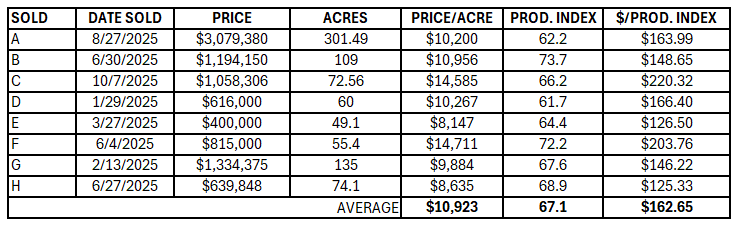
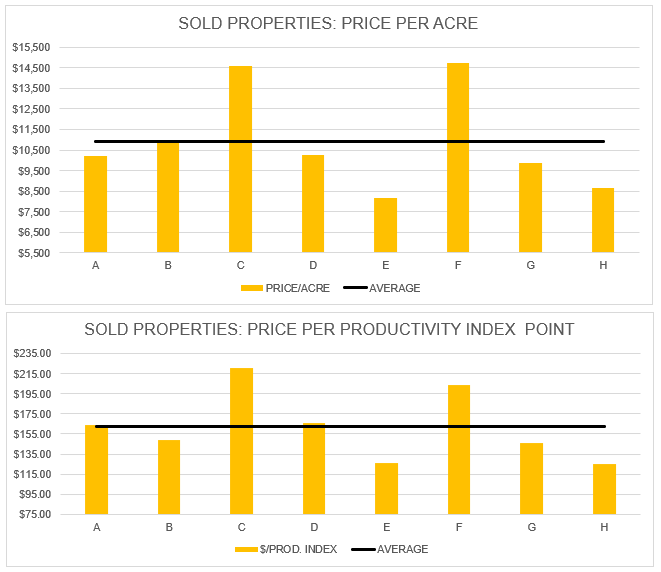
A look at Fulton County’s 2025 farmland market shows that productive acreage continued to carry considerable value, with average sales reaching $10,923/acre and $162.65 per productivity index point. Standout properties commanded even more, with sales topping out at $14,711 per acre.
Since 1977, the Geswein Farm & Land Team has been advising landowners to be stewards of the land and make decisions based on most current, accurate, and relevant data. The information in this report can provide you with a rough estimate of your property’s value; however, understanding the specific characteristics of your property and how they compare to the other sales will provide the most accurate value of your property. Additionally, properties sold by land brokers via auctions or listings consistently outperformed individual to individual transactions and properties sold by traditional home realtors.
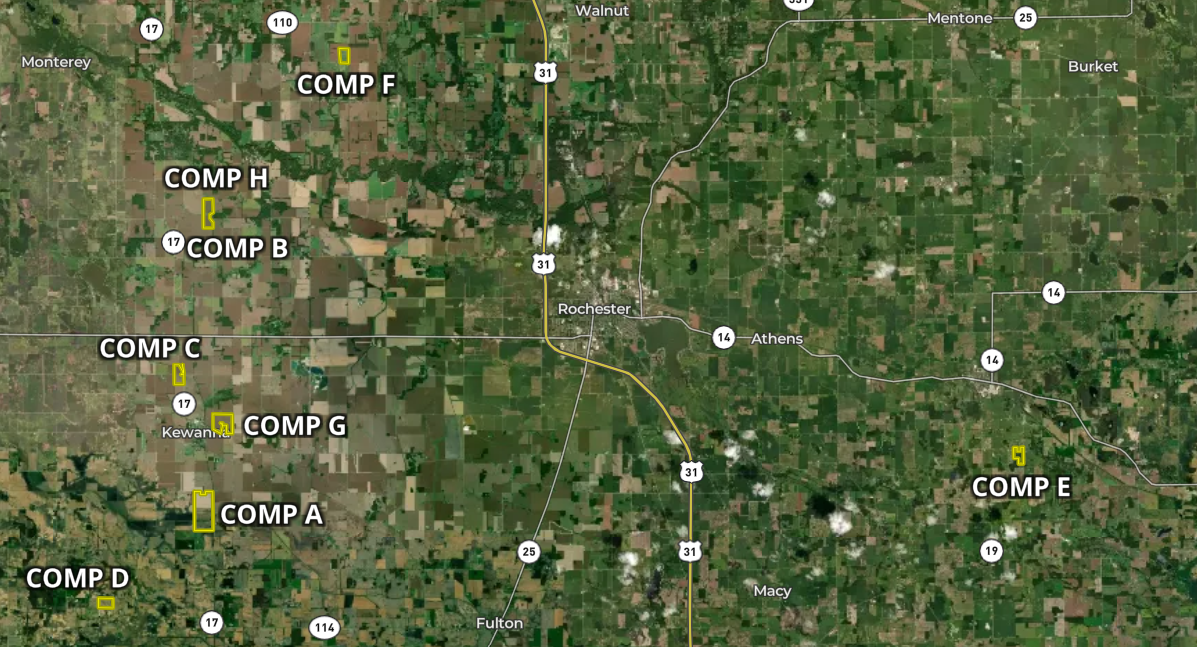
By The Numbers
A County Where Agriculture and Natural Beauty Come Together
Fulton County offers a farmland market shaped by productive agricultural ground, established farming communities, and a landscape that changes considerably from one part of the county to another.
Located in north-central Indiana, Fulton County is home to expansive row-crop farms, wooded acreage, the Tippecanoe River, and several recreational lakes. These features create a rural land market where agricultural productivity remains important, but location, topography, and property characteristics can influence buyer interest.
Throughout 2025, the farmland market demonstrated the continued appeal of quality agricultural ground, while differences in soil productivity and overall farmability helped distinguish individual properties.
As 2026 has progressed, Fulton County has also found itself at the center of discussions surrounding farmland preservation, future development, and the importance of protecting its agricultural identity.
Agriculture Remains Fulton County’s Foundation
Farming continues to be a defining part of Fulton County’s economy and rural landscape.
Corn and soybeans are prominent throughout the county, with wheat, hay, livestock, and other agricultural activities contributing to local farming operations. Communities such as Rochester, Akron, Kewanna, and Fulton are surrounded by farmland that supports both established producers and multigenerational agricultural families.
For local farmers, additional acreage can create opportunities to expand an operation, improve field efficiency, or consolidate land closer to existing farms.
This makes neighboring producers an important part of the farmland buyer pool, particularly when productive acreage becomes available near an established operation.
While larger economic developments may occasionally attract attention, agriculture remains central to how much of Fulton County’s rural land is used and valued.
History & Background of Fulton County, Indiana
County Seat: Rochester
Townships: Aubbeenaubbee / Henry / Liberty / Newcastle / Richland / Rochester / Union / Wayne
History: Founded in 1836, named after Robert Fulton – the inventor of the steamboat
Population: 20,480
Cities & Towns: Akron / Fulton / Kewanna / Rochester
Acreage: 237,440
Not All Fulton County Farmland Looks the Same
One of Fulton County’s most interesting characteristics is the diversity of its agricultural landscape.
The southwestern portion of the county, particularly around Grass Creek and west of Rochester, contains extensive areas of productive, relatively level farmland. These areas are well suited to larger agricultural operations and efficient row-crop production.
Farther north, the landscape changes. Areas surrounding the Tippecanoe River include more wooded acreage, rolling terrain, and varying soil characteristics. Other portions of the county contain sandier soils, lakes, and recreational properties.
These differences can significantly influence how agricultural buyers evaluate a farm.
Properties offering large, contiguous tillable fields, productive soils, and good drainage may appeal strongly to established farmers. Ground containing wooded areas, irregular field configurations, or limited tillable acreage may attract a different group of buyers.
In Fulton County, understanding the land’s individual characteristics is essential to understanding its market appeal.
According to the USDA National Agricultural Statistics Service (NASS), the following crop statistics have been reported for Fulton County, Indiana.
The 2022 Ag Census for Fulton County, Indiana, reported the following crop statistics:
Number of farms: 636
Land in farms (acres): 181,860
Average farm size (acres): 286
Total market value of products sold: $195,306,000
Government payments: $1,223,000
Farm-related income: $5,995,000
Total farm production expenses: $139,110,000
Net cash farm income: $63,414,000
What We’ve Experienced in 2026 So Far
As 2026 has progressed, farmland buyers have continued navigating a market influenced by agricultural profitability, operating expenses, commodity prices, and financing considerations.
For Fulton County, these conditions reinforce the importance of productive and efficiently managed farmland.
Buyers have reason to pay close attention to soil quality, drainage, field layout, access, and the amount of tillable acreage. Properties that can be incorporated easily into an existing operation may offer additional advantages to neighboring producers.
At the same time, the broader agricultural economy has encouraged a more thoughtful approach to land purchases. Rather than assuming every farm will generate similar interest, buyers must consider how a property’s characteristics support its long-term earning potential.
The result is a market where quality, location, and operational fit remain especially important considerations.
A Major 2026 Conversation: Protecting Farmland from Development
One of Fulton County’s most notable developments during 2026 has involved proposed data center construction near Akron.
Early in the year, the possibility of a large-scale data center prompted considerable community discussion about agricultural land, infrastructure, water resources, and the future of rural development.
In February, the Fulton County Area Plan Commission voted in favor of a 12-month moratorium on data center development. County officials subsequently approved a one-year pause intended to allow additional time to evaluate potential impacts and land-use regulations.
The issue also prompted educational outreach. In March, Fulton County Farm Bureau hosted a workshop at the Fulton County Fairgrounds in Rochester, bringing together agricultural representatives and industry experts to discuss data centers, zoning, and their potential effects on rural communities.
For farmland owners, these discussions are particularly relevant because they demonstrate how agricultural property can become part of broader economic development conversations.
While traditional farming remains the primary use for much of Fulton County’s acreage, decisions involving large-scale development could influence the future of certain rural properties.
The Tippecanoe River and Lake Country Add Another Dimension
Fulton County’s farmland market is also influenced by its natural surroundings.
The Tippecanoe River travels through the county, while Lake Manitou near Rochester and other lakes throughout the area contribute to the county’s recreational identity.
These resources create opportunities for fishing, boating, wildlife habitat, and rural recreation. They also contribute to differences in land characteristics and potential uses.
For agricultural buyers, drainage, soil conditions, floodplain considerations, and the percentage of usable cropland remain important. For recreational buyers, wooded acreage, water features, and wildlife opportunities may add to a property’s appeal.
This variety makes Fulton County a place where agricultural and recreational land markets can overlap without necessarily attracting the same buyers.
Fulton County’s Local Pulse
Farmland Preservation Has Taken Center Stage
The 2026 discussions surrounding proposed data center development near Akron have brought agricultural zoning, landowner interests, and rural preservation into the spotlight. The issue highlights the importance of thoughtful land-use planning as new development opportunities emerge.
Agricultural Education Remains a Community Priority
Fulton County Farm Bureau and Rochester High School FFA partnered during the 2026 Fulton County 4-H Fair to introduce younger generations to agriculture. Efforts like these help maintain the county’s connection to farming and promote awareness of its importance to the local economy.
Lake Manitou and the Tippecanoe River Add Rural Appeal
Fulton County’s waterways and recreational areas distinguish it from counties dominated almost entirely by row-crop farmland. These natural features contribute to a diverse rural land market.
Productive Farmland Continues to Be a Long-Term Asset
For established agricultural producers, efficiently managed farmland remains an important part of business planning. Properties with strong productivity, convenient access, and opportunities for expansion can be especially appealing.
What Could Shape the Rest of 2026?
As 2026 moves toward its conclusion, Fulton County’s farmland market will likely remain centered on agricultural productivity, property condition, and long-term land stewardship.
Local producers will continue evaluating opportunities to strengthen their existing operations, while buyers are likely to remain attentive to soil quality, drainage, accessibility, and field efficiency.
Meanwhile, ongoing discussions about land-use regulations and future development will remain important for landowners, particularly in areas where agricultural preservation and alternative land uses intersect.
Looking Ahead
Fulton County’s farmland market is shaped by more than productive soils alone.
Its established agricultural communities, varied terrain, recreational lakes, and Tippecanoe River landscape all contribute to the county’s unique rural identity. The land-use discussions of 2026 have added another important dimension by bringing greater attention to the future of agricultural acreage.
For Fulton County landowners, understanding a property’s productivity, condition, location, and potential buyer pool remains essential.
As the county continues balancing agricultural traditions with future opportunities, well-managed farmland will remain an important part of Fulton County’s economic and rural foundation.
Sources / Citations:
Source 1:
“United States Department of Agriculture.” USDA, www.nass.usda.gov/Statistics_by_State/Indiana/Publications/County_Estimates/index.php#:~:text=Access%20Quick%20Stats%20Lite,to%20NASS%20Surveys%20and%20Programs. Accessed 5 October 2026.
Source 2:
“USDA.” 2022 Census of Agriculture County Profile, www.nass.usda.gov/Publications/AgCensus/2022/Online_Resources/County_Profiles/Indiana/cp18049.pdf. Accessed 5 October 2026.
*The transaction and land sales data/information contained in this report was obtained from publicly available sources and sales disclosures deemed accurate and reliable but not guaranteed, no liability for accuracy, errors or omissions is assumed by Geswein Farm & Land Realty, LLC
Thinking About Selling?
Need Advice?
Get the guidance, service, and professional expertise you deserve.
- Family Farm Advisory for Succession Planning
- Undivided Interests & Tenants in Common
- Farmland Management Decisions
- Auctions & Listing
With our full-time experienced team, you’ll get our ‘boots on the ground’ work ethic paired with the latest in digital technology & national marketing reach – for best-in-class service and results.
Because you deserve more value.
Contact Us