


Lake County, Indiana
2026 Land Sales Report
Lake County farmland remained a valuable and sought-after asset in 2025, with location and property quality continuing to influence buyer interest. As 2026 unfolds, the market appears steady, with desirable tracts continuing to hold their appeal.
If you’d like to get specific land values on your own property or a farm near you for 2026, please contact Craig Stevenson today at (574) 870-4383.
Average Price of Land*
$10,968/acre
Jan. – Dec. 2025*
As high as $13,215/acre
in 2025*
Land Market Commentary & Local Trends
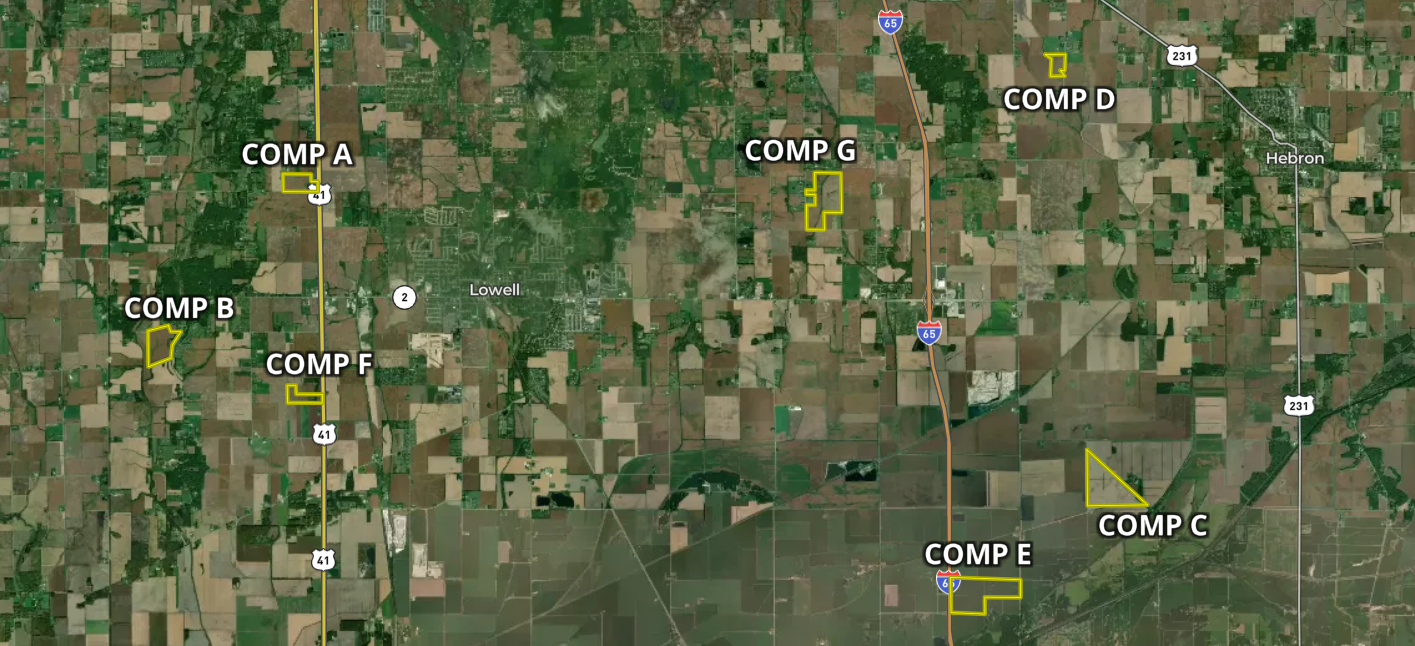
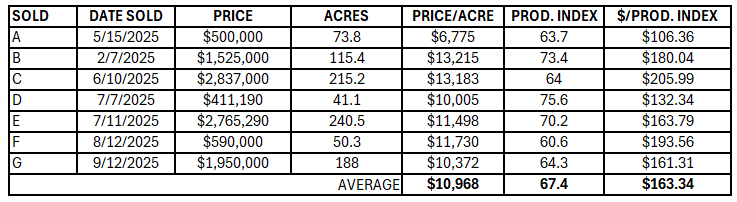
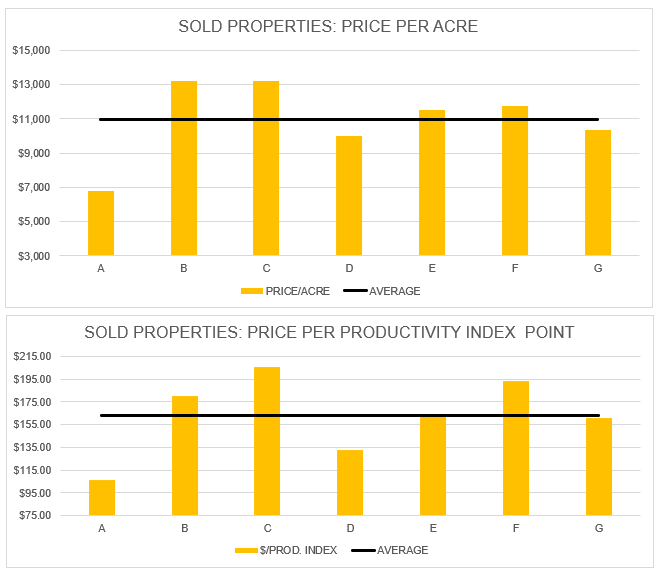
In Lake County, 2025 farmland sales averaged $10,968/acre, with an average of $163.34 per productivity index point. The upper end of the market showed even more strength, with farmland sales reaching $13,215 per acre.
Since 1977, the Geswein Farm & Land Team has been advising landowners to be stewards of the land and make decisions based on most current, accurate, and relevant data. The information in this report can provide you with a rough estimate of your property’s value; however, understanding the specific characteristics of your property and how they compare to the other sales will provide the most accurate value of your property. Additionally, properties sold by land brokers via auctions or listings consistently outperformed individual to individual transactions and properties sold by traditional home realtors.
By The Numbers
Where Agriculture Meets Northwest Indiana’s Changing Landscape
Lake County presents one of the more unique farmland markets in Indiana. The northern portion of the county is heavily urbanized and connected to the Chicago metropolitan area, while the southern portion retains a much more rural landscape filled with farms, open acreage, and agricultural communities.
That contrast is important when looking at farmland values. A productive farm in southern Lake County is competing for attention in a market where agricultural use remains important, but where development, infrastructure, and alternative land uses can also influence how certain properties are viewed.
Throughout 2025, buyers continued to recognize the value of quality agricultural ground. The first half of 2026 has added another layer to that story as Lake County continues working through questions surrounding development and the preservation of agricultural land.
Agriculture Still Has a Strong Presence in Southern Lake County
While Lake County is often associated with its industrial and urban communities, agriculture remains an important part of the county’s southern landscape.
Corn and soybeans make up much of the county’s row-crop production, with livestock and other agricultural operations adding diversity. The rural areas surrounding communities such as Lowell, Crown Point, Cedar Lake, Hebron, and St. John contain some of the county’s remaining agricultural acreage.
For local producers, available farmland can provide an opportunity to expand an existing operation or bring additional acreage into a more efficient farming system.
This makes neighboring farmers an important source of demand when quality agricultural properties become available.
According to the USDA National Agricultural Statistics Service (NASS), the following crop statistics have been reported for Lake County, Indiana.
The 2022 Ag Census for Lake County, Indiana, reported the following crop statistics:
Number of farms: 347
Land in farms (acres): 123,589
Average farm size (acres): 356
Total market value of products sold: $99,957,000
Government payments: $782,000
Farm-related income: $3,891,000
Total farm production expenses: $73,608,000
Net cash farm income: $31,022,000
Farmland and Development Share the Same Conversation
Lake County’s location creates an unusual situation for agricultural landowners. The county’s comprehensive planning materials recognize that much of the unincorporated area contains prime farmland, while also acknowledging significant development pressure from its relationship with Greater Chicago. The county’s plan specifically identifies productive agricultural land and rural character as resources worth considering as development occurs.
That tension has become particularly visible in 2026.
One example is a proposed data center in Eagle Creek Township. County planning documents describe a roughly 163-acre site currently zoned agricultural, surrounded primarily by farmland and farmsteads, with a request to change the zoning to permit a data center.
For farmland owners, developments like this demonstrate why location can matter almost as much as agricultural productivity for certain properties.
History & Background of Lake County, Indiana
County Seat: Crown Point
Townships: Calumet / Cedar Creek / Center / Eagle Creek / Hanover / Hobart / North / Ross / St. John / West Creek / Winfield
History: Formed in 1837, was named for its shoreline along Lake Michigan.
Population: 498,700
Cities & Towns: Gary / Hammond / East Chicago / Merrillville / Hobart / Lake Station / Crown Point / Whiting
Acreage: 319,000
2026 Has Put New Attention on Agricultural Land
The proposed Eagle Creek Township data center has generated discussion about what large-scale development could mean for rural portions of Lake County.
During a March 2026 Lake County Council meeting, a local resident raised concerns about a proposed data-center energy cluster and the potential impact of large industrial projects—including data centers, solar facilities, substations, and battery storage—on agricultural land.
The discussion is significant because it reflects a larger question facing the county: how can Lake County accommodate economic investment while maintaining the agricultural land and rural character that remain in its southern communities?
For farmland buyers and landowners, those questions may become increasingly important when considering the long-term potential of individual parcels.
The First Half of 2026: A More Property-Specific Market
The farmland market during the first half of 2026 has continued to favor properties with strong agricultural fundamentals.
Buyers are paying attention to productivity, drainage, accessibility, field configuration, and the condition of the acreage. In Lake County, however, the surrounding land uses can also carry additional weight.
A farm surrounded by other agricultural properties may primarily attract traditional farm buyers. Acreage closer to expanding residential, commercial, or industrial development may draw interest from a wider range of potential purchasers.
As a result, Lake County is a county where understanding the individual property and its surroundings is particularly important.
The Rural-Urban Divide Is Important to Landowners
Lake County’s agricultural market cannot be separated entirely from its development pattern.
The county’s northern communities have experienced decades of urban and industrial growth, while the southern portion continues to contain significant agricultural and open-space areas. County planning documents have specifically identified the pressure that residential and commercial development can place on prime farmland and rural communities.
That creates two very different land-use environments within the same county.
For agricultural producers, the continued availability of productive farmland is essential. For landowners, proximity to existing development and infrastructure may create additional considerations when evaluating long-term land value.
What Could Shape Lake County’s Farmland Market from Here?
Lake County’s farmland market will likely continue to be influenced by the balance between agricultural preservation and development.
Productive farms will remain important to local operators, particularly when acreage can strengthen an existing farming operation. At the same time, land-use decisions involving data centers, residential development, infrastructure, and other projects could affect how certain parcels are viewed.
For landowners, maintaining the productivity and condition of their farms remains important – but understanding what is happening around the property may be just as valuable.
Lake County Highlights
Agriculture Remains Part of Southern Lake County’s Identity
The southern portion of the county continues to support row-crop farms, livestock operations, and rural communities despite the extensive development found elsewhere in Lake County.
Data Centers Are a New Land-Use Discussion
The proposed Eagle Creek Township data center has brought agricultural land, infrastructure, energy demand, and development policy into the county’s 2026 conversation.
Location Can Make a Difference
Lake County’s proximity to Greater Chicago and established transportation networks means some farmland may have considerations beyond its agricultural productivity.
County Planning Continues to Address Growth
Lake County’s planning framework recognizes both the economic importance of development and the need to protect productive farmland, natural resources, and rural community character.
Looking Ahead
Lake County enters the second half of 2026 with a farmland market shaped by two very different forces.
For farmers, productive acreage remains the priority. For landowners, however, the surrounding landscape is becoming increasingly important as development continues to move through portions of the county.
That makes Lake County particularly interesting to watch. Its farmland market is not simply a reflection of crop productivity – it is also a reflection of where agricultural land fits within the future of Northwest Indiana.
Sources / Citations:
Source 1:
“United States Department of Agriculture.” USDA, www.nass.usda.gov/Statistics_by_State/Indiana/Publications/County_Estimates/index.php#:~:text=Access%20Quick%20Stats%20Lite,to%20NASS%20Surveys%20and%20Programs. Accessed 5 October 2026.
Source 2:
“USDA.” 2022 Census of Agriculture County Profile, www.nass.usda.gov/Publications/AgCensus/2022/Online_Resources/County_Profiles/Indiana/cp18089.pdf. Accessed 5 October 2026.
*The transaction and land sales data/information contained in this report was obtained from publicly available sources and sales disclosures deemed accurate and reliable but not guaranteed, no liability for accuracy, errors or omissions is assumed by Geswein Farm & Land Realty, LLC
Thinking About Selling?
Need Advice?
Get the guidance, service, and professional expertise you deserve.
- Family Farm Advisory for Succession Planning
- Undivided Interests & Tenants in Common
- Farmland Management Decisions
- Auctions & Listing
With our full-time experienced team, you’ll get our ‘boots on the ground’ work ethic paired with the latest in digital technology & national marketing reach – for best-in-class service and results.
Because you deserve more value.
Contact Us