


Starke County, Indiana
2026 Land Sales Report
For Starke County landowners, 2025 showed that good farmland still has a dependable place in the market. As 2026 takes shape, buyers remain interested but are paying closer attention to the qualities that set one farm apart from another.
If you’d like to get specific land values on your own property or a farm near you for 2026, please contact Craig Stevenson today at (574) 870-4383.
Average Price of Land*
$8,225/acre
Jan. – Dec. 2025*
As high as $9,900/acre
in 2025*
Land Market Commentary & Local Trends
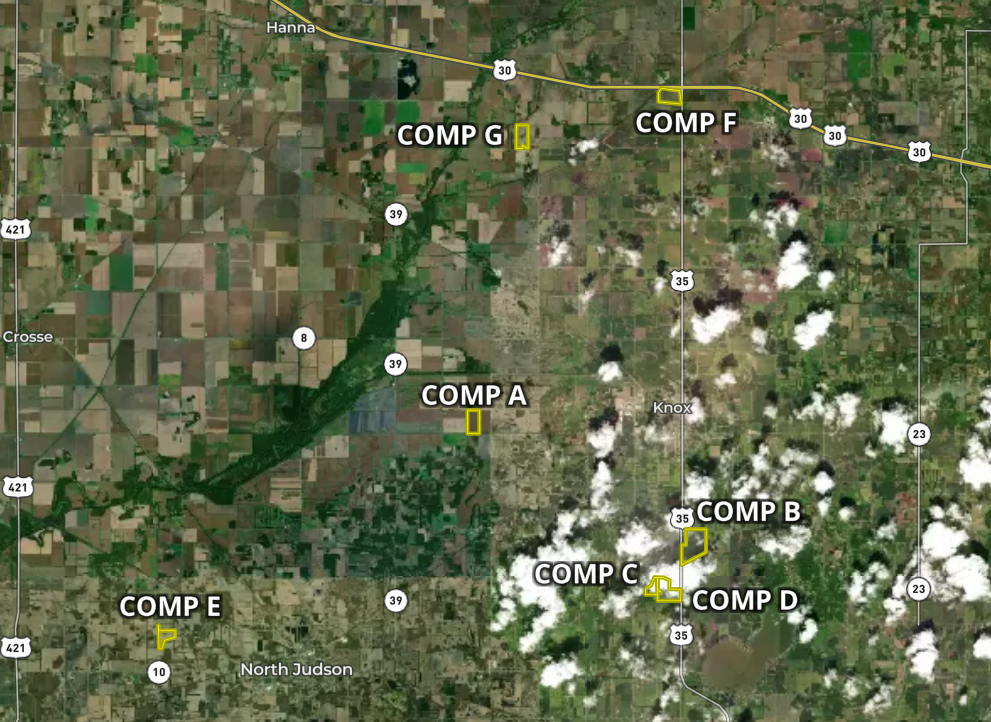
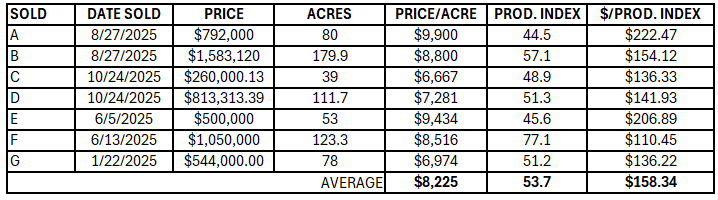
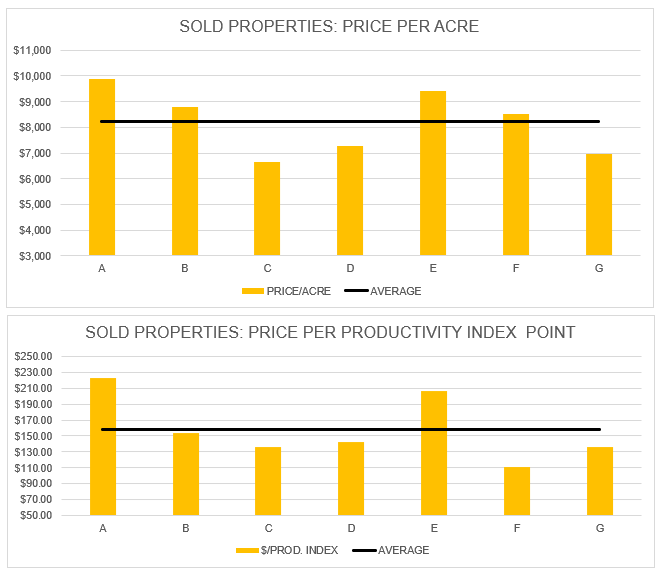
Starke County farmland remained valuable in 2025, with sampled sales averaging $8,225/acre and $158.34 per productivity index point. Higher-end properties pushed beyond the county average, with sales reaching as much as $9,900 per acre.
Since 1977, the Geswein Farm & Land Team has been advising landowners to be stewards of the land and make decisions based on most current, accurate, and relevant data. The information in this report can provide you with a rough estimate of your property’s value; however, understanding the specific characteristics of your property and how they compare to the other sales will provide the most accurate value of your property. Additionally, properties sold by land brokers via auctions or listings consistently outperformed individual to individual transactions and properties sold by traditional home realtors.
By The Numbers
A Farmland Market Built Around Practical Agriculture
Starke County’s farmland market tells a different story than many of the rapidly developing counties elsewhere in northern Indiana.
Here, agriculture remains closely tied to the county’s rural character. Farms, wooded acreage, wetlands, waterways, and small communities create a landscape where the usefulness of the land itself often carries significant weight. Buyers are not simply looking at acreage – they are considering how well a property drains, how efficiently it can be farmed, how productive the soils are, and how naturally it fits into an existing operation.
The 2025 market reflected continued demand for productive agricultural ground, while 2026 has reinforced the importance of evaluating each farm on its individual strengths.
History & Background of Starke County, Indiana
County Seat: Knox
Townships: California / Center / Davis / Jackson / North Bend / Oregon / Railroad / Washington / Wayne
History: Organized in 1850, named in honor of General John Stark
Population: 23,371
Cities & Towns: Hamlet / Knox / North Judson
Acreage: 199,000
Starke County’s Agricultural Foundation
Row-crop agriculture remains a familiar part of the Starke County landscape, with corn and soybeans occupying much of the county’s tillable ground. Livestock, hay, pasture, and smaller agricultural enterprises also contribute to the area’s farming economy.
For local producers, farmland ownership continues to represent a long-term commitment.
Additional acreage can provide opportunities to expand an operation, improve efficiencies, or add strategically located ground near land already being farmed. When acreage comes available next to or near an established operation, its location can sometimes be just as meaningful to the buyer as its individual characteristics.
That local connection helps keep neighboring farmers and established producers an important part of Starke County’s buyer pool.
According to the USDA National Agricultural Statistics Service (NASS), the following crop statistics have been reported for Starke County, Indiana.
The 2022 Ag Census for Starke County, Indiana, reported the following crop statistics:
Number of farms: 394
Land in farms (acres): 98,815
Average farm size (acres): 251
Total market value of products sold: $75,483,000
Government payments: $2,297,000
Farm-related income: $2,647,000
Total farm production expenses: $51,175,000
Net cash farm income: $29,252,000
Water Is Part of the Farmland Story
One characteristic that deserves particular attention in Starke County is water.
The county’s landscape includes the Yellow River, wetlands, low-lying areas, and an extensive agricultural drainage network. Those features make drainage an important part of evaluating farmland.
For a buyer, knowing how water moves across and away from a property can be essential. Tile drainage, regulated drains, ditch access, soil characteristics, and areas subject to excess moisture can all affect how consistently a farm performs.
Good management can make a meaningful difference. Ground that has been properly drained and maintained may offer a very different farming experience than acreage where water management remains a challenge.
The Best Farm Isn’t Always the One with the Most Acres
Starke County is a good example of why total acreage does not tell the entire story.
Buyers may place considerable emphasis on the amount of usable tillable ground, field configuration, access between fields, drainage, and whether wooded or wet areas affect farming efficiency.
A smaller tract with highly usable acreage and convenient access could fit an operation better than a larger property with fragmented fields or significant non-tillable areas.
That makes farmability an especially useful word when discussing Starke County land. Productivity is important, but buyers also want to know how efficiently they can put that productivity to work.
What We’ve Experienced in 2026 So Far
As 2026 has progressed, the farmland market has continued to reward quality while encouraging buyers to be more deliberate.
The strongest agricultural properties remain attractive, particularly when they offer productive soils, good drainage, efficient field layouts, and a location that complements an existing farming operation. At the same time, buyers are taking a closer look at the details before deciding what a property is worth to them.
That selectivity is important.
Rather than treating all agricultural acreage equally, buyers are distinguishing between farms that can be put to work efficiently and properties that may require additional improvements, drainage work, or management.
For Starke County landowners, this means the condition and usability of the farm can be an important part of its marketability.
Agriculture and Natural Land Often Sit Side by Side
Another feature that distinguishes Starke County is the relationship between agriculture and natural land.
The county includes productive cropland alongside wooded areas, wetlands, waterways, and recreational properties. Bass Lake and the Kankakee River region contribute another dimension to the area’s rural identity.
For some properties, these characteristics can create a broader buyer pool. A tract containing productive farmland along with woods, water, or wildlife habitat may appeal to someone interested in both agricultural income and recreational use.
For a traditional farm buyer, however, the key question remains how much of the property can be farmed efficiently. Understanding that distinction is important when comparing land throughout the county.
Starke County’s Local Pulse
Drainage Can Separate One Farm From Another
Water management remains an important consideration throughout the county. Farms with effective drainage and well-maintained fields may stand apart when buyers compare otherwise similar properties.
Local Operators Remain Important Buyers
Starke County’s agricultural market continues to be supported by producers looking for acreage that complements their existing operations. Proximity to land already being farmed can create additional interest in certain tracts.
Rural Character Adds Variety to the Market
Cropland, woods, wetlands, recreational acreage, and rural homesites all exist within Starke County’s landscape. That variety means properties may appeal to very different buyers depending on their individual characteristics.
What Could Shape the Rest of 2026?
As 2026 continues, Starke County’s farmland market will likely remain centered on quality, usability, and long-term agricultural potential.
Local producers will continue watching for opportunities to expand, while buyers are likely to remain selective about drainage, productivity, access, and overall farm condition. Properties that have been well managed and can be incorporated efficiently into an existing operation should remain among the most attractive offerings.
Looking Ahead
Starke County does not need rapid development or major metropolitan influence to make its farmland market interesting.
Its story is rooted in something much more fundamental: how well the land works.
Productivity matters, but so do drainage, field layout, access, stewardship, and location relative to existing operations. Those characteristics help explain why two farms of similar size can generate very different levels of buyer interest.
As the remainder of 2026 unfolds, Starke County’s best-positioned farmland will continue to be the ground that combines productive potential with the practical qualities farmers value every day.
Sources / Citations:
Source 1:
“United States Department of Agriculture.” USDA, www.nass.usda.gov/Statistics_by_State/Indiana/Publications/County_Estimates/index.php#:~:text=Access%20Quick%20Stats%20Lite,to%20NASS%20Surveys%20and%20Programs. Accessed 5 October 2026.
Source 2:
“USDA.” 2022 Census of Agriculture County Profile, www.nass.usda.gov/Publications/AgCensus/2022/Online_Resources/County_Profiles/Indiana/cp18149.pdf. Accessed 5 October 2026.
*The transaction and land sales data/information contained in this report was obtained from publicly available sources and sales disclosures deemed accurate and reliable but not guaranteed, no liability for accuracy, errors or omissions is assumed by Geswein Farm & Land Realty, LLC
Thinking About Selling?
Need Advice?
Get the guidance, service, and professional expertise you deserve.
- Family Farm Advisory for Succession Planning
- Undivided Interests & Tenants in Common
- Farmland Management Decisions
- Auctions & Listing
With our full-time experienced team, you’ll get our ‘boots on the ground’ work ethic paired with the latest in digital technology & national marketing reach – for best-in-class service and results.
Because you deserve more value.
Contact Us