


Jay County, Indiana
2026 Land Sales Report
After several years of appreciation, Jay County farmland continued to post solid values in 2025. Looking ahead to 2026, early indicators point to a market that remains strong but may be entering a period of slower, more measured growth.
If you’d like to get specific land values on your own property or a farm near you for 2026, please contact Hunter Hardebeck today at (765) 426-0159.
Average Price of Land*
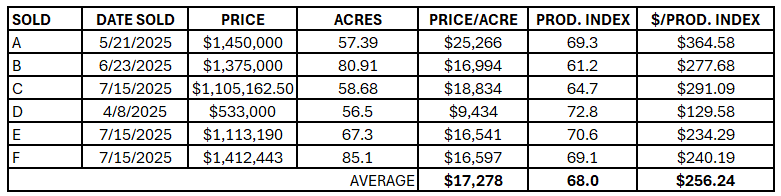
$17,278/acre
Jan. – Dec. 2025*
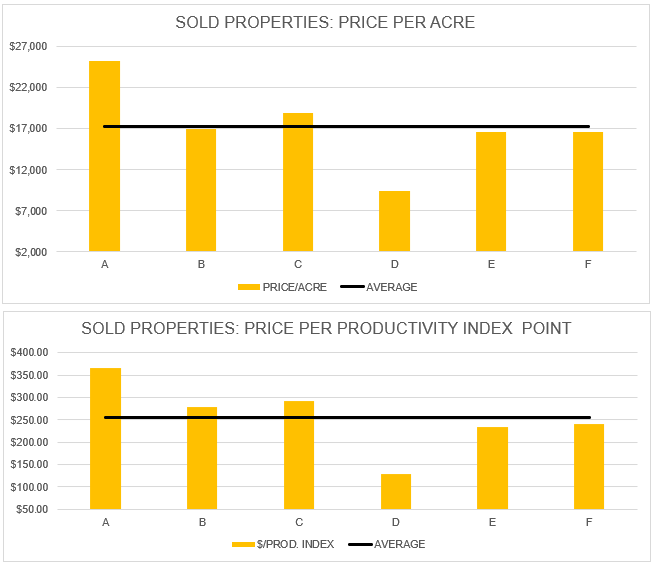
As high as $25,266/acre
in 2025*
Land Market Commentary & Local Trends
The 2025 Jay County farmland market posted an average sale price of $17,278 per acre and $256.24 per productivity index point. Strong demand for quality agricultural land continued throughout the year, with one of the highest recorded sales reaching an impressive $25,266 per acre.
Since 1977, the Geswein Farm & Land Team has been advising landowners to be stewards of the land and make decisions based on most current, accurate, and relevant data. The information in this report can provide you with a rough estimate of your property’s value; however, understanding the specific characteristics of your property and how they compare to the other sales will provide the most accurate value of your property. Additionally, properties sold by land brokers via auctions or listings consistently outperformed individual to individual transactions and properties sold by traditional home realtors.
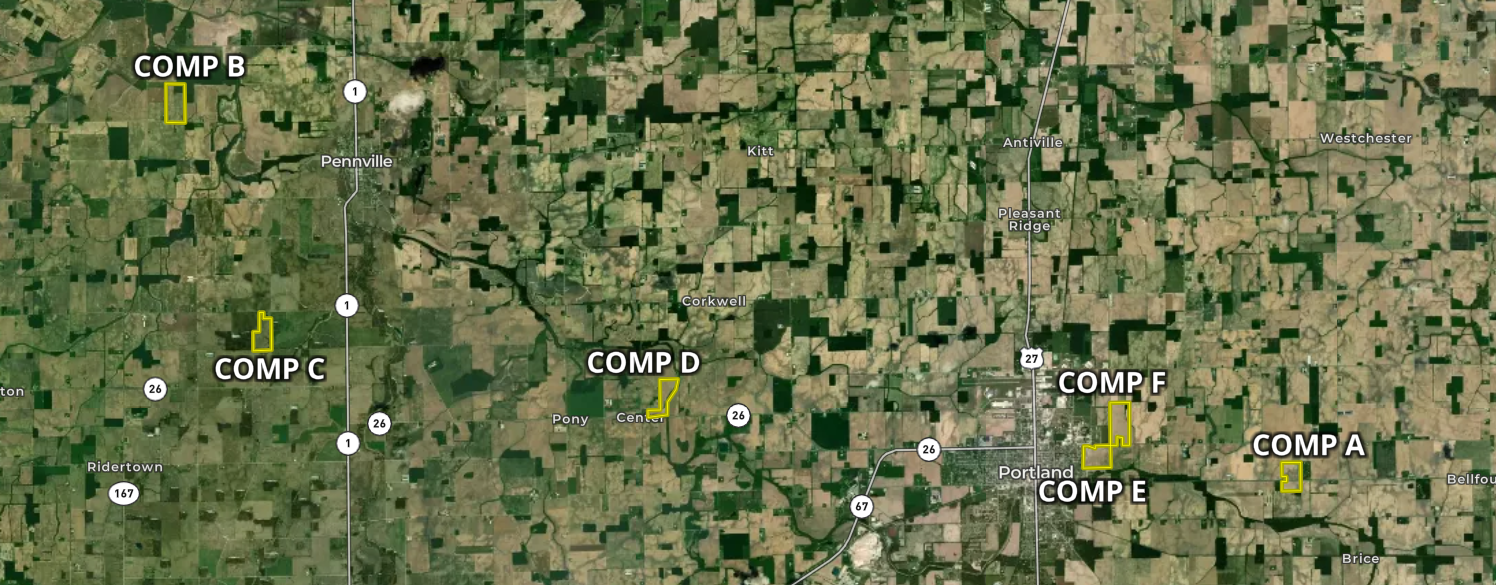
By The Numbers
Jay County in 2025: One of Indiana’s Quiet Agricultural Powerhouses
Jay County’s farmland market continued to demonstrate its strength throughout 2025, reinforcing the county’s reputation as one of East Central Indiana’s most productive agricultural regions. While much of the attention in Indiana’s land market often focuses on counties experiencing development pressure or rapid population growth, Jay County tells a different story—one built on agricultural performance, operational efficiency, and a deeply rooted farming tradition.
The year’s sales activity highlighted continued confidence in quality farmland. Buyers remained active, particularly for highly productive tracts capable of supporting long-term row-crop operations. Even as financing costs and farm profitability became larger considerations across the state, demand remained resilient for farms that offered strong agronomic characteristics and proven production history.
For many landowners, 2025 served as a reminder that Jay County’s land market continues to derive much of its strength from what happens in the field rather than what happens outside of agriculture.
History & Background of Jay County, Indiana
County Seat: Portland
Townships: Bearcreek / Greene / Jackson / Jefferson / Knox / Madison / Noble / Penn / Pike / Richland / Wabash / Wayne
History: Formed in 1836; named for John Jay, founding father and first Chief Justice of the United States.
Population: 20,478
Cities & Towns: Portland / Bryant / Dunkirk / Pennville / Redkey / Salamonia
Acreage: 246,000
Productivity Continues to Drive Demand
Few counties in Indiana are as closely associated with agricultural productivity as Jay County. The county’s extensive row-crop landscape, combined with decades of drainage improvements and farm investment, has helped create a farming environment that remains attractive to operators seeking efficiency and long-term performance.
As buyers evaluated opportunities throughout 2025, several characteristics consistently stood out: highly productive soils, well-maintained drainage systems, efficient field configurations, strong tillable acreage percentages, and opportunities for operational expansion.
In many cases, these factors carried more weight than broader economic uncertainty. Buyers were increasingly selective, but they remained willing to compete for farms that checked the right boxes.
This trend reflects a broader shift occurring throughout agricultural markets: while overall demand remains healthy, buyers are placing greater emphasis on quality and operational fit than they did during the most aggressive years of farmland appreciation.
A Market Defined by Agriculture, Not Development
Unlike counties located near major metropolitan growth corridors, Jay County’s farmland market remains overwhelmingly influenced by agricultural fundamentals. This distinction often creates a different market environment than what is observed in areas where development potential contributes significantly to land values.
In Jay County, farmland is typically valued for its ability to generate production and support farming operations. As a result, market performance tends to be more closely tied to: crop profitability, farm efficiency, productivity potential, local operator demand, and long-term agricultural outlook.
For landowners, this often creates a market that is more predictable and less susceptible to the swings associated with speculative development activity.
According to the USDA National Agricultural Statistics Service (NASS), the following crop statistics have been reported for Jay County, Indiana.
The 2022 Ag Census for Jay County, Indiana, reported the following crop statistics:
Number of farms: 801
Land in farms (acres): 198,780
Average farm size (acres): 248
Total market value of products sold: $602,966,000
Government payments: $1,291,000
Farm-related income: $10,018,000
Total farm production expenses: $420,591,000
Net cash farm income: $193,684,000
Local Pulse: What’s Happening in Jay County?
While agriculture remains the county’s foundation, several local developments and community priorities continue shaping Jay County’s future.
Portland’s Downtown and Community Investment
As the county seat, Portland continues to serve as the center of economic and community activity. Efforts to enhance downtown amenities, support local businesses, and improve public spaces remain important components of the county’s long-term vision.
Agricultural Innovation and Farm Efficiency
Local producers continue adopting new technologies and management practices designed to improve efficiency and maximize productivity. Precision agriculture, drainage improvements, and equipment modernization remain common themes throughout the county’s farming community.
Crossroads of Indiana and Ohio
Jay County’s location along the Indiana-Ohio border continues to influence local commerce and agricultural activity. The county’s position provides access to regional markets and contributes to its role as an important agricultural area within the broader region.
Rural Community Sustainability
Like many rural counties, Jay County continues focusing on maintaining strong schools, healthcare access, and local services that support both farm families and rural residents. These efforts contribute to overall community stability and long-term confidence in the county.
What Landowners Should Watch in 2026
As the market moves into 2026, several factors are likely to influence farmland activity throughout Jay County.
Areas to monitor include:
Commodity prices and farm income potential
Interest rate trends and financing costs
Availability of farmland inventory
Continued operator demand for expansion
Input costs and profitability margins
One of the most important themes may be whether the county’s strongest farms continue separating themselves from the broader market. Recent activity suggests buyers remain highly interested in productive acreage, but they are increasingly focused on properties that can deliver operational advantages and long-term returns.
Inventory levels will also be worth watching. In a county where farmland ownership often remains within families for extended periods, limited supply can continue supporting competition whenever quality tracts become available.
The Jay County Difference
What makes Jay County unique is not rapid growth, major development projects, or shifting land-use patterns. Instead, its strength comes from consistency.
The county has built a reputation around productive farmland, experienced operators, and a long-standing commitment to agriculture. Those qualities continue attracting interest from buyers who view farmland as both a productive asset and a long-term investment.
While market conditions may fluctuate from year to year, the factors that have historically supported Jay County farmland remain firmly in place.
Final Takeaway
Jay County’s farmland market in 2025 reflected the characteristics that have long defined the county: productivity, efficiency, and agricultural resilience. As buyers became more selective across Indiana, Jay County continued demonstrating that high-quality farmland remains highly valued when supported by strong farming fundamentals.
Looking ahead to 2026, the county appears well-positioned to continue benefiting from its agricultural strengths. For landowners, that means the conversation remains focused on what has always mattered most in Jay County—productive land, sound management, and a strong farming community.
Sources / Citations:
Source 1:
“United States Department of Agriculture.” USDA, www.nass.usda.gov/Statistics_by_State/Indiana/Publications/County_Estimates/index.php#:~:text=Access%20Quick%20Stats%20Lite,to%20NASS%20Surveys%20and%20Programs. Accessed 2 June 2026.
Source 2:
“USDA.” 2022 Census of Agriculture County Profile, www.nass.usda.gov/Publications/AgCensus/2022/Online_Resources/County_Profiles/Indiana/cp18075.pdf. Accessed 2 June 2026.
*The transaction and land sales data/information contained in this report was obtained from publicly available sources and sales disclosures deemed accurate and reliable but not guaranteed, no liability for accuracy, errors or omissions is assumed by Geswein Farm & Land Realty, LLC
Thinking About Selling?
Need Advice?
Get the guidance, service, and professional expertise you deserve.
- Family Farm Advisory for Succession Planning
- Undivided Interests & Tenants in Common
- Farmland Management Decisions
- Auctions & Listing
With our full-time experienced team, you’ll get our ‘boots on the ground’ work ethic paired with the latest in digital technology & national marketing reach – for best-in-class service and results.
Because you deserve more value.
Contact Us