


Randolph County, Indiana
2026 Land Sales Report
Randolph County farmland values remained strong through 2025, supported by steady demand for productive agricultural land. As 2026 approaches, market activity suggests values may be settling into a more stable pattern after several years of appreciation.
If you’d like to get specific land values on your own property or a farm near you for 2026, please contact Hunter Hardebeck today at (765) 426-0159.
Average Price of Land*
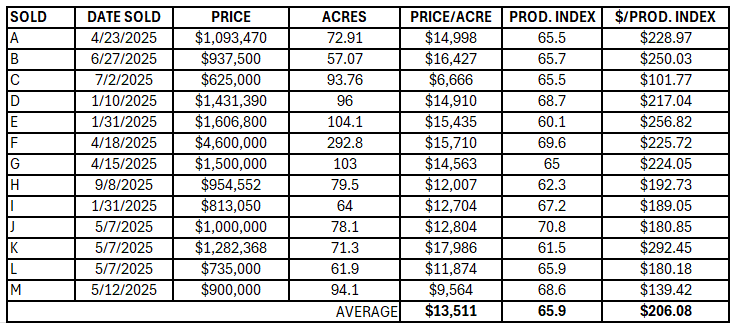
$13,511/acre
Jan. – Dec. 2025*
As high as $17,986/acre
in 2025*
Land Market Commentary & Local Trends
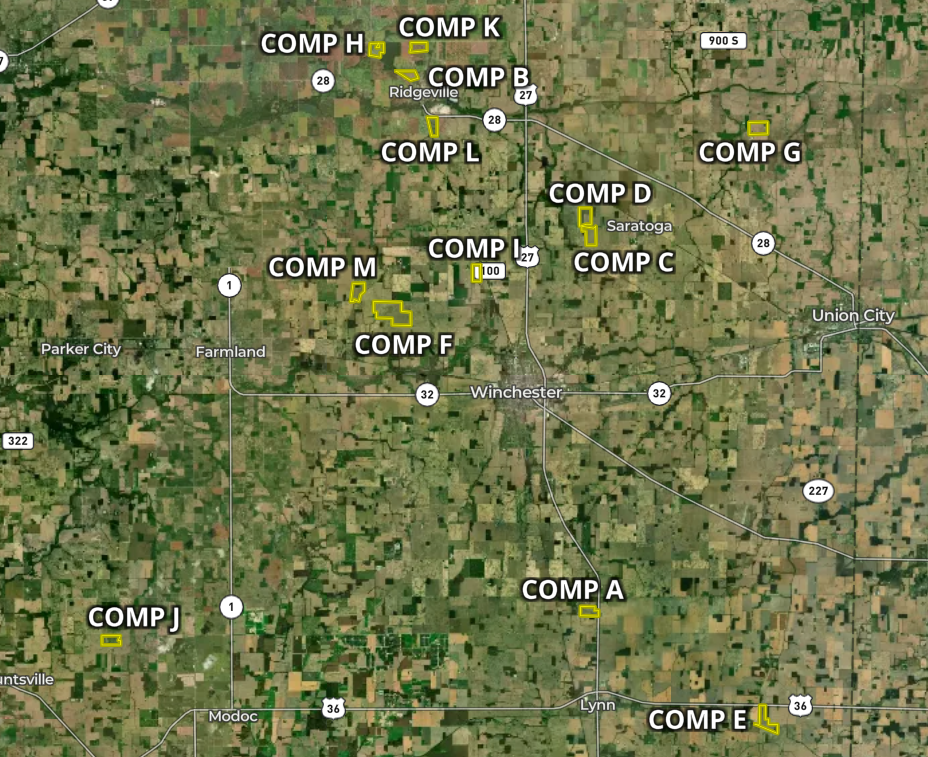
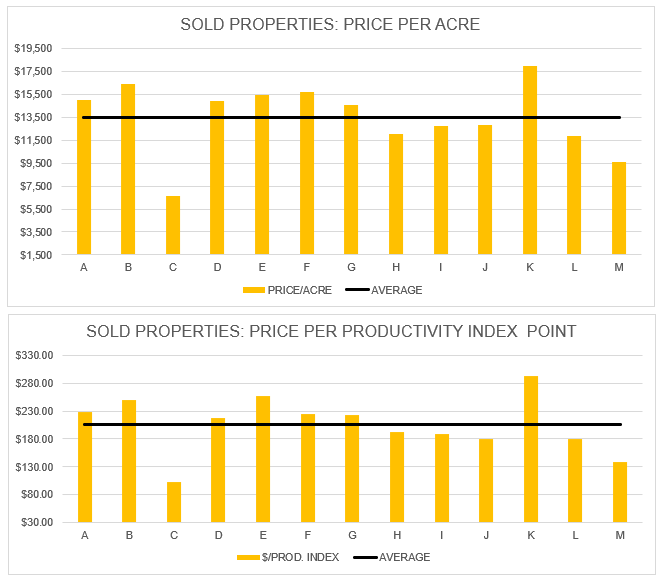
Based on 2025 sales data, Randolph County farmland averaged $13,511 per acre, with an average value of $206.08 per productivity index point. While these figures reflect the broader market, top-performing tracts commanded prices as high as $17,986 per acre, highlighting continued demand for quality farmland.
Since 1977, the Geswein Farm & Land Team has been advising landowners to be stewards of the land and make decisions based on most current, accurate, and relevant data. The information in this report can provide you with a rough estimate of your property’s value; however, understanding the specific characteristics of your property and how they compare to the other sales will provide the most accurate value of your property. Additionally, properties sold by land brokers via auctions or listings consistently outperformed individual to individual transactions and properties sold by traditional home realtors.
By The Numbers
Randolph County in 2025: A Market Rooted in Productivity
Randolph County’s farmland market continued to showcase the qualities that have long made eastern Indiana attractive to agricultural operators: productive soils, strong farming traditions, and a landscape built around row-crop agriculture. While buyers across Indiana became increasingly selective throughout 2025, demand remained steady for farms that offered the productivity and efficiency needed to support long-term profitability.
The year’s sales activity reflected a market that remains grounded in agricultural fundamentals. Rather than being driven by suburban expansion or large-scale development projects, Randolph County’s land market continues to be shaped primarily by farm performance, local demand, and the long-term value of productive acreage.
As the market transitions into 2026, the county appears well-positioned to continue benefiting from its agricultural strengths, particularly as buyers place greater emphasis on quality and operational efficiency.
History & Background of Randolph County, Indiana
County Seat: Winchester
Townships: Franklin / Green / Greensfork / Jackson / Monroe / Stoney Creek / Union / Ward / Washington / Wayne / White River
History: Formed in 1818; named for Randolph County, North Carolina, the origin of many early settlers.
Population: 24,000
Cities & Towns: Winchester / Union City / Farmland / Lynn / Modoc / Parker City / Ridgeville / Saratoga
Acreage: 289,920
Where Productivity Meets Value
One of Randolph County’s defining characteristics is its ability to offer highly productive farmland within a market that remains closely tied to agricultural economics. Throughout 2025, buyers consistently focused on the factors that directly impacted farm performance.
This emphasis on productivity created a market where well-maintained farms continued attracting strong interest. Buyers were willing to compete for quality acreage, particularly when properties offered operational advantages that could improve efficiency and profitability.
As borrowing costs and input expenses remained important considerations, the difference between average and premium farms became increasingly noticeable. Quality continued to command attention.
A County Defined by Agriculture and Independence
Unlike some counties experiencing significant development pressure, Randolph County remains firmly connected to its agricultural roots. Farming continues to play a central role in shaping both the landscape and the local economy.
The county’s location along the Indiana-Ohio border also contributes to its identity. Producers benefit from access to regional grain markets, agricultural services, and a broad network of farming operations that extend beyond state lines. This connectivity helps support a healthy agricultural environment while reinforcing the county’s reputation as a productive farming region.
For many landowners, this means farmland values remain more closely linked to agricultural performance than to outside development influences—a characteristic that can provide stability during periods of market uncertainty.
According to the USDA National Agricultural Statistics Service (NASS), the following crop statistics have been reported for Randolph County, Indiana.
The 2022 Ag Census for Randolph County, Indiana, reported the following crop statistics:
Number of farms: 675
Land in farms (acres): 238,870
Average farm size (acres): 354
Total market value of products sold: $328,813,000
Government payments: $666,000
Farm-related income: $10,679,000
Total farm production expenses: $222,009,000
Net cash farm income: $118,149,000
County Spotlight: What’s Happening in Randolph County?
While agriculture remains the county’s foundation, several local developments and community priorities continue shaping Randolph County’s future.
Winchester’s Continued Community Investment
As the county seat, Winchester remains the center of local commerce, government, and community activity. Investments in downtown improvements, public spaces, and local amenities continue supporting quality of life and economic vitality throughout the county.
Manufacturing and Local Industry
Manufacturing continues to play an important role in Randolph County’s economy. The presence of industrial employers helps diversify the local economic base and supports many of the communities that make up the county’s rural landscape.
Indiana-Ohio Regional Connectivity
Randolph County’s border location continues to create opportunities for regional commerce and agricultural activity. Access to multiple markets and transportation routes remains an advantage for both producers and businesses operating throughout the area.
Preservation of Rural Character
As many communities across the Midwest navigate growth and change, Randolph County continues emphasizing the preservation of its rural heritage, agricultural traditions, and close-knit communities – qualities that remain important to residents and landowners alike.
What Landowners Should Watch in 2026
As Randolph County enters 2026, several factors are likely to influence both farmland demand and market activity.
Key areas to monitor include:
Commodity market performance
Farm profitability and operating margins
Interest rate trends
Local farmland inventory levels
Continued demand from established operators
One question worth watching is whether the county’s strongest farms continue outperforming the broader market. Recent activity suggests buyers remain highly interested in productive acreage, particularly when quality farms become available in areas with strong agricultural demand.
Inventory may also play a significant role. In a county where farmland often remains in the same families for generations, even a small increase in available listings can influence competition and pricing dynamics.
Looking Ahead
The farmland market in Randolph County continues to reflect the county itself: practical, productive, and deeply connected to agriculture. While economic conditions will undoubtedly influence the market in 2026, the underlying strengths that support local farmland values remain firmly in place.
For landowners, that means the focus will likely remain on the qualities that have always mattered most—good soils, efficient operations, strong stewardship, and the long-term productivity of the land itself.
Final Takeaway
Randolph County’s 2025 farmland market demonstrated that productive agricultural land continues to command respect in eastern Indiana. While buyers may be more selective than they were during the market’s most aggressive years, demand for quality farmland remains resilient.
As the county looks toward 2026, its combination of agricultural productivity, regional connectivity, and rural stability positions it well for the future. For landowners, the story remains less about rapid change and more about the enduring value of well-managed farmland in a county built on agriculture.
Sources / Citations:
Source 1:
“United States Department of Agriculture.” USDA, www.nass.usda.gov/Statistics_by_State/Indiana/Publications/County_Estimates/index.php#:~:text=Access%20Quick%20Stats%20Lite,to%20NASS%20Surveys%20and%20Programs. Accessed 2 June 2026.
Source 2:
“USDA.” 2022 Census of Agriculture County Profile, www.nass.usda.gov/Publications/AgCensus/2022/Online_Resources/County_Profiles/Indiana/cp18135.pdf. Accessed 2 June 2026.
*The transaction and land sales data/information contained in this report was obtained from publicly available sources and sales disclosures deemed accurate and reliable but not guaranteed, no liability for accuracy, errors or omissions is assumed by Geswein Farm & Land Realty, LLC
Thinking About Selling?
Need Advice?
Get the guidance, service, and professional expertise you deserve.
- Family Farm Advisory for Succession Planning
- Undivided Interests & Tenants in Common
- Farmland Management Decisions
- Auctions & Listing
With our full-time experienced team, you’ll get our ‘boots on the ground’ work ethic paired with the latest in digital technology & national marketing reach – for best-in-class service and results.
Because you deserve more value.
Contact Us