


Allegan County, Michigan
2026 Land Sales Report
Strong buyer demand helped sustain Allegan County land values in 2025, keeping the market on solid footing. Looking ahead to 2026, price movement appears to be moderating after several years of upward momentum.
If you’d like to get specific land values on your own property or a farm near you for 2026, please contact Jason Cackley at (269) 240-3196.
Request a Land Values ReportAverage Price of Land*
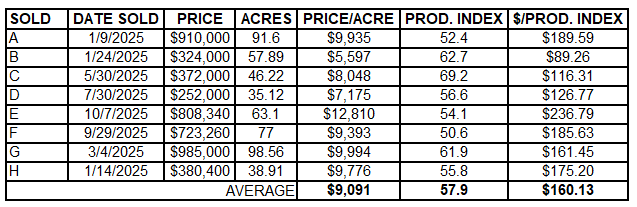
$9,091/acre
Jan. – Dec. 2025*
As high as $12,810/acre
in 2025*
Land Market Commentary & Local Trends
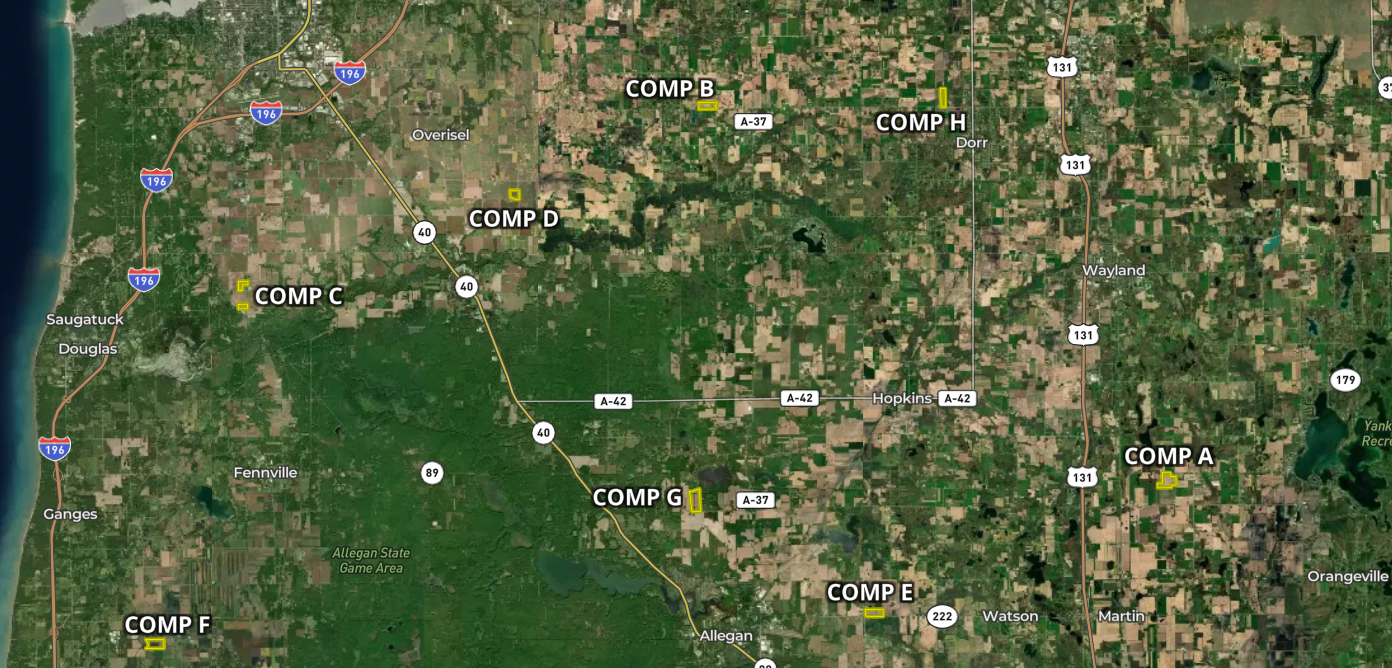
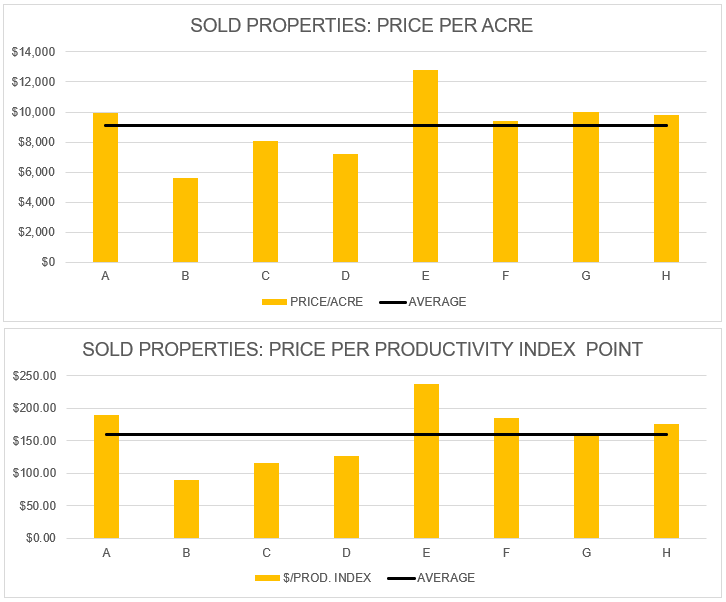
Based on 2025 sales data, Allegan County farmland averaged $9,091 per acre, with values equating to $160.13 per productivity index point. At the upper end of the market, select sales climbed to $12,810 per acre.
Since 1977, the Geswein Farm & Land Team has been advising landowners to be stewards of the land and make decisions based on most current, accurate, and relevant data. The information in this report can provide you with a rough estimate of your property’s value; however, understanding the specific characteristics of your property and how they compare to the other sales will provide the most accurate value of your property. Additionally, properties sold by land brokers via auctions or listings consistently outperformed individual to individual transactions and properties sold by traditional home realtors.
By The Numbers
History & Background of Allegan County, Michigan
County Seat: Allegan
Townships: Casco / Dorr / Fillmore / Ganges / Gun Plain / Heath / Hopkins / Laketown / Lee / Leighton / Manlius / Martin / Monterey / Otsego / Overisel / Salem / Saugatuck / Trowbridge / Valley / Watson / Wayland
History: Established in 1831; Named by Michigan historian Rowe Schoolcraft.
Population: 120,502
Cities & Towns: Allegan / Holland / Otsego / Fennville / Saugatuck / Wayland / Douglas / Hamilton / South Haven / Hamilton / Ganges / Casco / Hopkins / Fillmore / Dorr / Gun Plain / Laketown / Lee / Leighton / Manlius / Martin / Monterey / Overisel / Salem / Trowbridge / Valley / Watson
Acreage: 1,173,120
Allegan County in 2025: A Farmland Market with More Than One Driver
Allegan County’s farmland market in 2025 looked different from many traditional row-crop counties across the Midwest. While agricultural productivity remained central to land values, the county’s market was also shaped by western Michigan development pressure, specialty crop activity, and the diversity of its agricultural base. That combination gave Allegan County a farmland market that felt broader and more layered than a county driven solely by corn and soybean economics.
Throughout 2025, demand remained strongest for farms that offered clear utility and long-term flexibility. Buyers were not just looking at acres on paper – they were paying attention to what the land could do, what improvements were already in place, and how well a tract fit into the county’s wider agricultural landscape. In a county where row crops, fruit production, specialty agriculture, and rural-residential influence can all intersect, farmland is often evaluated through several lenses at once.
The result was a market that remained active, but highly selective. Better-positioned farms continued to command attention, while tracts with limitations – whether related to layout, drainage, fragmented acreage, or lower-quality tillable ground – faced a more measured response.
A Different Kind of Agricultural County
What sets Allegan County apart is the range of agricultural activity found across the county. Unlike many counties where land values are tied almost entirely to grain production, Allegan County supports a more varied farm economy. Row-crop farms remain important, but the county is also influenced by specialty crops, produce operations, greenhouse activity, livestock, and diversified farming systems that are more common in western Michigan.
That diversity matters in a farmland market. It means buyers are not always assessing land the same way from parcel to parcel. In some areas, productivity and tillable efficiency remain the primary value drivers. In others, irrigation potential, specialty crop suitability, access to farm markets, or proximity to established agricultural businesses may carry additional weight.
Throughout 2025, buyers in Allegan County were often focused on:
Soil capability and long-term productivity
Drainage, irrigation access, and water management
Field layout and the percentage of usable tillable acreage
Suitability for row crops versus specialty agricultural uses
Location relative to local markets, agribusiness, and rural communities
That broader evaluation framework makes Allegan County one of the more nuanced farmland markets in Michigan.
Premium Ground vs. Average Ground in Allegan County
The gap between premium farmland and average farmland became more visible in 2025.
Higher-performing farms – especially those with productive soils, strong drainage, efficient field shapes, and a high percentage of workable acres – continued to draw the strongest interest. In Allegan County, those tracts are often attractive because they offer optionality. A good farm can appeal to a traditional row-crop operator, a diversified producer, or a buyer focused on long-term land ownership in a strong agricultural corridor.
Average ground, on the other hand, often faced more scrutiny. Parcels with smaller or irregular fields, lower percentages of tillable acreage, heavier management needs, or more recreational and rural-residential influence did not always trade with the same momentum as top-end farms. In a more selective market, buyers have become increasingly careful about how each tract fits into an operation and whether the land supports efficient, income-producing use.
That does not mean demand has disappeared for average farms. It means the market is increasingly rewarding land that offers both productivity and versatility.
Local Land Dynamics: Why Allegan County Behaves Differently
Allegan County’s farmland market is shaped not only by what happens in the field, but also by where the county sits geographically.
Positioned between Grand Rapids, Kalamazoo, and the Lake Michigan shoreline, Allegan County has long operated at the intersection of agriculture, tourism, and rural growth. Some parts of the county remain deeply production-oriented and agricultural in character, while others feel the influence of second-home demand, rural residential interest, and broader west Michigan population movement.
That matters because it creates multiple layers of land demand. In certain townships, farmland values are still driven almost entirely by agricultural return and operator demand. In others, non-farm influences can affect landowner expectations, parcel splits, and buyer competition – especially on smaller tracts or farms located near growth corridors, recreational destinations, or major travel routes.
For landowners, Allegan County is a reminder that farmland value is not always determined by crop performance alone. Location inside the county can matter just as much as the soil map.
According to the USDA National Agricultural Statistics Service (NASS), the following crop statistics have been reported for Allegan County, Michigan.
The 2022 Ag Census for Allegan County, Michigan, reported the following crop statistics:
Number of farms: 534
Land in farms (acres): 223,423
Average farm size (acres): 418
Total market value of products sold: $143,343,000
Government payments: $3,285,000
Farm-related income: $7,345,000
Total farm production expenses: $100,613,000
Net cash farm income: $53,360,000
What’s Shaping the County Beyond the Sale Barn
Agriculture in Allegan County Is More Diverse Than the Typical Midwest Story
Allegan County remains a serious agricultural county, but it does not fit neatly into a single category. Alongside traditional row-crop acres, the county benefits from western Michigan’s broader agricultural economy, which includes fruit, produce, nursery activity, and other specialty crop influences. That diversity can create a wider buyer pool than in counties where farmland is valued almost exclusively through corn and soybean returns.
West Michigan Growth Pressure Is Still Part of the Story
Allegan County is not a suburban county in the same sense as areas closer to Chicago or Indianapolis, but it is still influenced by regional growth. Its proximity to Grand Rapids, Holland, Kalamazoo, and the Lake Michigan corridor gives portions of the county a different land-use profile than a purely interior agricultural market. Rural residential demand, recreation-oriented ownership, and long-term development speculation can all play a role in how certain tracts are viewed.
Farm Infrastructure and Water Access Matter Here
Because Allegan County’s agricultural base is more varied, land improvements can matter differently than they do in a straight row-crop market. Drainage, irrigation potential, storage, road access, and the practical usability of a farm can all influence how aggressively buyers pursue a property. In some areas, those features may matter just as much as the soil productivity rating itself.
What Early 2026 Is Suggesting So Far
The first quarter of 2026 has largely reinforced the themes that developed in 2025: demand is still present, but buyers are more disciplined and more property-specific in how they pursue land.
Across Michigan, farmland values have continued to show resilience, and state-level data has pointed to continued upward pressure in farm real estate values, with western Michigan still feeling the effects of both agricultural demand and non-farm land competition. In Allegan County, that likely means well-positioned farms should continue to hold attention, particularly where the acreage offers strong utility, production potential, or flexibility across different farm uses.
Early 2026 signals to watch in Allegan County include:
Continued strength for productive, functional farmland
Ongoing selectivity for average or mixed-use tracts
Interest in land that fits both agricultural and long-term ownership goals
The influence of west Michigan growth and housing demand on rural property values
Buyer preference for farms with strong usability rather than simply total acreage
If those patterns hold, 2026 may look less like a year of broad-based acceleration and more like a year where the best farms continue to separate themselves from the middle of the market.
What Allegan County Landowners Should Watch in 2026
For Allegan County landowners, the biggest question heading into the rest of 2026 is not whether farmland still has value – it does – but which types of land will continue to outperform as buyers remain selective.
First, watch the relationship between farm profitability and buyer confidence. Michigan farmland values have remained firm, but long-term strength still depends on the ability of agricultural acres to generate income or strategic value for the next owner. Productive, well-maintained tracts with efficient access and strong agronomic utility should continue to fare best in that environment.
Second, keep an eye on the county’s non-farm pressures. Allegan County is one of those places where broader west Michigan demand can influence rural land values in subtle ways, especially on farms near lakeshore corridors, growth routes, or areas with residential appeal. Those outside influences may not drive every sale, but they can shape expectations and keep certain tracts from behaving like a typical commodity farmland market.
Finally, watch inventory. In a county with a broad mix of farm types and ownership structures, not every property competes with every other property. When a clean, productive, well-located farm comes to market, it may still face strong competition simply because there are not many direct substitutes available.
Final Thoughts
Allegan County’s farmland market in 2025 was shaped by more than just agricultural value per acre. It reflected the county’s unique role within western Michigan: a place where productive farmland, specialty agriculture, regional growth, and long-term land ownership all intersect.
That complexity is exactly what makes the market worth watching. Some farms will continue to trade primarily on yield potential and farm efficiency. Others may attract interest because they offer flexibility, location advantages, or a fit within Allegan County’s broader agricultural economy. As 2026 unfolds, that layered market structure is likely to remain one of the county’s defining characteristics.
For landowners, the takeaway is clear: in Allegan County, understanding land value means understanding not only the farm itself, but the part of the county it sits in – and the kind of buyer it is most likely to attract.
Sources / Citations:
Source 1:
“United States Department of Agriculture.” USDA, www.nass.usda.gov/Statistics_by_State/Michigan/Publications/County_Estimates/index.php#:~:text=Access%20Quick%20Stats%20Lite,to%20NASS%20Surveys%20and%20Programs. Accessed 19 June 2026.
Source 2:
“USDA.” 2022 Census of Agriculture County Profile, www.nass.usda.gov/Publications/AgCensus/2022/Online_Resources/County_Profiles/michigan/cp26005.pdf. Accessed 19 June 2026.
*The transaction and land sales data/information contained in this report was obtained from publicly available sources and sales disclosures deemed accurate and reliable but not guaranteed, no liability for accuracy, errors or omissions is assumed by Geswein Farm & Land Realty, LLC
Thinking About Selling?
Need Advice?
Get the guidance, service, and professional expertise you deserve.
- Family Farm Advisory for Succession Planning
- Undivided Interests & Tenants in Common
- Farmland Management Decisions
- Auctions & Listing
With our full-time experienced team, you’ll get our ‘boots on the ground’ work ethic paired with the latest in digital technology & national marketing reach – for best-in-class service and results.
Because you deserve more value.
Contact Us