


Barry County, Michigan
2026 Land Sales Report
Strong interest in Barry County agricultural land helped keep values elevated during 2025. Entering 2026, the market appears to be shifting away from rapid gains and toward more normalized pricing conditions.
If you’d like to get specific land values on your own property or a farm near you for 2026, please contact Jason Cackley at (269) 240-3196.
Request a Land Values ReportAverage Price of Land*
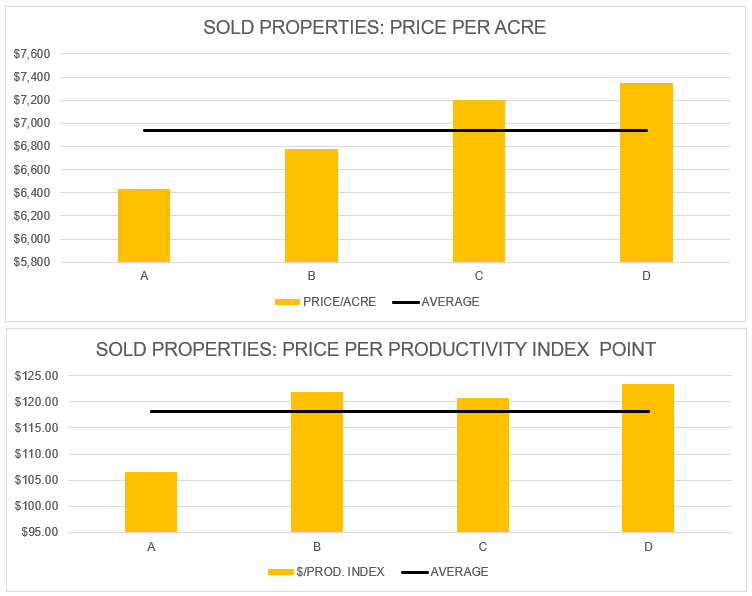
$6,942/acre
Jan. – Dec. 2025*
As high as $7,348/acre
in 2025*
Land Market Commentary & Local Trends
Throughout 2025, Barry County farmland maintained an average market value of $6,942 per acre, with buyers paying $118.16 per productivity index point on average. One of the strongest sales of the year reached $7,348 per acre.
Since 1977, the Geswein Farm & Land Team has been advising landowners to be stewards of the land and make decisions based on most current, accurate, and relevant data. The information in this report can provide you with a rough estimate of your property’s value; however, understanding the specific characteristics of your property and how they compare to the other sales will provide the most accurate value of your property. Additionally, properties sold by land brokers via auctions or listings consistently outperformed individual to individual transactions and properties sold by traditional home realtors.
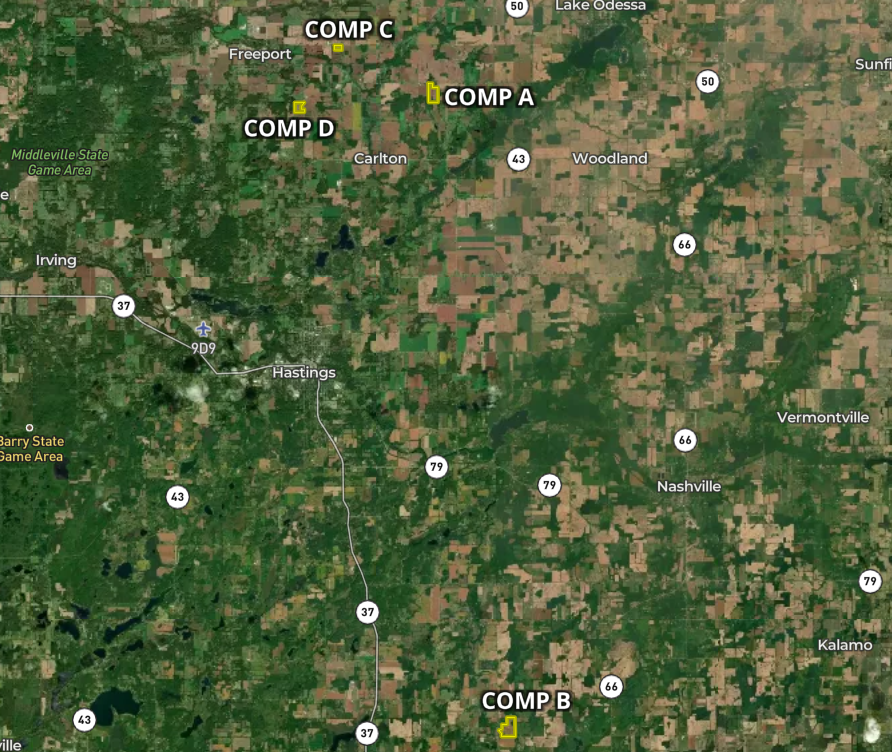
By The Numbers

Barry County in 2025: A Market Rooted in Agriculture, but More Selective in Tone
Barry County’s farmland market in 2025 reflected a steady agricultural base, but with a more measured tone than the rapid run-up years that defined much of the earlier market cycle. Demand for farmland remained present, especially among local operators and buyers focused on long-term ownership, yet the market showed clearer signs of selectivity. Buyers were still willing to compete for land that checked the right boxes, but they were increasingly focused on quality, utility, and how well a tract fits into an existing farm operation.
That shift matters in a county like Barry, where farmland does not trade on one single story. Some tracts are valued for their row-crop potential, others for hay ground, livestock support, or mixed agricultural use, and still others for their balance of tillable acreage, woods, and rural setting. As a result, 2025 felt less like a market where all land moved together and more like one where the strongest farms continued to separate themselves from average acreage.
For landowners, that means Barry County’s market still held value and demand in 2025 – but the conversation became more property-specific. Productive ground, functional farm layouts, and usable acreage continued to matter more than broad market momentum alone.
Barry County Agriculture Is Broader Than a Straight Row-Crop Story
Barry County’s agricultural base is one of the key reasons its farmland market behaves differently than some of the more purely grain-driven counties in the Midwest. The county has a broad mix of agricultural activity, with cropland, hay and forage ground, pasture, and livestock-oriented operations all playing a meaningful role in the local farm economy. Rather than being defined strictly by large-scale row-crop production, Barry County functions more as a mixed agricultural market where diversified operations and support acreage still matter.
That mix shows up in the farmland market. Some buyers are focused on productive cropland, while others are looking for land that supports livestock, feed production, hay ground, or a combination of uses. Because of that, farmland in Barry County is not always evaluated the same way from parcel to parcel. In some areas, tillable efficiency and crop productivity remain the primary drivers of value. In others, pasture utility, support acreage, layout, and the balance between open ground and non-tillable land can matter just as much.
That broader agricultural profile helps explain why Barry County can feel different from counties where nearly every farm sale is driven by the same type of buyer pursuing the same type of acreage.
What Separated Strong Farms from Average Farms in 2025
One of the clearest takeaways from Barry County’s 2025 market was the growing importance of functionality.
The farms that continued to draw the strongest interest were typically the ones with a high percentage of usable acreage, manageable field layouts, dependable access, and enough scale to fit efficiently into a farm operation. In Barry County, that does not always mean the biggest or most visually impressive tract – it often means the farm that is easiest to use and easiest to justify economically. Good cropland, reliable hay ground, productive mixed-use farms, and properties with practical improvements all tended to stand out.
Average tracts saw a different kind of response. Parcels with fragmented fields, heavier woods influence, awkward access, lower percentages of tillable acreage, or a layout that limited operational efficiency often required more buyer patience. Those farms still have a place in Barry County’s market, particularly for smaller operators, livestock users, or buyers with a mixed-use goal, but they were less likely to benefit from the kind of aggressive, across-the-board bidding that premium farmland can still attract.
That divide is important heading into 2026. Barry County is not a county where every acre competes on the same terms, and 2025 reinforced that reality.
According to the USDA National Agricultural Statistics Service (NASS), the following crop statistics have been reported for Barry County, Michigan.
The 2022 Ag Census for Barry County, Michigan, reported the following crop statistics:
Number of farms: 897
Land in farms (acres): 143,772
Average farm size (acres): 160
Total market value of products sold: $185,930,000
Government payments: $1,426,000
Farm-related income: $4,836,000
Total farm production expenses: $151,493,000
Net cash farm income: $40,700,000
A County Where Land Use Variety Shapes Value
Barry County sits in a part of Michigan where farmland is influenced not just by production, but by the county’s varied landscape and land use patterns. The county includes strong agricultural areas, but also lakes, wooded acreage, smaller rural homesites, and mixed-use parcels that can pull the market in more than one direction.
Because of that, Barry County’s land market often behaves differently than a county dominated by large, uninterrupted blocks of highly tillable ground. A farm in one part of the county may trade primarily on its agricultural value, while another tract may draw interest because it combines cropland, pasture, recreational appeal, and rural residential potential. That does not make Barry County less agricultural – it simply means landowners and buyers often weigh more than one use when evaluating a property.
This broader land-use profile can create a wider spread in values between tracts, especially when comparing clean, highly usable farms to smaller or more mixed-use parcels. It also helps explain why local knowledge matters so much in Barry County. Soil quality, field efficiency, drainage, road access, and the balance between open acreage and non-tillable land can all materially change how a farm is received by the market.
Barry County’s Agricultural Identity Still Anchors the Market
Even with its varied land mix, Barry County remains a working agricultural county. The local farm economy is supported by crop acres, livestock operations, hay and forage ground, and a broad base of smaller to mid-sized farms that continue to shape rural land demand. In many cases, that local operator presence is one of the county’s biggest stabilizers.
That matters because counties with a real base of working farmers often maintain steadier farmland demand than places where value is driven more heavily by outside development or speculative pressure. Barry County’s market may not always produce the same headline sale numbers seen in more intensely row-crop-focused areas, but it benefits from a broad agricultural foundation that supports ongoing interest in workable land.
In practical terms, that means Barry County farmland is often judged by questions like:
Can the acreage be farmed efficiently?
Does it support crop production, livestock use, or both?
How much of the tract is truly productive and usable?
Are improvements or land features helping or hurting its utility?
Is the farm a good fit for a local operator, a neighboring farm, or a long-term rural buyer?
Those are the questions that help explain why some farms outperform others in this county.
History & Background of Barry County, Michigan
County Seat: Hastings
Townships: Assyria / Baltimore / Barry / Carlton / Castleton / Hastings Charter / Hope / Irving / Johnstown / Maple Grove / Orangeville / Prairieville / Rutland Charter / Thornapple / Woodland / Yankee Springs
History: Established in 1839; Named after William Taylor Barry, U.S. Postmaster General at the time.
Population: 64,025
Cities & Towns: Hastings / Freeport / Middleville / Nashville / Woodland / Delton / Dowling / Hickory Corners / Assyria / Banfield / Cedar Creek / Cloverdale / Coats Grove / Irving / Lacey / Maple Grove / Orangeville / Prairieville / Quimby / Schultz
Acreage: 369,280
What Early 2026 Is Suggesting So Far
The first quarter of 2026 suggests that Barry County is carrying many of the same themes forward rather than moving into a dramatically different kind of market. Across Michigan, farmland values have remained resilient, and broader statewide reporting has pointed to continued upward pressure in farm real estate values even as buyers become more disciplined about what they pursue. In Barry County, that likely means the best-positioned farms should continue to hold their ground, while average or mixed-use tracts may remain more sensitive to pricing and presentation.
Early 2026 also reinforces the idea that local land competition is not limited strictly to traditional agriculture. Barry County’s mix of farms, woods, lakes, and homesites means some parcels may continue to attract interest from buyers who are motivated by a blend of agricultural use, rural lifestyle, and long-term land ownership goals. That does not mean non-farm demand is driving every sale, but it does add another layer to how certain properties may be valued and marketed.
For Barry County landowners, that creates a market worth watching closely. Farms that are clearly agricultural in function may continue to trade on farm fundamentals, while smaller or more flexible tracts may benefit from a wider buyer pool.
What Barry County Landowners Should Watch in 2026
Looking ahead, Barry County landowners should keep an eye on three themes.
First, watch the split between premium utility and average utility.
Farms with clean layouts, productive cropland, useful support acreage, and a clear agricultural purpose are still likely to perform best. In a county with varied farm types, the land that is easiest to operate often attracts the strongest interest.
Second, pay attention to how local agriculture continues to shape demand.
Barry County is not a county where crops alone tell the whole story. Feed ground, hay acres, livestock support land, and diversified farm use all matter here. That means local farm profitability—and the needs of neighboring operators – will continue to influence who is buying and what types of acreage they want most.
Third, keep an eye on broader rural land competition.
Barry County’s mix of farms, woods, lakes, and homesites means some parcels may attract interest well beyond the farm community. That is especially true for smaller tracts or farms with a blend of agricultural and lifestyle appeal. In those cases, land value may be shaped by more than just crop returns.
Final Thoughts
Barry County’s farmland market in 2025 was shaped by a broad agricultural base, a diverse land mix, and a buyer pool that became increasingly selective about utility and fit. It was not a market driven by a single story. Instead, it reflected the county’s identity as a place where cropland, hay ground, livestock support acreage, and mixed-use rural properties all play a role in shaping value.
That makes Barry County worth watching heading into the rest of 2026. The county’s farmland market may not move in lockstep with the most intensely row-crop-driven parts of the Midwest, but it has its own kind of strength: a local agricultural foundation, a flexible land base, and a buyer pool that still recognizes the long-term value of productive rural property.
For landowners, the takeaway is straightforward: in Barry County, the farms that tend to stand out are the ones that are usable, versatile, and well-positioned within the county’s broader agricultural landscape.
Sources / Citations:
Source 1:
“United States Department of Agriculture.” USDA, www.nass.usda.gov/Statistics_by_State/Michigan/Publications/County_Estimates/index.php#:~:text=Access%20Quick%20Stats%20Lite,to%20NASS%20Surveys%20and%20Programs. Accessed 19 June 2026.
Source 2:
“USDA.” 2022 Census of Agriculture County Profile, www.nass.usda.gov/Publications/AgCensus/2022/Online_Resources/County_Profiles/michigan/cp26015.pdf. Accessed 19 June 2026.
*The transaction and land sales data/information contained in this report was obtained from publicly available sources and sales disclosures deemed accurate and reliable but not guaranteed, no liability for accuracy, errors or omissions is assumed by Geswein Farm & Land Realty, LLC
Thinking About Selling?
Need Advice?
Get the guidance, service, and professional expertise you deserve.
- Family Farm Advisory for Succession Planning
- Undivided Interests & Tenants in Common
- Farmland Management Decisions
- Auctions & Listing
With our full-time experienced team, you’ll get our ‘boots on the ground’ work ethic paired with the latest in digital technology & national marketing reach – for best-in-class service and results.
Because you deserve more value.
Contact Us