


Berrien County, Michigan
2026 Land Sales Report
While Berrien County farmland remained in demand throughout 2025, the pace of value growth began to moderate. Entering 2026, pricing trends appear to be stabilizing rather than accelerating further.
If you’d like to get specific land values on your own property or a farm near you for 2026, please contact Jason Cackley at (269) 240-3196.
Request a Land Values ReportAverage Price of Land*
$9,067/acre
Jan. – Dec. 2025*
As high as $12,969/acre
in 2025*
Land Market Commentary & Local Trends
The 2025 Berrien County farmland market reflected an average price of $9,067 per acre and $168.66 per productivity index point. Stronger-performing sales pushed maximum values to $12,969 per acre.
Since 1977, the Geswein Farm & Land Team has been advising landowners to be stewards of the land and make decisions based on most current, accurate, and relevant data. The information in this report can provide you with a rough estimate of your property’s value; however, understanding the specific characteristics of your property and how they compare to the other sales will provide the most accurate value of your property. Additionally, properties sold by land brokers via auctions or listings consistently outperformed individual to individual transactions and properties sold by traditional home realtors.
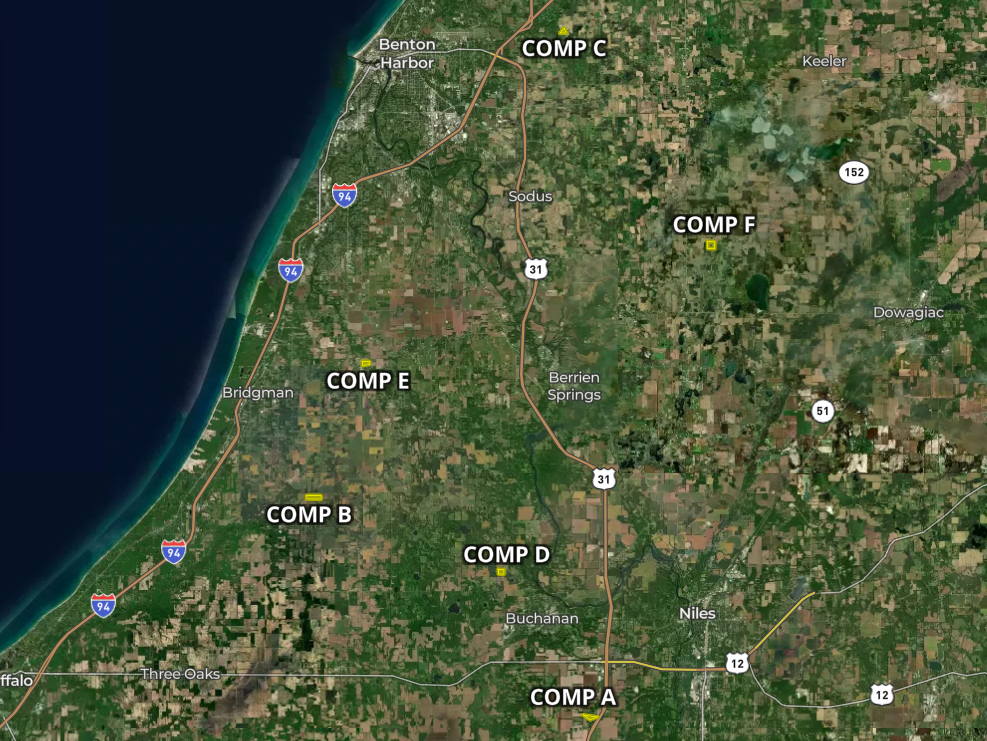
By The Numbers
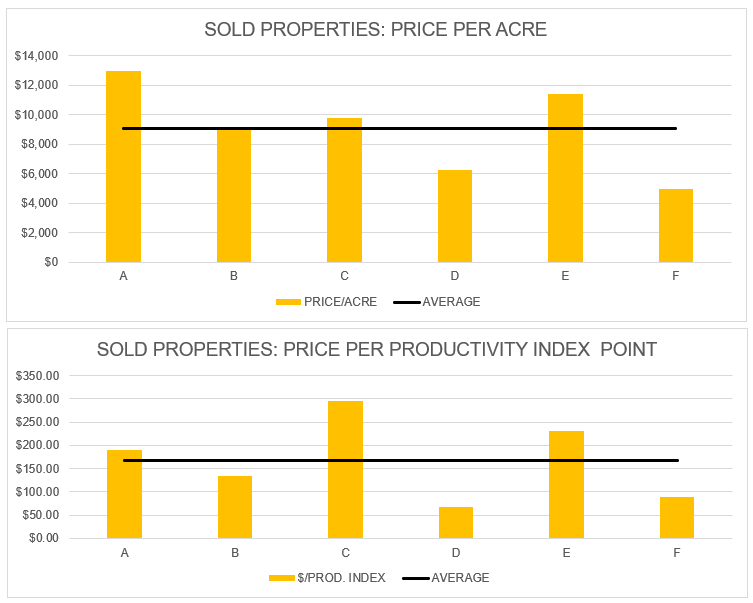
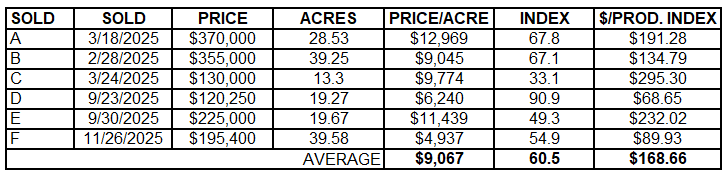
Berrien County in 2025: A Farmland Market with More Than One Value Driver
Berrien County’s farmland market in 2025 was shaped by a much broader set of influences than a typical row-crop county. Agricultural productivity still mattered, but it was only one part of the story. In Berrien County, land values are also tied to fruit production, vineyard and winery activity, produce operations, proximity to Lake Michigan, and the county’s position within one of Michigan’s most dynamic agricultural corridors.
That makes Berrien County a market where buyers are rarely evaluating land through just one lens. A tract may be judged for its row-crop utility, its suitability for permanent plantings, its access to farm markets and processors, or its appeal as a long-term landholding in southwest Michigan. In some areas, all of those factors can be in play at once.
Throughout 2025, that translated into a market that remained active but increasingly selective. Well-positioned farms with clear utility, productive soils, and a strong fit within the county’s agricultural economy continued to attract attention, while tracts with limitations – whether related to layout, fragmented acreage, or lower-quality tillable ground – faced a more measured response. For landowners, the takeaway is that Berrien County is still a market with real strength, but it is one where the “why” behind a farm’s value matters just as much as the acreage itself.
History & Background of Berrien County, Michigan
County Seat: St. Joseph
Townships: Bainbridge / Baroda / Benton Charter / Berrien / Chikaming / Coloma Charter / Galien / Hagar / Keeler / Lincoln Charter / Lake Charter / New Buffalo / Niles Charter / Oronoko Charter / Pipestone / Royalton / Sodus / St. Joseph Charter / Watervliet Charter / Weesaw / Shoreham / Buchanan
History: Established in 1829; Named after U.S. Senator John M. Berrien of Georgia.
Population: 154,316
Cities & Towns: St. Joseph / Benton Harbor / Niles / Berrien Springs / New Buffalo / Coloma / Watervliet / Baroda
Acreage: 1,011,840
Berrien County Agriculture Is Not a One-Crop Story
One of the defining features of Berrien County is the sheer diversity of its agricultural base. This is not a county driven solely by corn and soybean economics. Berrien sits at the center of southwest Michigan’s specialty crop economy, with a farm landscape that includes fruit production, vineyards, vegetables, nursery activity, and traditional field crops. Recent regional economic reporting highlights Berrien and neighboring Van Buren County as two of Michigan’s leading specialty-crop counties, underscoring just how different this market is from a more conventional grain-focused county.
That diversity shows up directly in the farmland market. Some buyers are pursuing highly workable cropland, while others are looking for orchard ground, vineyard sites, irrigated acreage, or farms with infrastructure that supports produce and perennial crops. In Berrien County, farmland value is often shaped by the type of production the land can support – not simply by how many tillable acres are on a survey.
It also means that “good ground” can look different here than it does elsewhere. In a row-crop county, the best farms are often defined by drainage, productivity ratings, and field efficiency. In Berrien County, those same factors still matter, but they may be joined by slope, air drainage, irrigation access, soil type for fruit or vine production, and location relative to packing, processing, agritourism, or direct-to-market channels.
Fruit, Vineyards, and Specialty Agriculture Help Define the County
If there is one thing that separates Berrien County from many other farmland markets in the region, it is the role of specialty agriculture. Berrien County has a long history of fruit production, and that identity continues to shape both the local economy and the land market. Local and regional reporting this spring noted that the county’s agricultural heritage runs especially deep in fruit and wine production, with Berrien County’s vineyards playing an outsized role in Michigan’s wine grape industry.
That broader crop mix matters because specialty-crop ground is often valued differently than straight commodity farmland. Orchard and vineyard properties may require more management and carry more production risk, but they can also support a different revenue profile and attract a different class of buyer. In Berrien County, land tied to fruit, grapes, produce, or other high-value crops can behave differently from ordinary tillable acreage, especially when improvements, established plantings, irrigation, or location within a known growing area are part of the package.
For a farmland report, that is worth emphasizing: Berrien County is one of those places where understanding agricultural value means understanding the county’s crop mix, not just the dirt.
What Separated Strong Farms from Average Farms in 2025
As 2025 unfolded, the gap between premium farms and average farms became easier to spot.
The strongest performing tracts were generally the ones with a clear agricultural purpose and a layout that supported efficient use. For some farms, that meant productive tillable acres with good access and a high percentage of workable ground. For others, it meant a specialty-crop setup with the right site characteristics, irrigation potential, or improvements already in place. In either case, buyers were most responsive to farms that felt functional, income-producing, and well positioned for the next operator.
Average tracts faced a more selective audience. Parcels with scattered acreage, weaker field efficiency, a lower percentage of usable land, or mixed influences that complicated the highest and best use often required more buyer patience. That does not mean these farms had no market – it means the market was increasingly discriminating against what it was willing to pay a premium for.
In a county like Berrien, where farmland can range from highly productive crop ground to orchards, vineyards, mixed-use acreage, and lifestyle-oriented rural tracts, the spread between “premium” and “average” land can be wider than the countywide averages alone suggest.
Why Location Matters So Much Within Berrien County
Berrien County is one of those places where location inside the county can meaningfully change how land is viewed.
Its position along the Lake Michigan corridor, combined with proximity to communities like St. Joseph, Benton Harbor, Berrien Springs, Niles, and the broader southwest Michigan / northern Indiana / Chicago orbit, means the county experiences more overlapping land influences than many interior farm counties. Agriculture remains a core driver of land value, but it is not the only one. Tourism, second-home demand, agritourism, winery and farm-market traffic, and rural residential demand all shape how certain tracts are marketed and perceived.
That does not mean development pressure overwhelms the agricultural market everywhere in Berrien County. It does mean that some farms trade strictly on agricultural return, while others are valued partly for location, flexibility, or future optionality. A tract near a strong fruit-growing corridor, a wine route, a shoreline-adjacent area, or a high-demand rural residential pocket may not behave exactly like a farm farther inland with a purely production-oriented buyer pool.
For landowners, that makes local context especially important. In Berrien County, two farms with similar acre counts may not compete in the same market at all.
According to the USDA National Agricultural Statistics Service (NASS), the following crop statistics have been reported for Berrien County, Michigan.
The 2022 Ag Census for Berrien County, Michigan, reported the following crop statistics:
Number of farms: 792
Land in farms (acres): 144,490
Average farm size (acres): 182
Total market value of products sold: $236,017,000
Government payments: $8,341,000
Farm-related income: $10,314,000
Total farm production expenses: $202,561,000
Net cash farm income: $52,111,000
Preservation, Transition, and the Long-Term Future of Berrien County Farmland
Another factor worth watching in Berrien County is the ongoing conversation around farmland preservation and long-term agricultural use. The county continues to operate a Purchase of Development Rights program in select townships, a reminder that preserving productive farmland remains an active issue locally rather than just a statewide talking point.
That matters because Berrien County sits in a region where agriculture is valuable, but farmland is also under pressure from competing land uses. As ownership changes hands over time, the future of local farmland will increasingly be shaped by who buys it, what they intend to do with it, and whether productive acres remain in agricultural use. In a county with strong specialty agriculture, that question can be especially important, since orchard and vineyard ground is not always easily replaced once it leaves production.
For landowners, this adds another layer to the market conversation. The value of land is not just about current price per acre; it is also about how the county balances growth, preservation, and the long-term viability of its agricultural base.
What Early 2026 Is Suggesting So Far
The first quarter of 2026 suggests that many of Berrien County’s 2025 themes are still intact.
Buyer interest in productive, well-positioned farmland appears to remain firm, but with a continued emphasis on selectivity. Farms with strong utility, useful improvements, and a clear fit within Berrien County’s agricultural economy are still likely to draw the most attention. At the same time, broader county conversations this spring have kept the future of agriculture in focus. In April 2026, local officials and agricultural leaders held a public roundtable on the future of farming in Berrien County, with discussions centered on sustainability, farm opportunity, and long-term agricultural viability.
There are also signs that non-farmland pressure is still part of the picture. Berrien County’s housing market continued to show year-over-year value growth as of spring 2026, which does not drive every farmland sale, but can influence smaller rural tracts, lifestyle properties, and landowner expectations in certain parts of the county.
Taken together, early 2026 points toward a market that is still healthy, but increasingly segmented. The best farms should remain competitive, while mixed-use or average tracts may depend more heavily on pricing discipline, location, and buyer type.
What Berrien County Landowners Should Watch in 2026
For Berrien County landowners, 2026 is likely to be a year where the local story matters as much as the broader farmland market.
First, watch how specialty agriculture continues to support demand.
Berrien County’s fruit, vineyard, and produce economy gives it a different foundation than many other counties. Farms that fit those uses – or that offer flexibility between specialty production and more traditional agriculture – may continue to attract interest even in a more cautious buying environment.
Second, pay attention to the split between purely agricultural tracts and mixed-influence properties.
Some parcels will continue to be valued almost entirely by farm return and productivity. Others may draw support from rural housing demand, agritourism appeal, recreational value, or long-term landholding interest. Understanding which market a property belongs to will be critical.
Third, keep an eye on preservation and transition issues.
In a county where agricultural land competes with other land uses, long-term ownership transitions matter. As farms change hands, the balance between continued agricultural use and outside development pressure will remain an important part of the county’s land story.
Finally, watch farm-specific utility.
In Berrien County, productive ground still matters – but so do irrigation, layout, crop fit, location, and the practical realities of how the land can be used. The farms that are easiest to operate and easiest to justify economically are still the ones most likely to lead the market.
Final Thoughts
Berrien County’s farmland market in 2025 was shaped by a combination of agricultural productivity, specialty crop strength, location, and land-use flexibility. It is not a county where every farm can be understood by a single benchmark or a single buyer profile. Some tracts are valued for their row-crop potential, others for fruit and vineyard production, and others for the way agriculture intersects with tourism, housing demand, and long-term land ownership in southwest Michigan.
That complexity is exactly what makes Berrien County worth watching. It remains a serious agricultural county, but one with more moving parts than a traditional commodity-farm market. As 2026 unfolds, the county’s strongest farms should continue to benefit from that broad agricultural foundation – particularly when they combine productive land, good location, and a clear fit within Berrien County’s evolving farm economy.
Sources / Citations:
Source 1:
“United States Department of Agriculture.” USDA, www.nass.usda.gov/Statistics_by_State/Michigan/Publications/County_Estimates/index.php#:~:text=Access%20Quick%20Stats%20Lite,to%20NASS%20Surveys%20and%20Programs. Accessed 19 June 2026.
Source 2:
“USDA.” 2022 Census of Agriculture County Profile, www.nass.usda.gov/Publications/AgCensus/2022/Online_Resources/County_Profiles/michigan/cp26021.pdf. Accessed 19 June 2026.
*The transaction and land sales data/information contained in this report was obtained from publicly available sources and sales disclosures deemed accurate and reliable but not guaranteed, no liability for accuracy, errors or omissions is assumed by Geswein Farm & Land Realty, LLC
Thinking About Selling?
Need Advice?
Get the guidance, service, and professional expertise you deserve.
- Family Farm Advisory for Succession Planning
- Undivided Interests & Tenants in Common
- Farmland Management Decisions
- Auctions & Listing
With our full-time experienced team, you’ll get our ‘boots on the ground’ work ethic paired with the latest in digital technology & national marketing reach – for best-in-class service and results.
Because you deserve more value.
Contact Us