


Boone County, Indiana
2026 Land Sales Report
After years of notable farmland appreciation, Boone County land values remained elevated in 2025, with transitional and development-influenced tracts continuing to command premium prices. In 2026 some rural areas may be showing signs of stabilization while high-demand pockets and transitional areas continue to support strong values.
For specific farmland or transitional land values on your own property or a farm near you, contact Johnny Klemme today at (765) 427-1619.
Average Price of Land*
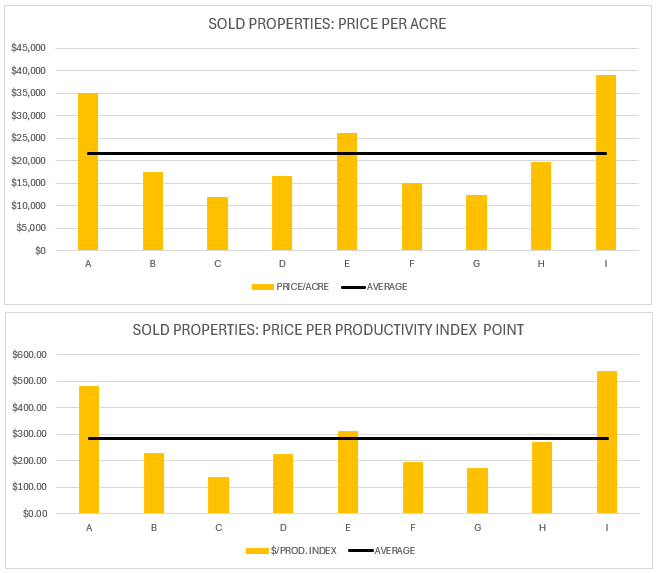
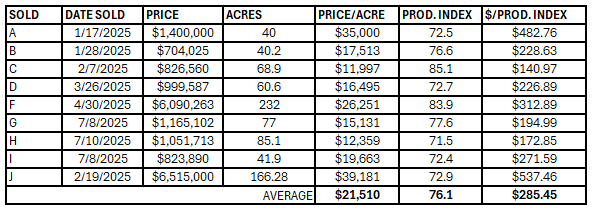
$21,510/acre
Jan. – Dec. 2025*
As high as $39,181/acre
in 2025*
Land Market Commentary & Local Trends by Johnny Klemme
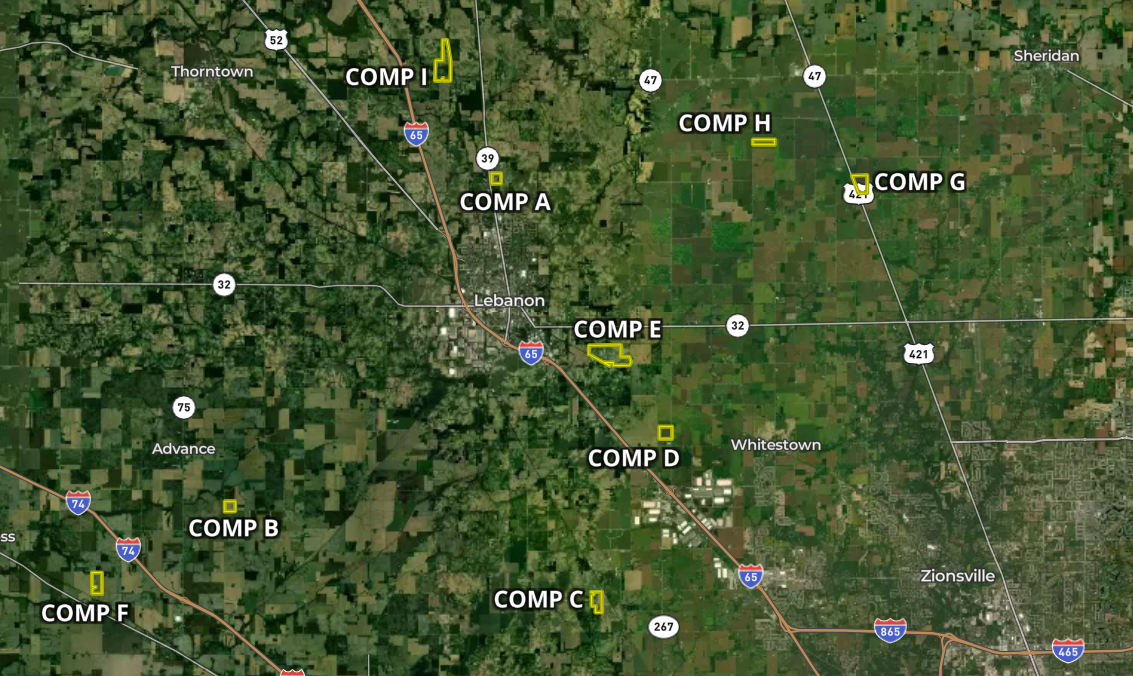
Based on 2025 sales data, Boone County farmland average $21,510 per acre, with an average value of $285.45 per productivity index point across the sampled sales below. Boone County’s market continued to be heavily influenced by development pressure, transitional land demand, and proximity to major growth corridors, particularly in areas tied to ongoing commercial and infrastructure expansion. Investor activity, including 1031 exchanges and buyers seeking strategic land positions, remained a meaningful factor in supporting elevated per-acre values. As Boone County moves into 2026, premium transitional tracts may continue pushing top-end sales higher, while more traditional rural farmland could begin reflecting a steadier, more selective pricing environment.
What is the LEAP Project?
As of 2026, Boone County’s LEAP Lebanon Innovation District remains a major force shaping the county’s economy, land market, and future development. Located along the I-65 corridor near Lebanon, the project continues attracting major investment from companies like Eli Lilly and Meta, alongside large-scale infrastructure improvements. This ongoing expansion has kept development pressure high on nearby farmland and transitional ground, supporting elevated land values in strategic areas. While LEAP has strengthened Boone County’s long-term economic outlook, it also continues to spark discussion around water resources, infrastructure capacity, and the balance between industrial growth and farmland preservation. You can learn more at the official LEAP website here >
By The Numbers
Boone County in 2026: Where Agriculture Meets One of Indiana’s Fastest-Changing Landscapes
Boone County stands out in Indiana farmland markets because it rarely behaves like a “pure agriculture” county for long. While it remains home to highly productive farmland, 2025 continued to highlight a second force shaping land values just as strongly – its position inside one of the fastest-growing corridors of the Indianapolis metro area.
That combination showed up clearly in pricing this year. Boone County farmland averaged approximately $21,510 per acre in 2025. At the top end, sales reached as high as $39,181 per acre, a figure that reflects just how quickly value can escalate when agricultural productivity overlaps with strategic location and future development potential.
Unlike more rural counties where land values are primarily driven by crop yield and soil quality, Boone County often rewards a broader set of factors – proximity to growth, access to infrastructure, and long-term land-use flexibility all play a meaningful role in pricing behavior.
Land Use Trends to Watch in 2026
Data Centers Put Boone County Land Use in the Spotlight
One of Boone County’s biggest 2026 land-use stories is the county’s one-year moratorium on new data center development in unincorporated areas. The pause gives local leaders time to study how these large facilities may affect utilities, infrastructure, agriculture, zoning, and rural character. For landowners, this is a clear reminder that farmland near growth corridors may attract attention from buyers looking beyond traditional agricultural use.
LEAP Continues to Shape the Farmland Conversation
The LEAP Lebanon Innovation District remains one of the most important land-use drivers in Boone County. With thousands of acres positioned along I-65 for advanced manufacturing, life sciences, research, technology, and corporate campus development, LEAP has changed how many owners, investors, and developers think about Boone County farmland. For some families, this creates opportunity. For others, it raises concerns about farmland conversion, water use, traffic, infrastructure, and the long-term identity of rural communities.
Comprehensive Planning Matters More Than Ever
Boone County’s comprehensive planning process is another major topic for 2026. Comprehensive plans help guide future decisions around land use, transportation, utilities, housing, economic development, and preservation. These plans do not sell land or rezone farms by themselves, but they do influence how future development requests are evaluated. Landowners near Lebanon, Whitestown, Zionsville, Advance, Thorntown, and Jamestown should pay close attention to future land-use maps and infrastructure planning.
Housing and Industrial Growth Push the Rural Edge
Boone County continues to see strong pressure for housing, logistics, industrial, and mixed-use development. Projects near I-65 and growing communities can create new jobs and tax base, but they can also push development closer to productive farms. This creates important questions: Should a farm stay in production? Is it now an edge-of-growth property? Could rezoning create a premium? Or would a sale today give up future upside?
Recreation and Conservation Still Have a Strong Place
Even with industrial growth in the headlines, conservation and recreation remain important. Zionsville’s 215-acre Carpenter Nature Preserve is a good example of Boone County’s parallel interest in green space, wildlife habitat, trails, wetlands, and outdoor quality of life. For owners of wooded, creek-bottom, transitional, or recreational land, conservation-minded buyers may be part of the broader market conversation.
Key Takeaways for Boone County Landowners
Boone County land is being pulled in several directions at once: agriculture, development, industrial growth, data centers, housing, conservation, and recreation. The best decisions will require more than asking, “What is my land worth today?” Landowners should also ask, “What could this land become, what risks come with that future, and how does this decision fit our family’s goals?”
Final Thought
In Boone County, 2026 is not just a real estate story. It is a land-use story. Productive farmland, family legacy, growth pressure, infrastructure, and community identity are all part of the same conversation. For landowners, staying informed may be the best way to protect value and make confident long-term decisions.
History & Background of Boone County, Indiana
County Seat: Lebanon
Townships: Center / Clinton / Eagle / Harrison / Jackson / Jefferson / Marion / Perry / Sugar Creek / Union / Washington / Worth
History: Named in honor of Daniel Boone, Famous Pioneer
Population: 74,164
Cities & Towns: Lebanon / Advance / Jamestown / Thorntown / Ulen / Whitestown / Zionsville
Acreage: 270,880
The 2022 Ag Census for Boone County, Indiana, reported the following crop statistics:
Number of farms: 519
Land in farms (acres): 205,588
Average farm size (acres): 396
Total market value of products sold: $230,230,000
Government payments: $513,000
Farm-related income: $7,501,000
Total farm production expenses: $171,817,000
Net cash farm income: $66,427,000
Boone County’s Market Reality: Two Value Systems at Work
One of the defining characteristics of Boone County’s land market is that it often operates with two parallel value tracks:
On one side is traditional farmland value – driven by productivity, drainage, field efficiency, and row-crop returns. On the other is location-driven value, where proximity to expanding communities, transportation routes, and industrial development corridors can significantly elevate pricing expectations.
In 2025, that divide remained especially visible. High-quality agricultural tracts still commanded strong competition from local operators, but strategically located parcels – particularly those closer to growth areas like Zionsville, Lebanon, and Whitestown – often attracted broader buyer interest beyond agriculture alone.
This dynamic helps explain why Boone County continues to post some of the highest per-acre farmland values in Indiana, even when compared to other strong agricultural regions.
Agriculture Still Strong, Even in a Growth Market
Despite increasing development pressure, Boone County remains a productive agricultural region. Corn and soybean production continue to anchor land use across large portions of the county, and high-quality tillable acreage still draws strong interest from operators focused on expansion and long-term efficiency.
Premium farmland in Boone County typically shares a few consistent traits:
Highly productive soils
Strong drainage and field infrastructure
Efficient parcel layout supporting modern equipment
Large contiguous acreage where available
However, even highly productive farms may see pricing influenced by something beyond agriculture – namely, what surrounds them. In Boone County, adjacency to growth corridors can significantly change how buyers evaluate long-term value.
Hot Topics in Boone County: Growth, Infrastructure & Land Pressure
Boone County’s “hot topics” in 2025-2026 extend well beyond traditional farm economics. As one of Indiana’s most development-active counties, local conversations increasingly reflect a mix of agriculture, residential expansion, and infrastructure investment.
Key developments shaping the county:
Whitestown & Lebanon Expansion
Continued residential and industrial growth around Whitestown and Lebanon remains one of the most influential forces in the county. Warehousing, housing developments, and commercial expansion continue reshaping nearby land demand and long-term pricing expectations.
Indianapolis Metro Westward Pressure
Boone County sits directly in the path of westward metro expansion from Indianapolis. This long-term growthy trend continues influencing landowner decisions, especially for properties near major corridors.
Interstate 65 & Logistics Development
The I-65 corridor remains a major driver of economic activity, supporting logistics, distribution, and industrial development. Proximity to this infrastructure continues to impact land desirability well beyond agricultural use.
Agricultural Preservation vs. Development Conversations
As growth expands, ongoing local discussions around zoning, farmland preservation, and responsible development continue to shape how the county balances its agricultural identity with rapid change.
Boone County Snapshot: High Productivity Meets High Pressure
Boone County’s farmland market is unique because it sits at the intersection of two powerful forces: strong agricultural productivity and sustained development pressure. Unlike counties where one factor dominates, Boone County’s land values are shaped by both – sometimes simultaneously on the same parcel.
This creates a market where value is not only about what the land produces today, but also how it fits into the county’s evolving long-term landscape.
What Landowners Should Watch in 2026
Looking ahead, Boone County landowners should pay attention to a broader set of drivers than most agricultural counties.
Key factors to watch:
Continued residential and industrial expansion along key corridors
Interest rate trends impacting both developers and farm operators
Availability of large contiguous tracts for development or expansion
Agricultural margins influencing purely farm-driven demand
Possible 2026 scenarios:
Stronger development activity: Could push premium location-based pricing even higher
Slower growth environment: Agricultural fundamentals may regain more influence
Stable but selective demand: High-quality farms remain competitive, but buyers become more disciplined
Increased inventory: Could create short-term pricing variability depending on location
Final Takeaway: Boone County Is a Dual-Market System
Boone County farmland does not fit neatly into a single category anymore. It is both a highly productive agricultural region and a high-demand growth corridor – and those two identities increasingly overlap.
For landowners, that means 2026 isn’t just about tracking farmland values. It’s about understanding which market is actually valuing your property at any given moment – the farm economy, the development economy, or both at once.
Sources / Citations:
Source 1:
“United States Department of Agriculture.” USDA, www.nass.usda.gov/Statistics_by_State/Indiana/Publications/County_Estimates/index.php#:~:text=Access%20Quick%20Stats%20Lite,to%20NASS%20Surveys%20and%20Programs. Accessed 15 May 2026.
Source 2:
“USDA.” 2022 Census of Agriculture County Profile, www.nass.usda.gov/Publications/AgCensus/2022/Online_Resources/County_Profiles/Indiana/cp18011.pdf. Accessed 15 May 2026.
*The transaction and land sales data/information contained in this report was obtained from publicly available sources and sales disclosures deemed accurate and reliable but not guaranteed, no liability for accuracy, errors or omissions is assumed by Geswein Farm & Land Realty, LLC
Thinking About Selling? Unsure what to do about the family farm?
Need Advice?
Get the guidance, service, and professional expertise you deserve.
With our full-time experienced team, you’ll get our ‘boots on the ground’ work ethic paired with the latest in digital technology & national marketing reach – for best-in-class service and results.
Because you deserve more value.
Contact Us