


Calhoun County, Michigan
2026 Land Sales Report
While Calhoun County farmland remained a desirable asset in 2025, value growth appears to be easing from the pace seen in prior years. The early 2026 outlook suggests a more selective and balanced market environment.
If you’d like to get specific land values on your own property or a farm near you for 2026, please contact Jason Cackley at (269) 240-3196.
Request a Land Values ReportAverage Price of Land*
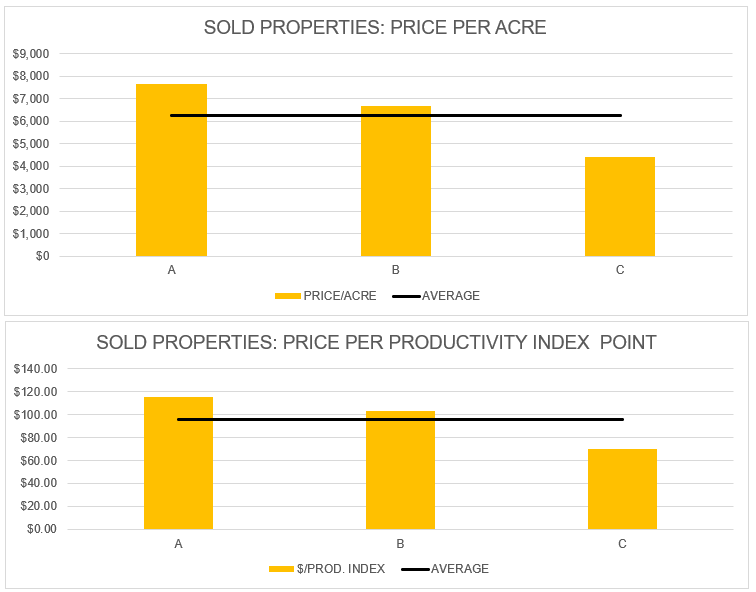
$6,264/acre
Jan. – Dec. 2025*
As high as $7,657/acre
in 2025*
Land Market Commentary & Local Trends
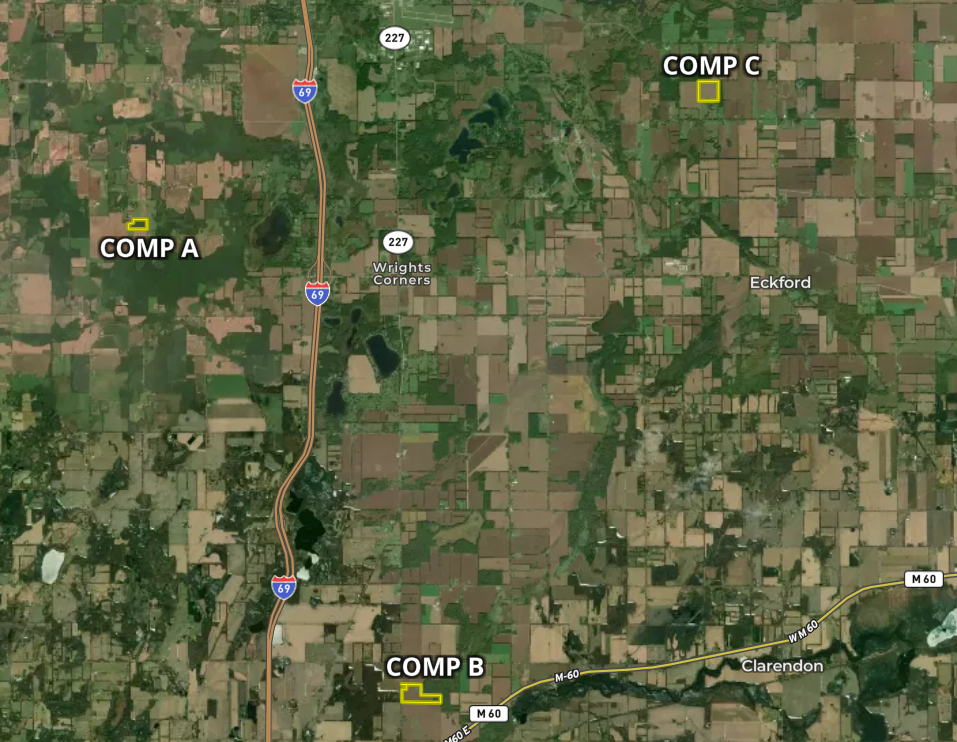
Average farmland values in Calhoun County reached $6,264 per acre in 2025, with pricing averaging $96.19 per productivity index point. Several sales outperformed the average, topping out at $7,657 per acre.
Since 1977, the Geswein Farm & Land Team has been advising landowners to be stewards of the land and make decisions based on most current, accurate, and relevant data. The information in this report can provide you with a rough estimate of your property’s value; however, understanding the specific characteristics of your property and how they compare to the other sales will provide the most accurate value of your property. Additionally, properties sold by land brokers via auctions or listings consistently outperformed individual to individual transactions and properties sold by traditional home realtors.
By The Numbers

History & Background of Calhoun County, Michigan
County Seat: Marshall
Townships: Albion / Athens / Bedford Charter / Burlington / Clarence / Clarendon / Convis / Eckford / Emmett Charter / Fredonia / Homer / Lee / Leroy / Marengo / Marshall / Newton / Pennfield Charter / Sheridan / Tekonsha
History: Established in 1829; Named after John C. Calhoun, a prominent U.S. statesman.
Population: 133,785
Cities & Towns: Battle Creek / Marshall / Albion / Springfield / Homer / Tekonsha / Athens
Acreage: 204,143
Calhoun County in 2025: A Market Defined by Value Sensitivity and Strong Farm Discipline
Calhoun County’s farmland market in 2025 reflected a steady but value-conscious environment, where buyers remained active but increasingly deliberate in how they approached acquisitions. Unlike some of Michigan’s more specialty-driven agricultural regions, Calhoun County continues to lean heavily on traditional row-crop production, which gives its land market a more direct connection to commodity performance, input costs, and farm-level profitability.
Throughout 2025, demand did not disappear – instead, it became more selective. Well-positioned farms with strong soils, efficient layouts, and dependable access continued to generate interest, but buyers were far more focused on aligning purchase decisions with long-term operational performance rather than short-term competition. As a result, the market felt steady, but not aggressive; supported, but more analytical.
For landowners, this shift matters. Calhoun County is still very much a functioning agricultural market, but the way buyers evaluate farmland has tightened. The emphasis has moved further toward usability, consistency, and return-driven decision-making.
Calhoun County Agriculture: A Row-Crop Foundation with Consistent Structure
Agriculture in Calhoun County is anchored by conventional Midwestern production systems, with corn and soybeans forming the backbone of the farming economy. The county’s agricultural profile is built around large-scale, mechanized farming operations, where efficiency and field productivity are central to both land use and land value.
Compared to counties with heavier specialty crop or recreational influence, Calhoun County is more straightforward in how its farmland is used and evaluated. Buyers tend to prioritize soil productivity, field shape, drainage conditions, and operational efficiency above all else. Farms that support consistent row-crop rotations and integrate smoothly into existing farming operations tend to attract the strongest interest.
Livestock-related agriculture and mixed-use farms also exist within the county, but the dominant force in the land market remains crop production. This keeps the valuation conversation closely tied to farm performance and long-term agricultural utility rather than broader lifestyle or alternative-use considerations.
According to the USDA National Agricultural Statistics Service (NASS), the following crop statistics have been reported for Calhoun County, Michigan.
The 2022 Ag Census for Calhoun County, Michigan, reported the following crop statistics:
Number of farms: 898
Land in farms (acres): 204,143
Average farm size (acres): 227
Total market value of products sold: $179,447,000
Government payments: $3,017,000
Farm-related income: $7,030,000
Total farm production expenses: $151,874,000
Net cash farm income: $37,621,000
What Defined Strong vs. Average Farmland in 2025
One of the clearest patterns in Calhoun County during 2025 was the growing separation between highly efficient farmland and more marginally functional tracts.
Premium farms tended to share a few consistent traits. These included strong soil productivity, well-drained fields, clean access, and layouts that allowed for efficient modern equipment operation. Larger contiguous tracts also continued to draw attention, particularly when they reduced inefficiencies and fit neatly into existing farming systems.
These properties remained competitive even in a more cautious buyer environment because they aligned directly with operational value. In other words, they made sense on the balance sheet of a working farm.
On the other end of the spectrum, average-quality tracts experienced a more selective response. Parcels with irregular field boundaries, drainage challenges, limited access, or lower overall efficiency required more patience in the market. While still viable for local operators or expansion-focused buyers, these farms did not benefit from the same level of urgency seen in higher-quality offerings.
This widening gap between top-tier and average ground is one of the key themes shaping Calhoun County heading into 2026.
A Market Influenced by Efficiency, Not Emotion
Calhoun County farmland is increasingly being evaluated through an efficiency-first lens. That means buyers are less interested in general “acre count” and more focused on how each acre performs within a working system.
Factors such as field layout & machinery efficiency, drainage & soil consistency, proximity to existing farm operations, and input cost versus yield potential are playing a larger role in purchase decisions than in previous market cycles.
This shift does not signal weakness in the market. Instead, it reflects a more disciplined buyer base that is closely tied to production agriculture. In a county where farming operations are typically large-scale and highly systemized, land that improves efficiency naturally rises to the top.
Regional Positioning and Its Role in Land Demand
Calhoun County’s location in south-central Michigan places it within reach of several strong agricultural corridors. Its farmland market benefits from proximity to other productive farming regions, which supports a consistent pool of active operators looking to expand or consolidate operations.
Unlike counties closer to major metro expansion zones, Calhoun County is still primarily driven by agriculture rather than suburban development pressure. That helps maintain a clearer connection between land value and farm utility. However, it also means that shifts in commodity markets and input costs tend to have a more immediate impact on buyer behavior.
In this environment, land demand is less speculative and more operational. Buyers are typically evaluating farms based on how they fit into existing or planned agricultural systems, rather than viewing them as long-term development holdings.
Calhoun County’s Agricultural Base Supports Market Stability
One of the stabilizing forces in Calhoun County’s farmland market is the strength of its underlying agricultural base. The county remains firmly rooted in production agriculture, with a network of active operators who understand local soils, field conditions, and long-term productivity trends.
This creates a market dynamic where demand is often supported from within the county and surrounding region. Neighboring farm expansion remains one of the most consistent drivers of land sales, particularly for higher-quality tracts that offer operational advantages.
Even during periods of broader market caution, this type of demand tends to provide a baseline level of stability. Land may not always sell quickly or at aggressive competition levels, but it continues to move when it aligns with practical farming needs.
Early 2026 Trends: Steady Demand, More Selective Buyers
The early part of 2026 suggests that Calhoun County is continuing many of the same trends established in 2025. Buyer activity remains present, but the decision-making process is still highly selective. Farms that offer strong productivity and operational efficiency continue to draw attention, while marginal tracts require more targeted marketing and pricing alignment.
At the same time, there is no indication of a broad slowdown in agricultural interest. Instead, the market appears to be functioning in a more measured state, where buyers are willing to act – but only when the farm clearly supports long-term value.
This environment reinforces the importance of accurate positioning. In Calhoun County, how a farm is presented, described, and structured in the market can significantly influence how it is received.
What Calhoun County Landowners Should Watch in 2026
Looking ahead, there are several key themes landowners should monitor:
Continued focus on efficiency over acreage.
Buyers are prioritizing farms that are easy to operate and integrate into existing systems.
The widening gap between strong and average ground.
Top-tier farms remain competitive, while lower-efficiency tracts may require more strategic pricing.
Local operator demand.
Expansion by neighboring farms continues to be one of the strongest drivers of sales activity.
Input costs and commodity direction.
Farm profitability remains closely tied to buyer behavior, especially for average-quality ground.
Final Thoughts
Calhoun County’s farmland market in 2025 was defined by stability, discipline, and a clear emphasis on farm functionality. It remains a strong agricultural county where land value is closely tied to production potential and operational efficiency.
As 2026 unfolds, that foundation does not appear to be changing. Instead, the market is becoming more refined in how it distinguishes between farms that simply exist as acreage and farms that actively support efficient agricultural production.
For landowners, the key takeaway is straightforward: in Calhoun County, the farms that perform best in the market are the ones that perform best in the field.
Sources / Citations:
Source 1:
“United States Department of Agriculture.” USDA, www.nass.usda.gov/Statistics_by_State/Michigan/Publications/County_Estimates/index.php#:~:text=Access%20Quick%20Stats%20Lite,to%20NASS%20Surveys%20and%20Programs. Accessed 22 June 2026.
Source 2:
“USDA.” 2022 Census of Agriculture County Profile, www.nass.usda.gov/Publications/AgCensus/2022/Online_Resources/County_Profiles/michigan/cp26025.pdf. Accessed 22 June 2026.
*The transaction and land sales data/information contained in this report was obtained from publicly available sources and sales disclosures deemed accurate and reliable but not guaranteed, no liability for accuracy, errors or omissions is assumed by Geswein Farm & Land Realty, LLC
Thinking About Selling?
Need Advice?
Get the guidance, service, and professional expertise you deserve.
- Family Farm Advisory for Succession Planning
- Undivided Interests & Tenants in Common
- Farmland Management Decisions
- Auctions & Listing
With our full-time experienced team, you’ll get our ‘boots on the ground’ work ethic paired with the latest in digital technology & national marketing reach – for best-in-class service and results.
Because you deserve more value.
Contact Us