


Clinton County, Indiana
2026 Land Sales Report
Clinton County farmland values remained resilient throughout 2025, continuing to build on prior years of appreciation, though emerging trends suggest the market may be shifting toward a more balanced and steady pace of 2026 approaches. Land Use & Transitional farms from agriculture to industrial, data centers, and solar farms took center stage.
If you’d like to get specific land values on your own farmland or a farm near you for 2026, please contact Johnny Klemme today at (765) 427-1619.
Average Price of Land*
Avg. $12,840/acre
Jan. – Dec. of 2025*
As high as $17,500/acre
in 2025*
Land Market Commentary & Local Trends
What’s Really Going On With That Clinton County Data Center Fight — And What It Means For Your Farm
If you’ve got land anywhere near Frankfort, Indiana, you’ve probably heard about the big data center fight in Clinton County. And even if you don’t, you should still care, because the same thing could show up in your county next.
Here’s the short version, in plain English, and then I want to answer the questions I keep hearing from folks about what’s actually happening and what it means for landowners like you.
What Happened, 2026 In Plain Terms
A company called Logix Realty wanted to build a massive data center campus on farmland just outside Frankfort. We’re talking a data center, a concrete plant, and even a hydroponic “farm” all in one — on land that had been growing corn and soybeans for generations. They started out asking to rezone about 153 acres from agricultural to industrial back in mid-2025. By the time it hit the county commissioners in January 2026, that ask had grown to over 700 acres.
Folks showed up to hearing after hearing. A lot of them weren’t against progress — they just didn’t want to lose good farmland, or worry about their wells running dry. On January 20, 2026, the Clinton County Commissioners voted 3-0 to say no (WIBC 93.1 FM). The company can’t reapply on that same piece of ground for a full year (Citizen Portal).
But that’s not the end of the story. The county also put a pause on new battery storage facilities while they figure out proper rules (Clinton County Today), a $200 million solar farm is moving ahead on rockier ground north of town (WLFI News 18), and the county is redoing its whole comprehensive land-use plan right now (Clinton County Planning Commission). None of this is really over. It’s just paused.
I’ve personally sold farmland less than fifteen miles from where all this is happening, so I’ve been paying close attention. And I think the questions people are asking about it are worth answering honestly — not with a bunch of spin, one way or the other.
The Questions I’m Hearing — Answered Straight
“Is this going to dry up our wells?”
This is the number one worry, and it’s a fair one. Residents raised concerns about the Tippecanoe River Basin aquifer and how much water a facility like this would actually pull each day (KNS Radio Network. Here’s the honest answer: nobody has a perfect number yet. Water use from data centers is genuinely hard to pin down and even harder to regulate, which is exactly why Governor Braun ordered a statewide water study due by the end of this year (Reporter.net). If you’re near a proposed project, this is a legitimate question to keep asking loudly at every hearing.
“Is losing farmland worth the tax money?”
This is the real heart of the debate, and reasonable people land on both sides. The county gets new tax base and jobs; the community loses ground that’s fed families for generations. There’s no universal right answer — it depends on the specific ground, the specific project, and what that community values most. What I’d tell any landowner: don’t let someone else’s tax-revenue argument make your decision for you. Your farm’s value and your family’s goals come first.
“They said no — so is this really over?”
Not necessarily. The commissioners’ denial means Logix can’t come back to that exact piece of ground for 12 months (WIBC 93.1 FM). That’s a pause, not a permanent “no.” If you own ground near a project like this, treat that year like a planning window — a good time to get your farm valued, talk to your attorney, and get your affairs in order before the next petition shows up.
“What’s happening with these battery storage ‘farms’ everybody’s talking about?”
Clinton County put a one-year moratorium on new battery energy storage systems (BESS) so they could write real zoning rules — proper setbacks, fire safety standards, the works — since existing rules just weren’t built for this technology (Clinton County Today). As of this summer, the county appointed a committee to finish those rules before the moratorium runs out (Citizen Portal). Expect more of these proposals once the rules are in place.
“Is my farmland worth more or less because of all this?”
Here’s some good news, backed by real numbers: Purdue’s 2026 farmland outlook shows Indiana land values held near record levels through 2025 — top-quality ground averaging almost $14,826 an acre statewide — even while crop prices and farm income were soft. A big reason? Development pressure from solar, industrial growth, and yes, data centers (Purdue Center for Commercial Agriculture). Purdue’s own researchers noted this pressure can spill over into neighboring counties too, especially through 1031 exchange activity. We saw this ourselves this spring — our 602-acre auction spanning Clinton, Montgomery, and Tippecanoe counties, near the Eli Lilly LEAP District and I-65, drew serious interest from investors as much as farmers (AgriNews). Bottom line: being near this kind of activity, even if you never sell to a developer, is quietly changing what your ground is worth.
“Will the power grid even handle this stuff?”
It’s a real concern residents keep bringing up — worries about strained power and possible brownouts if big industrial users move in without upgrades to match. It’s a fair question to ask any developer or utility company at a public hearing, and one the county should be pressing for real answers on before approving anything new.
What This Means For You
You don’t have to own land next door to a data center or solar farm for this story to matter to you. If your farm sits anywhere near a growth corridor, an energy project, or a county that’s updating its land-use rules, the same forces may be at work on your ground’s value and your options.
I’m not here to tell you to sell, and I’m not here to tell you to hold. What I am telling you is: don’t wait for a rezoning notice to show up in your mailbox to start thinking this through. Get your ground valued or contact us for an agricultural appraisal. Talk to your family. Know your options — whether that’s a straight sale, a Buyer’s Choice auction, or rolling into new ground through a 1031 exchange.
That’s the whole point of everything we do at Geswein Farm & Land — helping families and landowners make this decision on their own terms, on their own timeline, instead of somebody else’s.
Got a question about what’s happening with land use or values near you? Reach out — I’m always happy to talk it through, no pressure, no obligation.
Sources:
-
WIBC 93.1 FM — “Clinton County Commissioners Reject Rezoning Proposal for Data Center”
-
KNS Radio Network — “Proposed Data Center Rezoning Heads To Public Hearing In Clinton County”
-
KNS Radio Network — “Clinton County Commissioners: Data Center”
-
WLFI News 18 — “1,700-acre solar farm close to breaking ground in Clinton County”
- Purdue Center for Commercial Agriculture — “2026 Farmland and Cash Rent Outlook”
-
AgriNews — “Tight land supply meets rare opportunity in large-scale farmland auction”
-
Reporter.net — “Data centers’ water use and disposal isn’t easy to understand or legislate”
Farmland Sales & Price Per Acre
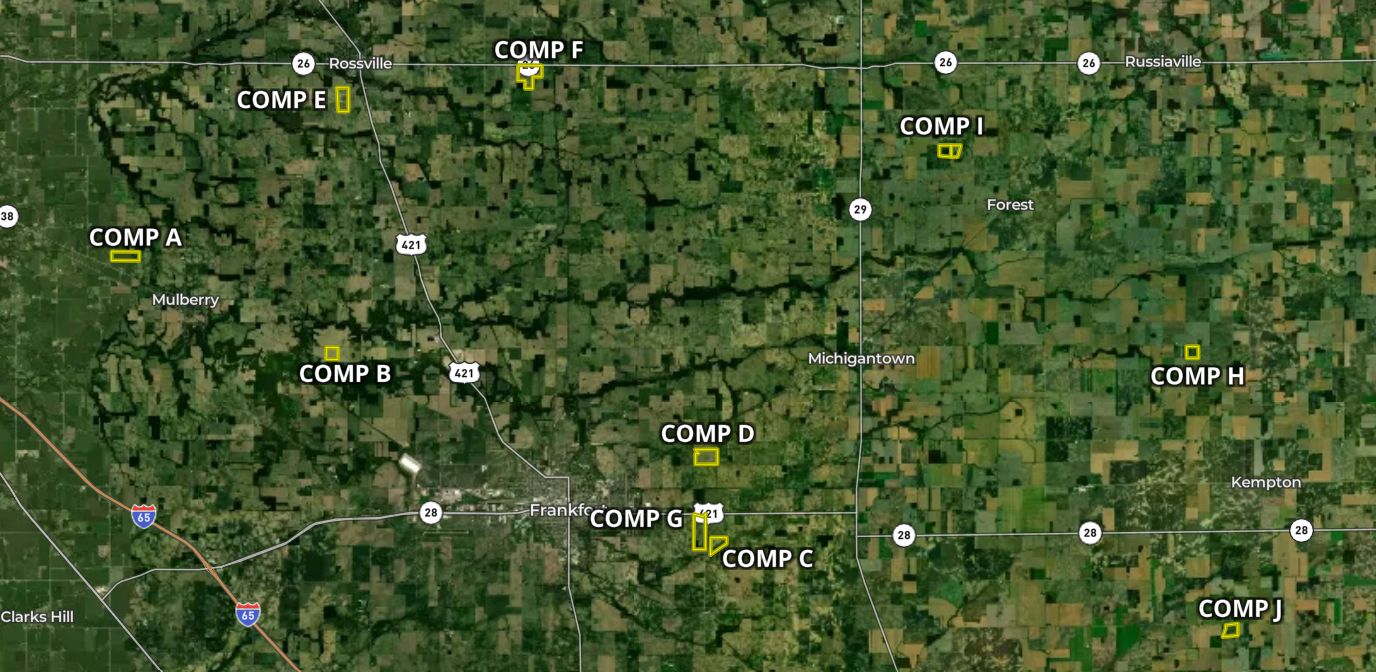
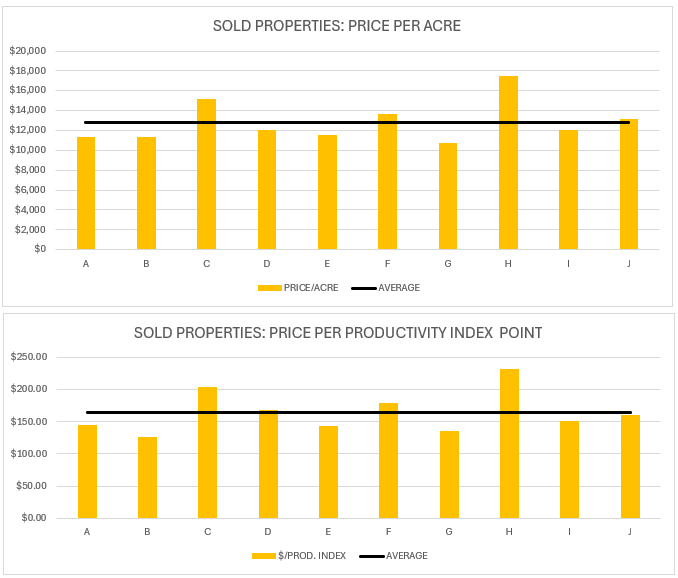
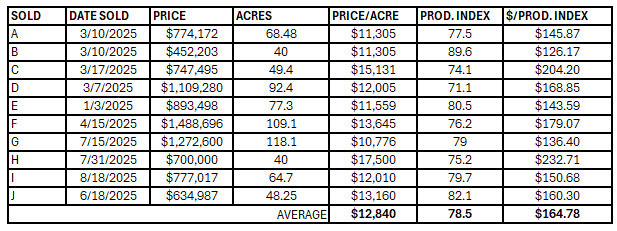
Across our sampled 2025 farmland sales data, the average price was $12,840 per acre, with an average of $164.78 per productivity index point based on the sales below. While these figures reflect the broader market, it is worth noting that some 2025 farmland sales reached as high as $17,500 per acre, offering important insight into land values heading into 2026.
Since 1977, the Geswein Farm & Land Team has been advising farmland owners on the sale, management, and stewardship of land based on most current, accurate, and relevant data. The information in the sampled data report below can provide you with a rough estimate of your farmland value; however, understanding the specific characteristics of your property and how they compare to the other sales will provide the most accurate value of your property. Additionally, properties sold by land brokers via auctions or listings consistently outperformed individual to individual transactions and properties sold by traditional home realtors.
By The Numbers
What Changed in from 2025 to 2026?
Clinton County’s farmland market in 2025 continued to demonstrate why this area remains one of Indiana’s dependable agricultural performers – but the year was less about runaway growth and more about market maturity. After several years of substantial appreciation, the county’s land market began showing signs that buyers were no longer simply chasing acres – they were chasing quality, efficiency, and return potential.
The average farmland values in Clinton County point to a county that continues to command strong respect from buyers, but the real story lies in how the top end of the market behaved. Premium sales pushed as high as $17,500 per acre, proving that Clinton County’s best farms – those with strong soils, dependable drainage, and efficient field structure – still drew aggressive competition.
What changed most from 2024 was not necessarily whether land remained valuable, but how buyers defined value. Rather than broad enthusiasm lifting nearly every tract, 2025 increasingly became a year where the county’s highest-performing farms separated themselves from average ground. In Clinton County, where agriculture remains a dominant economic force, this shift suggests the market is becoming more strategic. Heading into 2026, landowners may find that farm-specific strengths matter more than ever.
Market Activity & Pricing
Per Land.com, activity suggests Clinton County continues to maintain a healthy but measured level of rural land inventory, with nearly $16 million in farms and rural real estate currently marketed across roughly 1,000 acres. While Clinton County may not carry the sheer listing volume of some larger Indiana counties, its market remains active enough to provide useful insight into both buyer demand and available supply.
Frankfort continues to anchor much of the county’s active land market, reflecting both its economic importance and central role within Clinton County. Covering approximately 405 square miles, Clinton County’s geography supports a land market heavily rooted in agricultural productivity rather than large-scale development pressure.
This distinction matters. In Clinton County, farmland values are still shaped primarily by what the land can produce, how efficiently it can be farmed, and how attractive it is to local operators or regional investors seeking stable agricultural returns. Because of that, listings prices often tell only part of the story – real value is frequently tied to productivity, drainage, and long-term farm performance.
Overview of Clinton County Agriculture
Clinton County has long been recognized for its strong agricultural foundation, particularly through row-crop production centered around corn and soybeans. The county’s farmland market is largely built on this productive base, making agricultural fundamentals the central force behind land valuation.
Top-tier farmland in Clinton County is typically associated with strong productivity ratings, quality drainage infrastructure, efficient field shape, and larger contiguous acreage that supports modern equipment and economies of scale. These farms often represent the county’s most competitive land offerings because they align directly with operator profitability.
Clinton County’s farmland market is not entirely uniform. Average or lower-tier tracts may face challenges tied to drainage inconsistency, less efficient layouts, or lower productivity soils. In 2025, these differences became increasingly important. Buyers appeared more willing to pay for certainty – certainty in yield potential, operational ease, and long-term return – than for acreage alone.
Since Clinton County is less influenced by urban sprawl than some nearby counties, its land market often behaves more like a true agricultural value system. That means soil, structure, and stewardship can have an outsized impact on price performance.
History & Background of Clinton County, Indiana: Home of the Hot Dog Festival
County Seat: Frankfort
Townships: Center / Forest / Jackson / Johnson / Kirklin / Madison / Michigan / Owen / Perry / Ross / Sugar Creek / Union / Warren / Washington
History: Named for DeWitt Clinton, early American politician and former governor of the state of New York
Population: 32,843
Cities & Towns: Frankfort / Colfax / Kirklin / Michigantown / Mulberry / Rossville
Acreage: 238,786
Clinton County Agriculture Snapshot
Much of the foundational demographic and agricultural framework for Clinton County comes from the USDA Census of Agriculture, which is updated every five years. While this data does not change annually, it remains an important benchmark for understanding the county’s broader agricultural identity.
For Clinton County, that identity remains firmly rooted in production agriculture. The county’s long-standing emphasis on row crops continues to support consistent land demand, and that structural stability helps explain why farmland values have remained resilient even as broader economic conditions shift.
For landowners and prospective sellers, this long-term USDA data is most useful when paired with current market activity – providing both the historical framework and the real-time buyer behavior necessary to understand where Clinton County’s land market stands today.
The 2022 Ag Census for Clinton County, Indiana, reported the following crop statistics:
Number of farms: 526
Land in farms (acres): 205,912
Average farm size (acres): 391
Total market value of products sold: $274,170,000
Government payments: $1,111,000
Farm-related income: $10,009,000
Total farm production expenses: $221,927,000
Net cash farm income: $63,364,000
Clinton County Field Notes: Local Drivers, Community Activity & Landowner Focus
Clinton County’s local pulse is shaped by a steady mix of agricultural production, small-city stability, and infrastructure-connected activity around Frankfort. Rather than rapid change, the county’s momentum tends to come from incremental shifts that still matter to landowners – especially those tied to farming efficiency, community growth, and long-term land use decisions.
Clinton County topics to watch in 2025-2026:
Frankfort’s Role as the County Hub
Frankfort continues to anchor much of Clinton County’s activity, from local services and government operations to retail and employment. As the county seat, it remains a key driver of how population concentration and nearby development influence surrounding rural land demand.
U.S. Highway 421 & I-65 Corridor Influence
Clinton County’s location along major transportation routes – including proximity to I-65 and access via U.S. 421 – continues to play a meaningful role in land value dynamics. These corridors support both agricultural logistics and broader connectivity to regional markets, which can influence buyer interest in nearby properties.
Strong Row-Crop Identity Across the County
Clinton County remains firmly rooted in corn and soybean production, and that consistency continues to shape land expectations. Local conversations often center on maintaining productivity, managing input costs, and preserving long-term soil health across highly farmed ground.
Land Ownership Transition & Generational Farming
Like many established agricultural counties, Clinton County is seeing continued attention on farm succession planning and ownership transitions. Elevated land values have made long-term planning more important for families deciding how and when to transition assets.
In Clinton County, the local story is not driven by rapid disruption, but by steady agricultural performance and infrastructure-linked stability. For landowners, that means the most important changes are often the subtle ones – how farms are operated, how families plan ahead, and how connectivity continues shaping land value over time.
What Landowners Should Watch in 2026
As Clinton County moves into 2026, the biggest question may not be whether farmland remains valuable – it’s what type of farmland remains most competitive.
Several factors are likely to shape the year ahead, including interest rates, crop profitability, land availability, and buyer confidence. Clinton County’s market has historically benefited from a strong agricultural backbone, but as borrowing costs and operational margins fluctuate, buyer discipline may continue sharpening.
For landowners, this means understanding where their farm sits within the county’s value hierarchy. Highly productive, well-maintained farms with strong drainage and efficient acreage are likely to remain the county’s most resilient assets. Meanwhile, farms with more limitations may face a market where buyers negotiate harder and prioritize return more carefully.
2026 Market Scenarios
Looking ahead, several outcomes could influence Clinton County’s farmland trajectory:
If interest rates ease: Buyer confidence may strengthen, especially for premium tillable farms.
If grain margins remain under pressure: Buyers may continue prioritizing only the strongest tracts, widening the value gap between top-end and average farms.
If more land comes to market: Greater supply may create additional pricing pressure, particularly on less competitive parcels.
If local operators remain financially strong: Clinton County could continue benefiting from stable demand rooted in long-term agricultural confidence.
Overall, 2026 may be a year where Clinton County landowners benefit most from preparation and positioning rather than assuming broad market momentum. In a county where agriculture still drives value, the farms most likely to stand out are those that combine productivity, efficiency, and long-term operational appeal.
Sources / Citations:
Source 1:
“United States Department of Agriculture.” USDA, www.nass.usda.gov/Statistics_by_State/Indiana/Publications/County_Estimates/index.php#:~:text=Access%20Quick%20Stats%20Lite,to%20NASS%20Surveys%20and%20Programs. Accessed 11 May 2026.
Source 2:
“USDA.” 2022 Census of Agriculture County Profile, www.nass.usda.gov/Publications/AgCensus/2022/Online_Resources/County_Profiles/Indiana/cp18029.pdf. Accessed 11 May 2026.
*The transaction and land sales data/information contained in this report was obtained from publicly available sources and sales disclosures deemed accurate and reliable but not guaranteed, no liability for accuracy, errors or omissions is assumed by Geswein Farm & Land Realty, LLC
Thinking About Selling? Unsure what to do about the family farm?
Need Advice?
Get the guidance, service, and professional expertise you deserve.
- Family Farm Advisory for Succession Planning
- Undivided Interests & Tenants in Common
- Farmland Management Decisions
- Auctions & Listing
With our full-time experienced team, you’ll get our ‘boots on the ground’ work ethic paired with the latest in digital technology & national marketing reach – for best-in-class service and results.
Because you deserve more value.
Contact Us