


Delaware County, Indiana
2026 Land Sales Report
Following a period of sustained growth, Delaware County farmland continued to post solid values in 2025. Looking ahead to 2026, the market appears to be transitioning toward a more balanced pace, with price gains becoming more moderate.
If you’d like to get specific land values on your own property or a farm near you for 2026, please contact Hunter Hardebeck today at (765) 426-0159.
Average Price of Land*
$13,794/acre
Jan. – Dec. 2025*
As high as $16,728/acre
in 2025*
Land Market Commentary & Local Trends
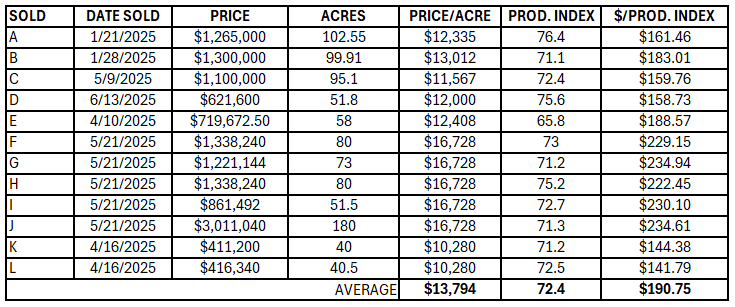
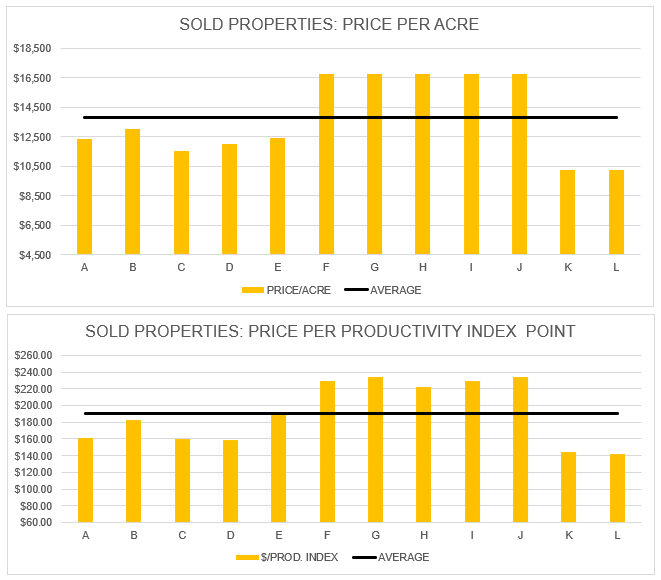
The Delaware County farmland market remained strong in 2025, with an average sale price of $13,794 per acre and an average of $190.75 per productivity index point. While the average sale reflects a healthy market, premium tracts continued to command significant interest, with one of the highest recorded sales reaching $16,728 per acre.
Since 1977, the Geswein Farm & Land Team has been advising landowners to be stewards of the land and make decisions based on most current, accurate, and relevant data. The information in this report can provide you with a rough estimate of your property’s value; however, understanding the specific characteristics of your property and how they compare to the other sales will provide the most accurate value of your property. Additionally, properties sold by land brokers via auctions or listings consistently outperformed individual to individual transactions and properties sold by traditional home realtors.
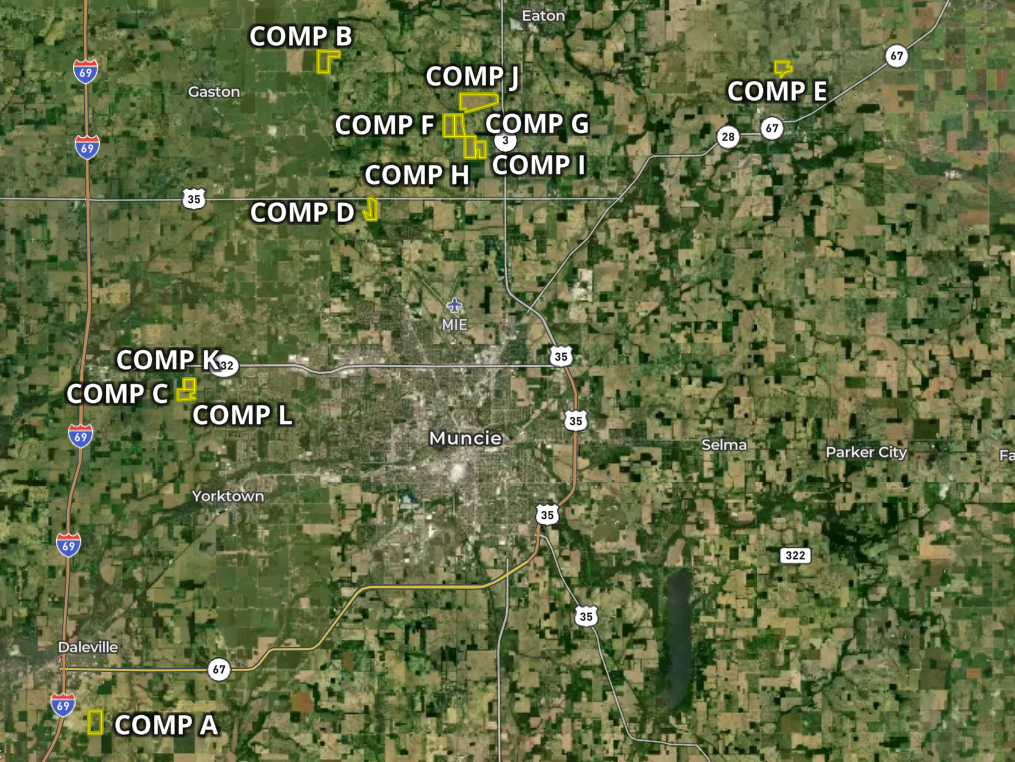
By The Numbers
Delaware County in 2025: Consistency in an Evolving Landscape
Delaware County’s farmland market in 2025 demonstrated a balance that many agricultural regions strive for: strong agricultural fundamentals paired with a diversified local economy. While farmland values across Indiana have generally entered a more measured phase following several years of rapid appreciation, Delaware County continued to benefit from steady demand for productive farmland and a reputation for high-quality row-crop production.
What made 2025 particularly noteworthy was the market’s consistency. Rather than being defined by a handful of extraordinary transactions, the county saw continued interest in productive tillable acreage from both local operators and long-term agricultural investors. Buyers remained active, but increasingly focused on efficiency, productivity, and operational fit rather than simply expanding acreage at any cost.
As the market looks toward 2026, Delaware County appears positioned as a county where agricultural performance remains the primary driver of value, even as broader economic factors continue influencing buyer behavior.
Agriculture and Economic Diversity: A Unique Combination
Delaware County occupies an interesting position within East-Central Indiana. Agriculture remains a cornerstone of the county’s landscape, but unlike some neighboring counties that are almost entirely agriculture-driven, Delaware County benefits from a broader economic foundation.
The presence of education, healthcare, manufacturing, and service-sector employment helps create a stable economic environment that supports rural communities throughout the county. This diversity can be particularly important during periods of agricultural uncertainty, providing additional economic activity that helps sustain local businesses and services.
For landowners, this means farmland values are supported not only by crop production but also by the overall health and stability of the surrounding region.
According to the USDA National Agricultural Statistics Service (NASS), the following crop statistics have been reported for Delaware County, Indiana.
The 2022 Ag Census for Delaware County, Indiana, reported the following crop statistics:
Number of farms: 506
Land in farms (acres): 156,043
Average farm size (acres): 308
Total market value of products sold: $156,243,000
Government payments: $523,000
Farm-related income: $7,357,000
Total farm production expenses: $115,416,000
Net cash farm income: $48,708,000
Quality Continues to Separate Itself
One of the clearest themes emerging from Delaware County’s 2025 market activity was the continued importance of farm quality.
Highly productive farms featuring strong soils, effective drainage systems, and efficient field layouts continued to attract the strongest buyer interest. In many cases, these tracts generated competition because they offered operators the opportunity to maximize productivity while controlling costs.
At the same time, buyers appeared increasingly selective when evaluating average-quality properties. Factors such as field shape, accessibility, drainage concerns, and tillable percentages played a larger role in purchasing decisions than they may have during the more aggressive market conditions seen several years ago.
The result is a market that increasingly rewards operational efficiency and long-term productivity rather than treating all acres equally.
Community Spotlight: What’s Happening in Delaware County?
While agriculture remains central to the county’s identity, several local developments and community trends continue shaping Delaware County’s future.
Muncie’s Continued Revitalization Efforts
As the county seat and largest city in the county, Muncie continues to see investment aimed at strengthening downtown activity, housing opportunities, and community development. These efforts help support the broader regional economy and contribute to long-term confidence in the area.
Ball State University’s Regional Impact
The presence of Ball State University continues to be one of Delaware County’s defining advantages. Beyond education, the university supports workforce development, research initiatives, cultural opportunities, and economic activity that extend throughout the county.
Manufacturing and Innovation
Manufacturing remains an important part of Delaware County’s economic identity. Ongoing investment in advanced manufacturing and workforce training initiatives continues to support employment and economic stability across the region.
Quality of Life and Community Investment
Local leaders continue focusing on parks, trails, housing, and community amenities that help attract and retain residents. While these projects may not directly affect farmland values, they contribute to the county’s overall attractiveness and long-term economic health.
History & Background of Delaware County, Indiana
County Seat: Muncie
Townships: Center / Delaware / Hamilton / Harrison / Liberty / Monroe / Mount Pleasant / Niles / Perry / Salem / Union / Washington
History: Formed in 1827; named for the Delaware Native American Tribe.
Population: 111,000
Cities & Towns: Muncie / Albany / Chesterfield / Daleville / Eaton / Gaston / Selma / Yorktown
Acreage: 252,800
What Landowners Should Watch in 2026
As Delaware County moves into 2026, several factors are likely to influence both farmland demand and market activity.
Key areas to monitor include:
Commodity prices and farm profitability
Interest rate movement and financing costs
Availability of farmland for sale
Continued demand from local operators
Broader economic conditions throughout East-Central Indiana
One trend worth watching is whether the county’s strongest farms continue outperforming the broader market. Recent activity suggests buyers remain willing to compete aggressively for high-quality acreage, particularly when productive farms come to market in areas with strong farming operations.
At the same time, a larger supply of available land or changes in farm profitability could create greater differentiation between premium and average-quality tracts.
Final Takeaway
Delaware County’s farmland market in 2025 was defined less by dramatic shifts and more by steady confidence in productive agricultural land. The county continues to benefit from a strong farming foundation, a diversified economy, and institutions that support long-term regional stability.
As 2026 approaches, the market appears positioned to reward the same characteristics that have historically driven value in Delaware County: productivity, stewardship, and operational efficiency. For landowners, understanding those fundamentals may be just as important as watching broader economic headlines.
Sources / Citations:
Source 1:
“United States Department of Agriculture.” USDA, www.nass.usda.gov/Statistics_by_State/Indiana/Publications/County_Estimates/index.php#:~:text=Access%20Quick%20Stats%20Lite,to%20NASS%20Surveys%20and%20Programs. Accessed 2 June 2026.
Source 2:
“USDA.” 2022 Census of Agriculture County Profile, www.nass.usda.gov/Publications/AgCensus/2022/Online_Resources/County_Profiles/Indiana/cp18035.pdf. Accessed 2 June 2026.
*The transaction and land sales data/information contained in this report was obtained from publicly available sources and sales disclosures deemed accurate and reliable but not guaranteed, no liability for accuracy, errors or omissions is assumed by Geswein Farm & Land Realty, LLC
Thinking About Selling?
Need Advice?
Get the guidance, service, and professional expertise you deserve.
- Family Farm Advisory for Succession Planning
- Undivided Interests & Tenants in Common
- Farmland Management Decisions
- Auctions & Listing
With our full-time experienced team, you’ll get our ‘boots on the ground’ work ethic paired with the latest in digital technology & national marketing reach – for best-in-class service and results.
Because you deserve more value.
Contact Us