


When it comes to inheriting farmland, fair and equal aren’t always the same thing. One heir may have spent decades farming the property. Another may have built a career away from agriculture. One may need liquidity while another wants to continue owning land for the long term. Another may have contributed labor, management or capital to the operation. Treating everyone identically doesn’t usually account for those different circumstances, which is why farmland succession planning should begin well before the inheritance happens with a conversation about what fair actually means for the family.
One way to bring more structure to these conversations is to consider the LAND VALUES framework. Created by Johnny Klemme, this framework encourages families to look beyond the acreage and market value of the property, and consider the broader values connected to the land, the family and the future.
Here’s how to do that:
L — Legacy
What does the land represent to the family? What traditions, stories and accomplishments are connected to it? What does the family hope future generations will remember?
A — Agriculture
Who wants to farm? Is maintaining an operating farm an important family goal? What does the next generation need to remain viable in agriculture?
N — Needs
What does each heir actually need? One may need liquidity while another may have a greater need or desire for long-term land ownership. Financial circumstances matter when considering what an equitable plan might look like.
D — Decisions
Who should make decisions about the land in the future? If multiple heirs become co-owners, how will decisions about leasing, selling, improvements or management be made?
V — Values
What principles matter most to the family? Stewardship? Independence? Keeping the land intact? Supporting the next generation? Maximizing financial value? Families should identify those priorities rather than assuming everyone shares the same definition of success.
A — Assets
What else is available besides the farmland? Retirement accounts, investments, life insurance, equipment, buildings and other assets may provide ways to create an equitable inheritance without dividing the farm itself.
L — Livelihood
For a farming heir, the land may not simply be an investment. It may be the foundation of livelihood. Understanding the economic role the property plays can be critical when designing a succession plan.
U — Understanding
Does everyone understand the plan, the reasoning behind it and the implications of different ownership structures? A plan that makes sense on paper can still create conflict if family members don’t understand how it was developed.
E — Expectations
What does each person expect to happen? Expectations that remain unspoken can become some of the biggest sources of conflict after a transition.
S — Stewardship
Who will care for the land going forward? Stewardship can include farming practices, conservation, improvements, relationships with tenants and the long-term condition of the property.
Using the LAND VALUES framework doesn’t determine who gets what. Instead, it provides a way to ask better questions before the family makes those decisions. It allows families to consider the heirs’ contributions alongside the property’s financial value and each heir’s future need. An inheritance doesn’t necessarily have to mean everyone receives the same number of acres. There may be other ways to create equitable outcomes. The possibilities depend on the family’s assets, goals and legal and tax circumstances.
The point is to avoid assuming that an equal division of acreage is the only definition of fairness. Sometimes the best solution is to recognize that heirs have different interests in the land. A thoughtful succession plan can explore whether the family’s assets can be structured to accommodate different goals while preserving as much value as possible.
Emotions can run high when it comes to farmland. Generations have worked the land, celebrated holidays in the farmhouse, raised children and built a livelihood in the same place decade after decade. This is why understanding what matters to each person can help families make decisions with fewer surprises later.
The LAND VALUES framework helps move the conversation from “How many acres does everyone get?” to “What does this land mean, what does each person need and what kind of legacy are we trying to create?”
Estate planning professionals can find additional resources to share with clients at americanfamilyfarmland.com/farmland-support-for-professional-advisors.
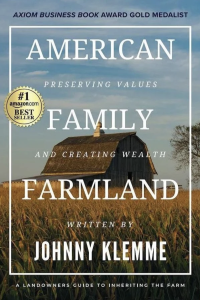
Johnny Klemme works with farm families, landowners, investors and advisors navigating the challenges of inherited farmland, succession and legacy. He explores these same themes in his bestselling book, “American Family Farmland: Preserving Values and Creating Wealth,” bringing real-world insights to audiences nationwide and helping organizations spark meaningful conversations about land, family, wealth and legacy.
If you would like to have Johnny speak at your next meeting, conference or event, or would like copies of his book for your next function, please contact Kristen Schmitt at smallpresspublicist@gmail.com.


