


Grant County, Indiana
2026 Land Sales Report
Grant County farmland values remained firm throughout 2025, supported by steady demand for quality agricultural land. As the market moves into 2026, early trends suggest price growth may begin leveling into a more stable pace.
If you’d like to get specific land values on your own property or a farm near you for 2026, please contact Hunter Hardebeck today at (765) 426-0159.
Average Price of Land*
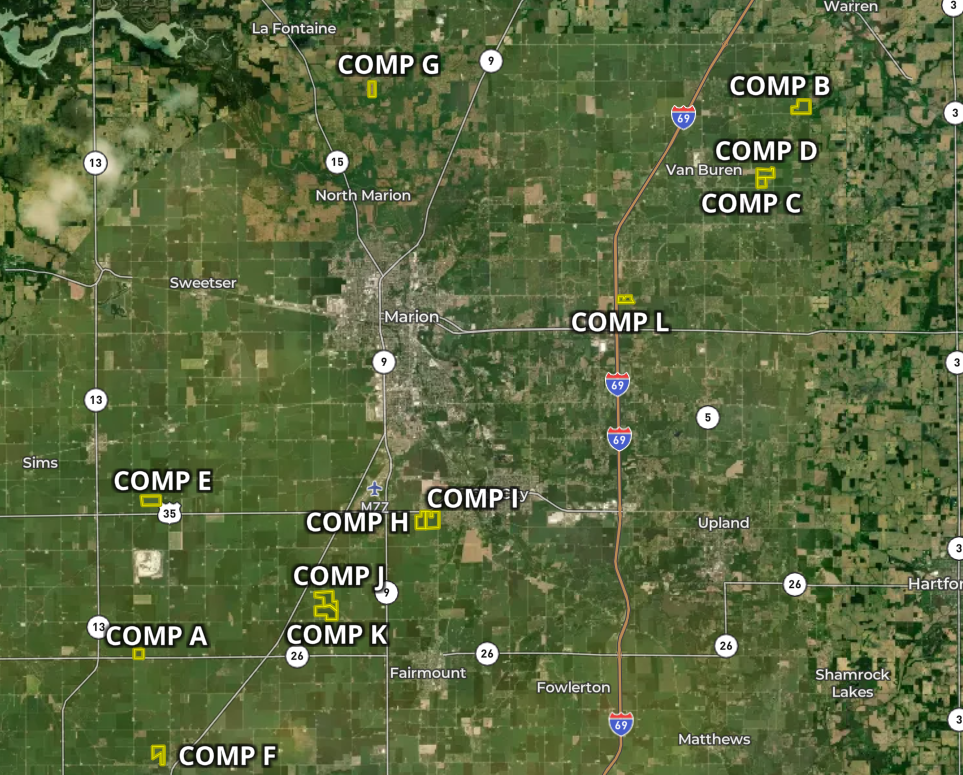
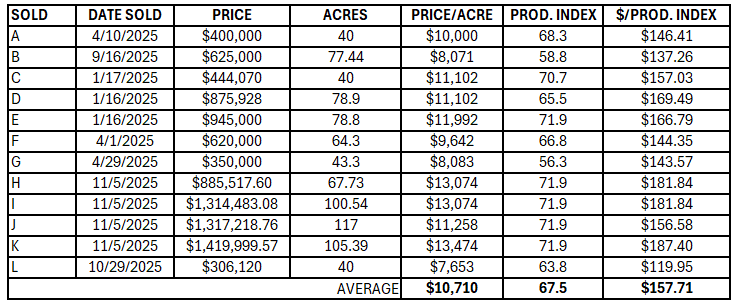
$10,710/acre
Jan. – Dec. 2025*
As high as $13,474/acre
in 2025*
Land Market Commentary & Local Trends
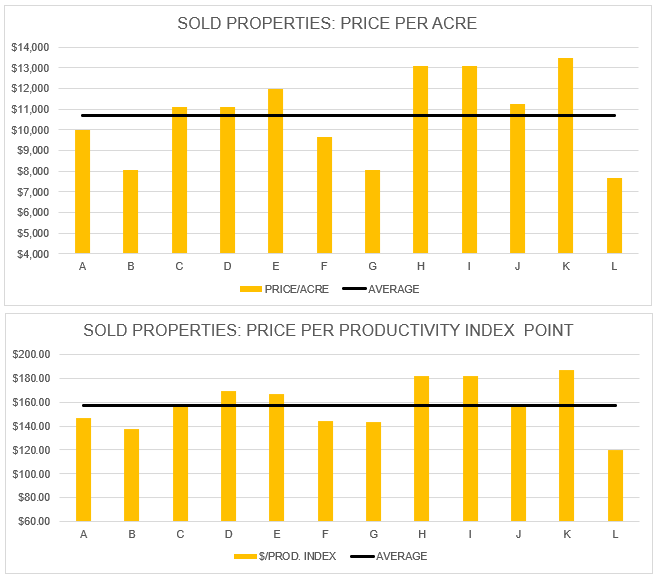
Based on 2025 sales data, Grant County farmland averaged $10,710 per acre, with an average value of $157.71 per productivity index point. While the overall market remained steady, top-performing farmland sales reached as high as $13,474 per acre, reflecting continued demand for quality agricultural ground heading into 2026.
Since 1977, the Geswein Farm & Land Team has been advising landowners to be stewards of the land and make decisions based on most current, accurate, and relevant data. The information in this report can provide you with a rough estimate of your property’s value; however, understanding the specific characteristics of your property and how they compare to the other sales will provide the most accurate value of your property. Additionally, properties sold by land brokers via auctions or listings consistently outperformed individual to individual transactions and properties sold by traditional home realtors.
By The Numbers
Grant County in 2025: A Market Built on Practical Agriculture
Grant County’s farmland market in 2025 reflected something increasingly valuable in today’s land environment: stability rooted in agriculture itself. While some Indiana counties continue seeing values shaped by suburban expansion or industrial development pressure, Grant County remained much more closely tied to traditional farm fundamentals – productivity, efficiency, and long-term operator demand.
For the full 2025 market year, Grant County’s farmland values showed that buyers were still competing for strong farms, even as overall market conditions became more selective across Indiana.
Unlike counties where a handful of exceptional development-driven sales dramatically skew averages, Grant County’s market continued behaving more consistently. The spread between the county average and the top-end sale suggests a market where farmland values remained grounded in agricultural performance rather than speculative pricing pressure.
For many landowners, 2025 reinforced the idea that Grant County continues to operate as a working-farm market first.
History & Background of Grant County, Indiana
County Seat: Marion
Townships: Center / Fairmount / Franklin / Green / Jefferson / Liberty / Mill / Monroe / Pleasant / Richland / Sims / Van Buren / Washington
History: Established in 1831; Named after Captains Samuel and Moses Grant, military officers killed north of the Ohio River
Population: 66,674
Cities & Towns: Fairmount / Fowlerton / Gas City / Jonesboro / Marion / Matthews / Swayzee / Sweetser / Upland / Van Buren
Acreage: 265,536
Grant County’s Land Market: Productivity Still Leads the Conversation
In Grant County, farmland value is still largely determined by how well the land performs operationally. Buyers continue prioritizing productive soils, drainage quality, farm efficiency, parcel accessibility, & long-term yield reliability.
That focus became increasingly noticeable in 2025 as buyers across Indiana became more disciplined with higher borrowing costs and tighter farm margins. In Grant County specifically, farms with strong operational characteristics continued attracting attention, while average-quality tracts often faced more measured bidding activity.
This shift does not necessarily signal weakness—it signals a market becoming more selective. Buyers are still willing to pay for quality, but they are increasingly evaluating farms through a profitability lens rather than simply competing for available acreage.
Agriculture Remains Central to Grant County’s Identity
Grant County’s agricultural landscape continues to play an important role in the county’s broader economy and rural character. Corn and soybean production remain dominant across much of the area, and farmland continues serving as both a productive asset and a long-term investment for many local operators and landowners.
Compared to rapidly expanding metro-adjacent counties, Grant County’s farmland market tends to move at a steadier pace. That often creates a more grounded pricing structure where values are influenced less by outside speculation and more by agricultural consistency.
For landowners, that can provide a different type of market confidence—one tied more directly to farm performance than development cycles.
According to the USDA National Agricultural Statistics Service (NASS), the following crop statistics have been reported for Grant County, Indiana.
The 2022 Ag Census for Grant County, Indiana, reported the following crop statistics:
Number of farms: 457
Land in farms (acres): 159,502
Average farm size (acres): 349
Total market value of products sold: $167,757,000
Government payments: $540,000
Farm-related income: $5,469,000
Total farm production expenses: $110,282,000
Net cash farm income: $63,485,000
County Outlook: What’s Driving Conversation in Grant County?
While agriculture remains a major focus, several county-specific developments and community trends continue shaping Grant County’s broader local landscape.
Local topics and regional watchpoints in 2025–2026 include:
Marion’s Economic Revitalization Efforts
As the county seat and largest city in Grant County, Marion continues seeing attention surrounding downtown investment, workforce development, and economic revitalization initiatives aimed at strengthening long-term community growth.
Manufacturing & Industrial Presence
Grant County’s manufacturing base remains an important part of the local economy, contributing to employment stability and helping support broader regional activity beyond agriculture alone.
Rural Housing & Community Stability
Many smaller communities throughout Grant County continue focusing on maintaining local services, housing availability, and rural quality of life – factors that indirectly support long-term landowner confidence.
Agricultural Efficiency & Input Costs
Like much of Indiana farm country, local producers continue watching fertilizer pricing, equipment costs, interest rates, and commodity margins closely as they evaluate expansion and operational decisions.
What Landowners Should Watch in 2026
Looking ahead, Grant County’s farmland market may continue rewarding consistency and operational quality over aggressive speculation.
Key factors to monitor:
Interest rate movement and borrowing conditions
Commodity prices and farm profitability
Local farmland inventory levels
Buyer selectivity toward premium acreage
Continued operator demand for productive tracts
Possible 2026 market scenarios:
If crop margins improve: Buyer confidence could strengthen for quality farmland
If rates remain elevated: Buyers may continue prioritizing only top-performing farms
If inventory increases: More competition among sellers could create pricing separation
If supply remains limited: Stable demand may continue supporting values
Final Takeaway: Grant County Continues to Reflect Agricultural Fundamentals
Grant County’s 2025 farmland market did not rely on dramatic headlines to demonstrate value. Instead, it reflected a more traditional agricultural market—one where productivity, operational strength, and buyer discipline continue driving outcomes.
For landowners, that may be one of the county’s greatest strengths moving into 2026. In Grant County, farmland values still tend to reflect what the land can consistently do year after year—and in today’s environment, that kind of stability continues to matter.
Sources / Citations:
Source 1:
“United States Department of Agriculture.” USDA, www.nass.usda.gov/Statistics_by_State/Indiana/Publications/County_Estimates/index.php#:~:text=Access%20Quick%20Stats%20Lite,to%20NASS%20Surveys%20and%20Programs. Accessed 2 June 2026.
Source 2:
“USDA.” 2022 Census of Agriculture County Profile, www.nass.usda.gov/Publications/AgCensus/2022/Online_Resources/County_Profiles/Indiana/cp18053.pdf. Accessed 2 June 2026.
*The transaction and land sales data/information contained in this report was obtained from publicly available sources and sales disclosures deemed accurate and reliable but not guaranteed, no liability for accuracy, errors or omissions is assumed by Geswein Farm & Land Realty, LLC
Thinking About Selling?
Need Advice?
Get the guidance, service, and professional expertise you deserve.
- Family Farm Advisory for Succession Planning
- Undivided Interests & Tenants in Common
- Farmland Management Decisions
- Auctions & Listing
With our full-time experienced team, you’ll get our ‘boots on the ground’ work ethic paired with the latest in digital technology & national marketing reach – for best-in-class service and results.
Because you deserve more value.
Contact Us