


Ingham County, Michigan
2026 Land Sales Report
After several years of rising land values, Ingham County entered 2025 with continued market strength but a more cautious pace of growth. Moving into 2026, farmland values appear supported by consistent demand and limited availability of quality acres.
If you’d like to get specific land values on your own property or a farm near you for 2026, please contact Brock Solmos at (574) 360-5520.
Request a Land Values ReportAverage Price of Land*
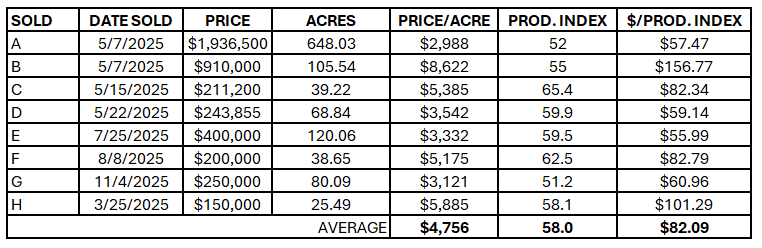
$4,756/acre
Jan. – Dec. 2025*
As high as $8,622/acre
in 2025*
Land Market Commentary & Local Trends
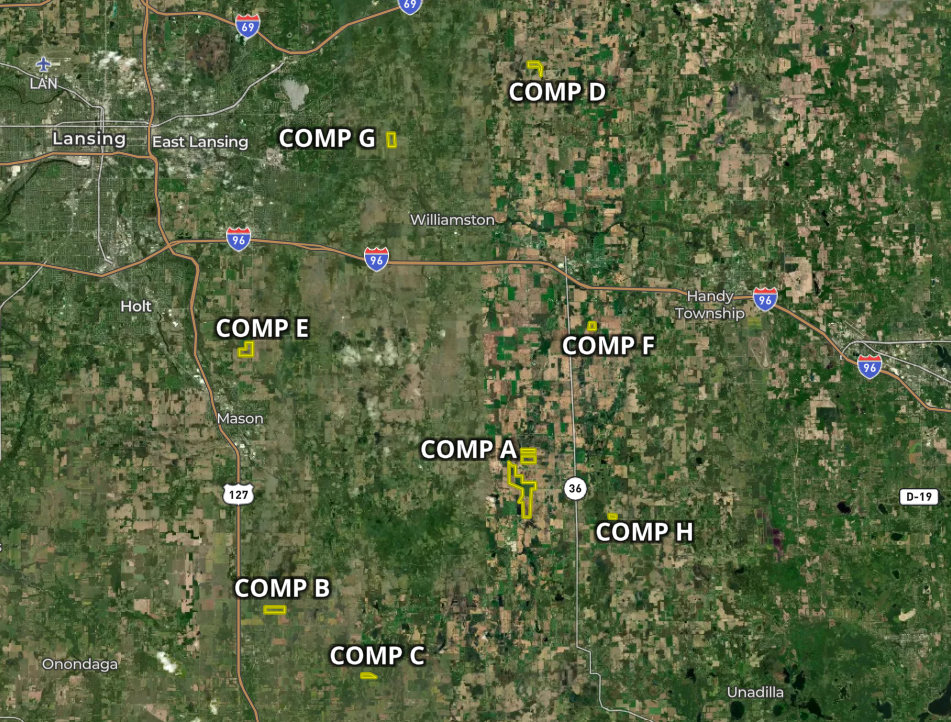
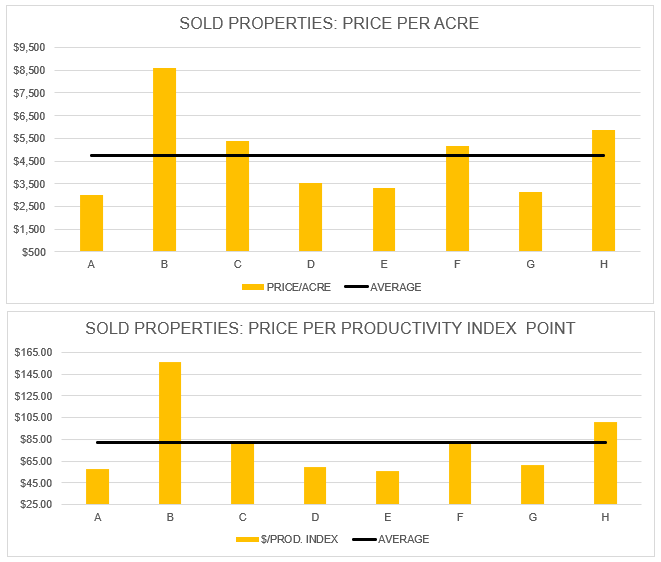
The 2025 farmland market in Ingham County showed continued interest in agricultural ground, with average sales totaling $4,756 per acre and $82.09 per productivity index point. The strongest properties remained highly sought after, pushing the upper end of the market to $8,622 per acre.
Since 1977, the Geswein Farm & Land Team has been advising landowners to be stewards of the land and make decisions based on most current, accurate, and relevant data. The information in this report can provide you with a rough estimate of your property’s value; however, understanding the specific characteristics of your property and how they compare to the other sales will provide the most accurate value of your property. Additionally, properties sold by land brokers via auctions or listings consistently outperformed individual to individual transactions and properties sold by traditional home realtors.
By The Numbers
Farming at the Crossroads of Innovation and Growth
Ingham County presents one of Michigan’s most distinctive farmland markets. Home to the state capital, Michigan State University, and a diverse regional economy, the county experiences influences that extend well beyond traditional agriculture. Even so, farming continues to play a vital role across much of the county, particularly outside the urban centers of Lansing and East Lansing.
Throughout 2025, buyers approached farmland with a greater focus on long-term productivity and operational value. Rather than chasing rapid appreciation, purchasers concentrated on acquiring farms that offered strong agricultural characteristics, reliable infrastructure, and lasting income potential.
That disciplined mindset has continued through the first half of 2026. Demand remains healthy for quality farmland, but buyers are taking more time to evaluate each property’s individual strengths before making long-term investments.
History & Background of Ingham County, Michigan
County Seat: Mason
Townships: Alaiedon / Aurelius / Bunker Hill / Delhi / Ingham / Lansing / Leroy / Leslie / Locke / Meridian / Onondaga / Stockbridge / Williamstown / Bath / Eaton / Windsor
History: Founded in 1829 & named after Samuel D. Ingham; Ingham County was established by an act of the Michigan Territorial Legislature.
Population: 289,709
Cities & Towns: Lansing / East Lansing / Mason / Williamston / Dansville / Okemos / Haslett / Leslie / Webberville / Stockbridge
Acreage: 358,400
Agriculture Remains an Essential Part of Ingham County
Although Ingham County is widely recognized for government, education, and healthcare, agriculture continues to shape much of the county’s rural landscape.
Corn, soybeans, wheat, and hay remain the primary crops, supported by livestock operations, specialty farms, and diversified agricultural businesses. The county also benefits from its close relationship with Michigan State University, whose agricultural research, Extension programs, and educational initiatives continue to influence farming practices throughout the region.
This combination of practical farming experience and access to agricultural innovation has helped local producers remain competitive while adapting to changing economic conditions.
Productivity Still Drives Buyer Decisions
The farmland market continues to reward properties that are prepared for efficient production.
Buyers remain attracted to farms with productive soils, dependable drainage, well-maintained access, and field layouts that support modern equipment. These characteristics reduce operating costs while providing greater confidence in long-term performance.
Properties requiring drainage improvements, field reconfiguration, or additional investment continue to sell, but buyers are evaluating those opportunities more carefully than they did during the exceptionally competitive markets of recent years.
Today’s market places increasing value on preparation, stewardship, and operational efficiency.
According to the USDA National Agricultural Statistics Service (NASS), the following crop statistics have been reported for Ingham County, Michigan.
The 2022 Ag Census for Ingham County, Michigan, reported the following crop statistics:
Number of farms: 863
Land in farms (acres): 189,573
Average farm size (acres): 220
Total market value of products sold: $156,312,000
Government payments: $2,051,000
Farm-related income: $5,435,000
Total farm production expenses: $139,097,000
Net cash farm income: $24,701,000
A County Influenced by More Than Agriculture
One of Ingham County’s defining characteristics is the way agriculture coexists with a growing metropolitan region.
Communities surrounding Lansing, East Lansing, Mason, Williamston, and other population centers continue to experience residential, commercial, and infrastructure investment. While the vast majority of farmland continues to serve agricultural purposes, location has become an increasingly important consideration for certain properties.
Parcels situated near expanding communities or major transportation corridors may attract interest beyond traditional farming operations, while farms in the county’s more rural areas continue to be valued primarily for their agricultural productivity.
This balance between rural preservation and regional growth gives Ingham County a land market unlike many others in Michigan.
Mid-Year 2026: Confidence Remains, but Buyers Are More Selective
The first half of 2026 has reinforced the market’s continued shift toward careful decision-making.
Local operators remain active participants in the farmland market, but they are placing greater emphasis on long-term returns than short-term market momentum. Well-maintained farms with strong production histories continue to receive significant attention, particularly when inventory remains limited.
Buyers are also spending more time evaluating improvements, drainage systems, and soil conditions before making purchasing decisions. This careful approach reflects both current financing conditions and a growing emphasis on preserving profitability over the long term.
Overall, the market has remained stable, with demand continuing to favor farms that demonstrate consistent agricultural performance.
Looking Ahead: What Could Shape the Rest of 2026?
Several themes are expected to influence Ingham County’s farmland market through the remainder of the year.
Interest rates and farm profitability will continue affecting purchasing decisions, particularly for buyers financing acquisitions. At the same time, inventory levels will remain an important factor, as limited availability of quality farmland continues to support competition when desirable properties reach the market.
Landowners should also keep an eye on regional development activity. While agriculture remains the county’s dominant rural land use, continued growth around the Lansing metropolitan area may create additional considerations for certain properties based on location and future land-use potential.
Maintaining productive soils, investing in drainage, and preserving operational efficiency will remain some of the strongest contributors to long-term farmland value.
Community Spotlight
Michigan State University Continues to Influence Agriculture
As home to one of the nation’s leading agricultural universities, Ingham County benefits from ongoing research, Extension programs, and innovation that support producers throughout Michigan. Advances in crop management, precision agriculture, and conservation practices continue to strengthen the region’s agricultural industry.
Regional Growth Brings New Opportunities
The Lansing-East Lansing region continues to experience investment in housing, healthcare, education, and infrastructure. While most farmland remains dedicated to agriculture, continued regional growth reinforces the importance of location for certain rural properties.
Strong Infrastructure Supports Farm Operations
Ingham County’s transportation network, agribusiness services, and proximity to regional markets provide producers with efficient access to grain facilities, equipment suppliers, processors, and agricultural support businesses, helping sustain a competitive farming economy.
Final Thoughts
Ingham County’s farmland market reflects the unique balance between productive agriculture and one of Michigan’s most dynamic regional economies. Farming remains the foundation of rural land values, while education, research, and regional growth provide additional layers of long-term stability.
The first half of 2026 has demonstrated that quality continues to lead the market. Buyers remain committed to acquiring productive farmland, but they are doing so with greater attention to operational efficiency, stewardship, and each property’s individual characteristics.
As 2026 continues, Ingham County is well positioned to remain a stable and resilient farmland market – one where agricultural tradition, innovation, and thoughtful land management continue to shape long-term value.
Sources / Citations:
Source 1:
“United States Department of Agriculture.” USDA, www.nass.usda.gov/Statistics_by_State/Michigan/Publications/County_Estimates/index.php#:~:text=Access%20Quick%20Stats%20Lite,to%20NASS%20Surveys%20and%20Programs. Accessed 13 July 2026.
Source 2:
“USDA.” 2022 Census of Agriculture County Profile, www.nass.usda.gov/Publications/AgCensus/2022/Online_Resources/County_Profiles/michigan/cp26065.pdf. Accessed 13 July 2026.
*The transaction and land sales data/information contained in this report was obtained from publicly available sources and sales disclosures deemed accurate and reliable but not guaranteed, no liability for accuracy, errors or omissions is assumed by Geswein Farm & Land Realty, LLC
Thinking About Selling?
Need Advice?
Get the guidance, service, and professional expertise you deserve.
- Family Farm Advisory for Succession Planning
- Undivided Interests & Tenants in Common
- Farmland Management Decisions
- Auctions & Listing
With our full-time experienced team, you’ll get our ‘boots on the ground’ work ethic paired with the latest in digital technology & national marketing reach – for best-in-class service and results.
Because you deserve more value.
Contact Us