


Iroquois County, Illinois
2026 Land Sales Report
Iroquois County farmland values remained well-supported throughout 2025, driven by continued interest in productive row-crop ground. As 2026 begins, market conditions point toward a period of greater price consistency.
If you’d like to get specific land values on your own property or a farm near you for 2026, please contact Jeremy Thompson today at (815) 351-5572.
Average Price of Land*
$10,653/acre
Jan. – Dec. 2025*
As high as $13,300/acre
in 2025*
Land Market Commentary & Local Trends
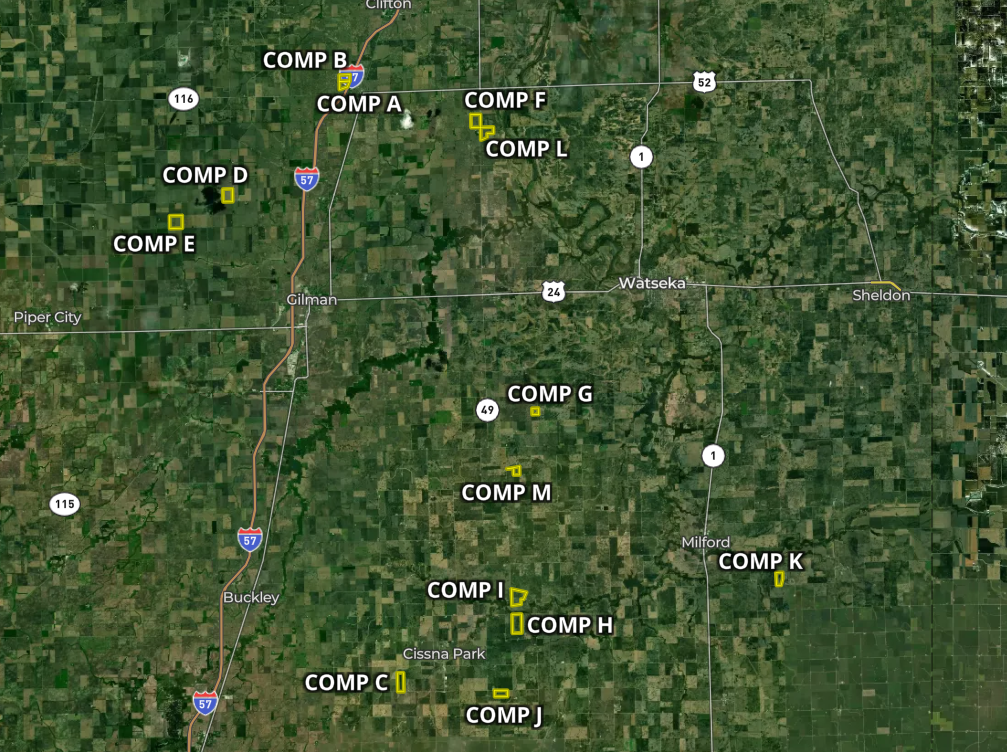
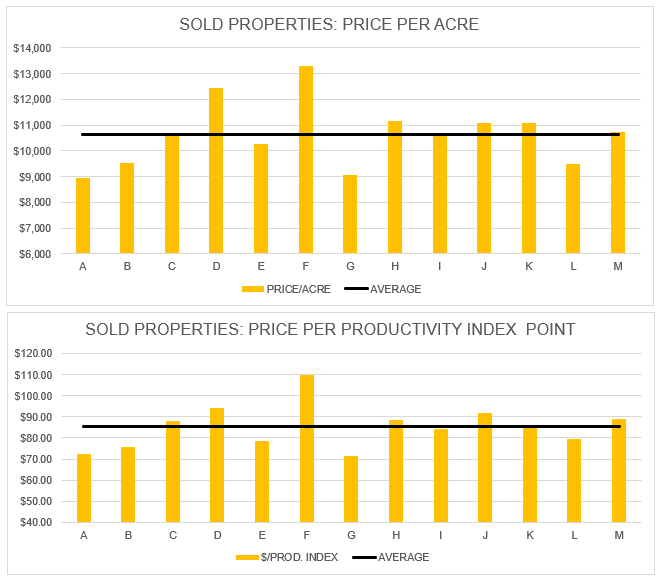
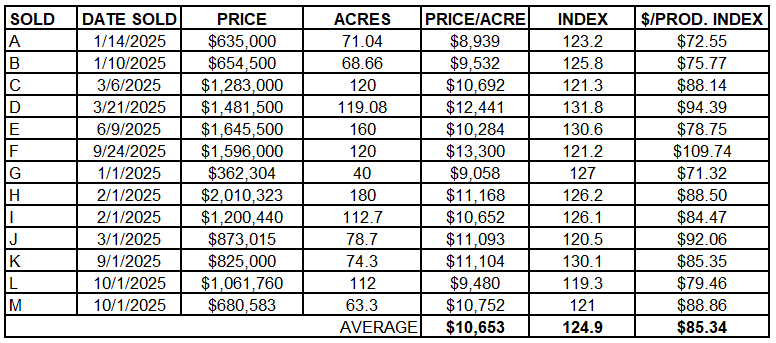
The Iroquois County farmland market averaged $10,653 per acre in 2025, with buyers paying an average of $85.34 per productivity index point. At the upper end of the market, select tracts achieved sale prices of up to $13,300 per acre.
Since 1977, the Geswein Farm & Land Team has been advising landowners to be stewards of the land and make decisions based on most current, accurate, and relevant data. The information in this report can provide you with a rough estimate of your property’s value; however, understanding the specific characteristics of your property and how they compare to the other sales will provide the most accurate value of your property. Additionally, properties sold by land brokers via auctions or listings consistently outperformed individual to individual transactions and properties sold by traditional home realtors.
By The Numbers
History & Background of Iroquois County, Illinois
County Seat: Watseka
Townships: Artesia / Ash Grove / Ashkum / Beaver / Beaverville / Belmont / Chebanse / Concord / Crescent / Danforth / Douglas / Fountain Creek / Iroquois / Loda / Lovejoy / Martinton / Middleport / Milford / Milks Grove / Onarga / Papineau / Pigeon / Prairie Green / Ridgeland / Sheldon / Stockland
History: Founded in 1833, named after the Iroquois people
Population: 26,067
Cities & Towns: Ashkum / Beaverville / Buckley / Cissna Park / Clifton / Crescent City / Danforth / Donovan / Fountain Creek / Gilman / Hallock / Iroquois / Loda / Martinton / Milford / Onarga / Papineau / Sheldon / Stockland / Thawville / Watseka / Wellington / Woodland
Acreage: 714,880
A Year Defined by Agricultural Fundamentals
Iroquois County’s farmland market in 2025 continued to reflect the characteristics that have long made the county one of Illinois’ premier agricultural regions. While farmland markets across the Midwest have become more selective following several years of rapid appreciation, demand remained steady for farms that offered strong production capabilities and long-term operating value.
Throughout the year, buyers remained focused on quality. Productive acreage, efficient farm layouts, and well-maintained tracts consistently attracted attention from both local operators and long-term investors. Rather than broad-based bidding across all property types, the market increasingly rewarded farms that could demonstrate operational advantages and reliable performance.
For many landowners, 2025 reinforced an important reality: farmland values in Iroquois County continue to be driven primarily by agricultural performance rather than outside development pressures.
The Strength of a Production-Oriented County
Agriculture is deeply woven into the identity of Iroquois County. The county’s landscape is dominated by large-scale row-crop operations, and farming remains one of the most significant economic drivers throughout the region.
Because of this, buyers tend to evaluate land through a practical lens. The focus remains on factors that directly influence productivity and profitability, including: soil quality & consistency, drainage infrastructure, field size & efficiency, access to transportation networks, and long-term production potential.
This emphasis creates a market that remains closely connected to farm economics and operational performance. While broader economic conditions certainly influence buyer sentiment, the underlying value of farmland in Iroquois County remains tied to what the land can produce.
According to the USDA National Agricultural Statistics Service (NASS), the following crop statistics have been reported for Iroquois County, Illinois.
The 2022 Ag Census for Iroquois County, Illinois, reported the following crop statistics:
Number of farms: 1,544
Land in farms (acres): 669,168
Average farm size (acres): 433
Total market value of products sold: $772,064,000
Government payments: $9,065,000
Farm-related income: $31,925,000
Total farm production expenses: $482,539,000
Net cash farm income: $330,514,000
Why Buyers Are Becoming More Selective
One of the most notable trends from 2025 was the continued separation between average-quality farms and top-tier acreage.
Properties with strong agronomic characteristics continued generating the greatest interest. Buyers were willing to compete for farms that offered efficient operations and long-term reliability, particularly in a market where profitability remains under close scrutiny.
Meanwhile, farms with limitations such as drainage concerns, irregular layouts, or operational inefficiencies often received more measured attention. This does not necessarily indicate weaker demand – it simply reflects a marketplace where buyers are placing greater emphasis on quality and long-term value.
As agriculture becomes increasingly data-driven, farm-specific characteristics are playing a larger role in purchasing decisions than ever before.
Local Lens: What’s Shaping Iroquois County?
Agriculture Remains the Economic Backbone
Unlike some counties where development activity drives land-use conversations, Iroquois County remains firmly rooted in agriculture. Farming continues to support local businesses, equipment dealers, grain facilities, and rural communities throughout the county.
The Illinois-Indiana Connection
Located along the Illinois-Indiana border, Iroquois County benefits from access to multiple regional grain markets and transportation routes. This geographic advantage helps support agricultural commerce and provides flexibility for local producers.
Conservation and Water Management
Water management remains an important topic throughout the county. Ongoing investments in drainage systems, conservation practices, and soil stewardship continue to play a critical role in maintaining long-term productivity across the landscape.
Rural Communities and Local Investment
Communities such as Watseka, Gilman, Onarga, and Crescent City continue investing in schools, public services, and community amenities. While these efforts may not directly influence farmland values, they contribute to the county’s overall stability and quality of life.
Early 2026 Trends: What the Market is Showing
The first quarter of 2026 has largely reinforced many of the themes that emerged during 2025.
Market participants continue reporting healthy interest in quality farmland, particularly when inventory remains limited. Buyers remain active, but they are increasingly focused on long-term returns and operational efficiency.
Several trends have become apparent during the opening months of the year:
Continued demand for productive farms
Strong competition for high-quality acreage
Limited supply supporting market activity
Greater attention to profitability metrics
Careful evaluation of farm-specific characteristics
While market conditions will continue evolving throughout the year, the early signals suggest that confidence in farmland ownership remains strong.
Key Factors to Watch Through the Remainder of 2026
As the year progresses, several factors will likely influence farmland demand and pricing throughout Iroquois County: commodity prices & grain market performance, interest rate movement, farm profitability & operating costs, availability of farmland inventory, and demand from local & regional operators.
Inventory levels may be particularly important. In a county where farmland ownership often remains within families for generations, even a modest increase in available listings can influence buyer competition and market dynamics.
At the same time, productive farms are expected to remain highly sought after whenever opportunities become available.
Looking Beyond the Numbers
One of the reasons Iroquois County continues to attract attention is its consistency. The county has built a reputation around productive farmland, experienced operators, and a strong agricultural infrastructure that supports long-term success.
Those qualities do not change dramatically from year to year, and they continue providing a foundation for the local farmland market regardless of broader economic cycles.
For buyers, sellers, and landowners alike, that stability remains one of the county’s greatest strengths.
Final Thoughts
Iroquois County’s farmland market in 2025 demonstrated the enduring value of productive agricultural land. While buyers have become more selective, demand remains firmly rooted in the county’s agricultural strengths and long-standing farming tradition.
Early activity in 2026 suggests many of those same trends remain in place. Quality continues to matter, inventory remains an important variable, and productive farmland continues to be viewed as a valuable long-term asset.
As the year unfolds, Iroquois County’s combination of agricultural scale, operational efficiency, and strong farming heritage should continue positioning it as one of eastern Illinois’ most respected farmland markets.
Sources / Citations:
Source 1:
“USDA.” 2022 Census of Agriculture County Profile, www.nass.usda.gov/Publications/AgCensus/2022/Online_Resources/County_Profiles/Illinos/cp17019.pdf. Accessed 16 June 2026.
Source 2:
“USDA.” 2022 Census of Agriculture County Profile, www.nass.usda.gov/Publications/AgCensus/2022/Online_Resources/County_Profiles/Illinois/cp17075.pdf. Accessed 16 June 2026.
*The transaction and land sales data/information contained in this report was obtained from publicly available sources and sales disclosures deemed accurate and reliable but not guaranteed, no liability for accuracy, errors or omissions is assumed by Geswein Farm & Land Realty, LLC
Thinking About Selling?
Need Advice?
Get the guidance, service, and professional expertise you deserve.
- Family Farm Advisory for Succession Planning
- Undivided Interests & Tenants in Common
- Farmland Management Decisions
- Auctions & Listing
With our full-time experienced team, you’ll get our ‘boots on the ground’ work ethic paired with the latest in digital technology & national marketing reach – for best-in-class service and results.
Because you deserve more value.
Contact Us