


Jasper County, Indiana
2026 Land Sales Report
For Jasper County landowners, 2025 reflected a farmland market still supported by the long-term appeal of agricultural real estate. Moving through 2026, the focus has shifted toward more measured pricing, with productive acreage and favorable property characteristics remaining important to buyers.
If you’d like to get specific land values on your own property or a farm near you for 2026, please contact Craig Stevenson today at (574) 870-4383.
Average Price of Land*
$11,112/acre
Jan. – Dec. 2025*
As high as $19,043/acre
in 2025*
Land Market Commentary & Local Trends
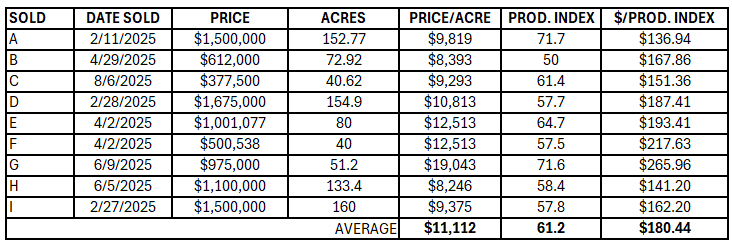
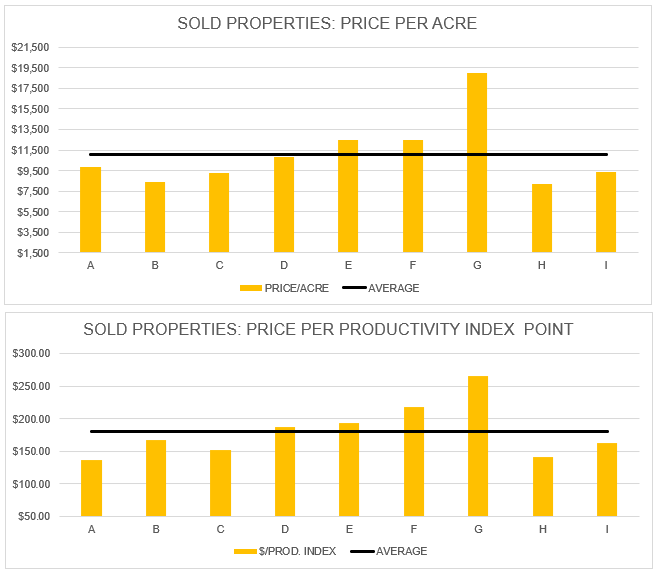
The numbers from Jasper County’s 2025 farmland sales paint an interesting picture, with an average of $11,112/acre and $180.44 per productivity index point. Some properties stood well above that average, with farmland sales reaching an impressive $19,043 per acre.
Since 1977, the Geswein Farm & Land Team has been advising landowners to be stewards of the land and make decisions based on most current, accurate, and relevant data. The information in this report can provide you with a rough estimate of your property’s value; however, understanding the specific characteristics of your property and how they compare to the other sales will provide the most accurate value of your property. Additionally, properties sold by land brokers via auctions or listings consistently outperformed individual to individual transactions and properties sold by traditional home realtors.
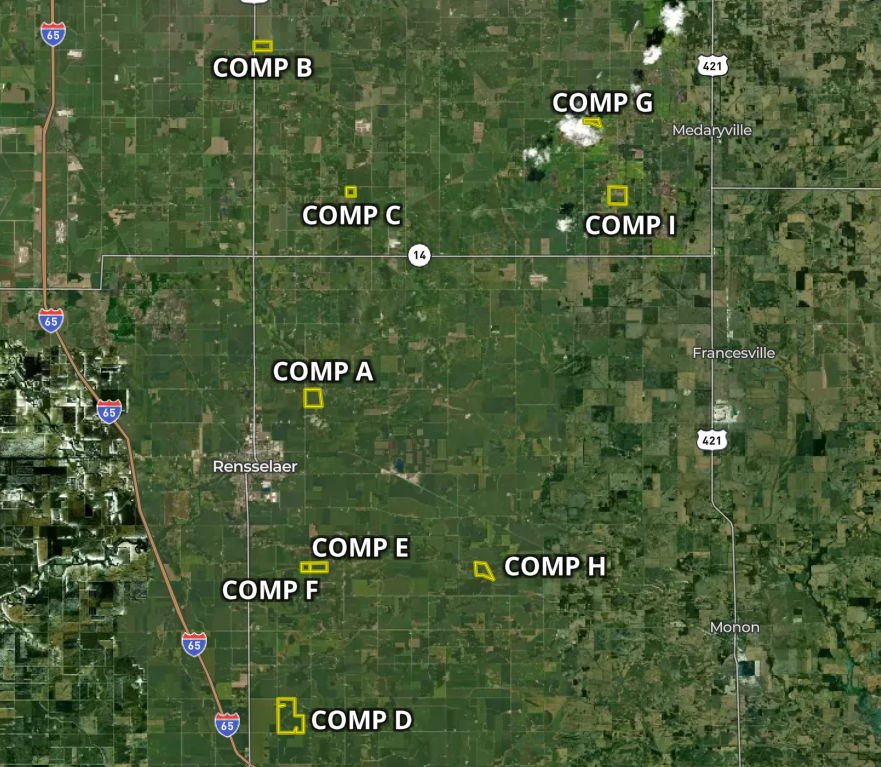
By The Numbers
History & Background of Jasper County, Indiana
County Seat: Rensselaer
Townships: Barkley / Carpenter / Gillam / Hanging Grove / Jordan / Kankakee / Keener / Marion / Milroy / Newton / Union / Walker / Wheatfield
History: Officially formed in 1838, named after Sgt. William Jasper – a Revolutionary War hero.
Population: 32,918
Cities & Towns: De Motte / Remington / Rensselaer / Roselawn / Wheatfield
Acreage: 358,144
More Than Open Fields: The Story Behind Jasper County Farmland
Jasper County has long been recognized for its strong agricultural presence, but there is more to its farmland market than productive soils and expansive fields.
Located in northwestern Indiana, the county combines large-scale farming operations, a significant livestock industry, established rural communities, and convenient access to major transportation routes. From Rensselaer and Remington to DeMotte and Wheatfield, agriculture remains a defining feature of the local landscape.
Throughout 2025, farmland sales reflected the importance of agricultural productivity, location, and overall property quality. While productive acreage continued to attract interest, differences in soil characteristics, drainage, and operational efficiency helped distinguish individual farms.
As 2026 has progressed, Jasper County’s farmland market has continued to be influenced by agricultural economics, long-term investment considerations, and the county’s unique position within Northwest Indiana.
Corn, Cattle, and Generations of Agricultural Investment
Agriculture is more than a traditional industry in Jasper County. It is a major contributor to the county’s economy and an important part of its identity.
Corn and soybeans dominate much of the agricultural landscape, but Jasper County also stands out for its livestock production. Dairy farming, cattle operations, and hog production contribute significantly to the local agricultural economy, creating a diverse farming environment.
This combination of crop and livestock production helps distinguish Jasper County from counties that rely more heavily on row crops alone.
For established producers, additional farmland can provide opportunities to expand crop production, secure feed supplies, improve manure-management logistics, or consolidate acreage near existing facilities.
These practical advantages can make certain properties particularly attractive to neighboring farmers and livestock operators.
In Jasper County, farmland is not simply an investment. It is an essential part of a much larger agricultural operation.
According to the USDA National Agricultural Statistics Service (NASS), the following crop statistics have been reported for Jasper County, Indiana.
The 2022 Ag Census for Jasper County, Indiana, reported the following crop statistics:
Number of farms: 608
Land in farms (acres): 312,985
Average farm size (acres): 515
Total market value of products sold: $589,674,000
Government payments: $3,022,000
Farm-related income: $14,571,000
Total farm production expenses: $433,025,000
Net cash farm income: $174,242,000
The Difference Between Good and Great Ground
Jasper County’s agricultural landscape includes extensive areas of productive farmland, but individual properties can vary considerably in their characteristics.
For traditional agricultural buyers, soil productivity remains important. However, drainage, field configuration, accessibility, and the percentage of tillable acreage can be just as influential when evaluating a potential purchase.
Large, contiguous fields with efficient layouts may offer advantages for modern farming equipment and large-scale crop production. Properties with irregular boundaries, drainage limitations, or non-tillable acreage may require additional management.
Location also matters.
A farm adjoining an established operation may be especially attractive because it allows a producer to expand without significantly increasing transportation or equipment costs.
These differences help explain why premium agricultural properties can attract a different level of interest than more average-quality farmland.
Nine Months Into 2026: A Market Focused on the Fundamentals
As 2026 has unfolded, agricultural buyers have continued navigating a market influenced by commodity prices, operating expenses, financing costs, and long-term farm profitability.
These broader conditions have encouraged a thoughtful approach to farmland acquisitions.
For Jasper County producers, purchasing additional acreage is often a strategic decision. Buyers must consider whether a property can strengthen an existing operation, support livestock production, or provide dependable agricultural income over time.
Productive farms with good drainage, efficient field layouts, and convenient access remain well positioned to attract interest.
At the same time, properties requiring substantial improvements or offering less efficient farming conditions may receive closer evaluation.
Rather than focusing solely on acreage, buyers have reason to consider the complete agricultural value of a property.
The 2026 market environment reinforces the importance of productivity, operational fit, and long-term ownership potential.
From Farm Gates to Interstate Access
One of Jasper County’s distinguishing advantages is its location along Interstate 65.
The interstate connects the county to the broader Northwest Indiana region, Indianapolis, and the Chicago metropolitan market. Communities such as Rensselaer and Remington benefit from this accessibility, which supports agricultural transportation, commercial activity, and economic development opportunities.
For local agriculture, transportation infrastructure plays an important role in moving grain, livestock, equipment, and agricultural products.
Jasper County’s proximity to regional markets also creates opportunities for businesses involved in manufacturing, distribution, and agricultural services.
While most farmland continues to be valued primarily for agricultural production, properties near established infrastructure or commercial development may have additional considerations.
For landowners, understanding a property’s location within the county’s transportation and economic network can provide valuable perspective on its long-term potential.
Beyond the Fence Rows: What’s Moving Jasper County
Livestock Gives Agriculture Another Dimension
Jasper County has a particularly strong livestock sector, including dairy, cattle, and hog production.
These operations contribute to demand for cropland, feed production, and agricultural infrastructure. For some producers, acquiring additional ground can help support the needs of an existing livestock operation rather than simply increasing the number of acres farmed.
Economic Development Remains on the Radar
The Jasper County Economic Development Organization continues promoting the county’s business opportunities, including available industrial properties, utility-served sites, and transportation advantages.
During 2026, these efforts remain relevant to the county’s broader economic outlook. For farmland owners, development activity is worth monitoring, particularly near established communities and major transportation corridors.
The Iroquois River Adds Character to the Landscape
The Iroquois River travels through Jasper County, contributing to its natural features and agricultural landscape.
Properties near waterways may have additional considerations involving drainage, floodplain characteristics, and land management. Wooded areas and recreational features can also create appeal for buyers interested in uses beyond traditional farming.
Agricultural Land Assessments Remain Worth Watching
Jasper County’s assessor information indicates that Indiana’s agricultural land base rate for the 2026 assessment year, payable in 2027, remains unchanged from the previous assessment year.
Although assessed agricultural land values are not the same as market sale prices, property taxation remains an important consideration for landowners evaluating annual ownership costs.
A Different Kind of Buyer Advantage
Jasper County’s farmland market benefits from a combination of traditional agricultural demand and the operational needs of its livestock industry.
For a row-crop farmer, a desirable property may offer highly productive soils, large fields, and convenient access.
For a livestock producer, nearby acreage may provide additional benefits through feed production, manure application opportunities, and improved operational efficiency.
For another buyer, location near a major transportation corridor or an established community may be an important consideration.
These different motivations contribute to a farmland market where the most likely buyer can vary from one property to another.
Understanding those motivations can help landowners better recognize what makes their acreage attractive.
What Will Matter Most as 2026 Winds Down?
As the remainder of 2026 approaches, Jasper County’s farmland market will likely continue emphasizing agricultural productivity, efficient land management, and long-term investment value.
Local farmers and livestock producers will remain attentive to opportunities that strengthen their existing operations, while buyers are likely to continue evaluating drainage, field configuration, soil quality, and property condition.
The county’s transportation advantages and ongoing economic development efforts will also remain worth watching, particularly for properties near established growth areas.
The Road Ahead for Jasper County Landowners
Jasper County’s farmland market reflects the strength and diversity of its agricultural economy.
Its productive row-crop fields, substantial livestock industry, established farming communities, and regional transportation connections all contribute to a distinctive rural land market.
As 2026 moves toward its conclusion, well-managed agricultural ground should remain attractive to buyers seeking productive acreage and opportunities for long-term ownership.
For Jasper County landowners, the most important consideration is understanding how their property’s productivity, location, and agricultural usefulness fit the needs of potential buyers.
In a county where farming remains such a significant economic force, those characteristics will continue to shape the farmland market well beyond 2026.
Sources / Citations:
Source 1:
“United States Department of Agriculture.” USDA, www.nass.usda.gov/Statistics_by_State/Indiana/Publications/County_Estimates/index.php#:~:text=Access%20Quick%20Stats%20Lite,to%20NASS%20Surveys%20and%20Programs. Accessed 9 October 2026.
Source 2:
“USDA.” 2022 Census of Agriculture County Profile, www.nass.usda.gov/Publications/AgCensus/2022/Online_Resources/County_Profiles/Indiana/cp18073.pdf. Accessed 9 October 2026.
*The transaction and land sales data/information contained in this report was obtained from publicly available sources and sales disclosures deemed accurate and reliable but not guaranteed, no liability for accuracy, errors or omissions is assumed by Geswein Farm & Land Realty, LLC
Thinking About Selling?
Need Advice?
Get the guidance, service, and professional expertise you deserve.
- Family Farm Advisory for Succession Planning
- Undivided Interests & Tenants in Common
- Farmland Management Decisions
- Auctions & Listing
With our full-time experienced team, you’ll get our ‘boots on the ground’ work ethic paired with the latest in digital technology & national marketing reach – for best-in-class service and results.
Because you deserve more value.
Contact Us