


When Tara Vander Dussen left her family’s dairy farm for college, she never thought she’d return to the industry as an environmental consultant and advocate. The spark occurred after a conversation with her dad about the heated debates between dairy farmers and legislators who, she says, were after the same things – cleaner water, better regulations for dairy – but were speaking “two different languages.”
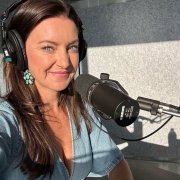
Since that conversation, she’s built an impressive resume that includes 10 years of environmental consulting, bridging the gaps between farmer and lawmaker. In 2015, she switched her focus, creating a blog geared toward changing the dialogue within the dairy industry. As the New Mexico Milk Maid, shared information and research about sustainable practices used by dairy farmers, prompting interesting discussions within the area. In 2021, she joined the podcast, Field Work, and, in 2022, started the Discover Ag podcast with co-host Natalie Kovarik, which currently falls on the Top 10 list of food podcasts nationwide, and recently segued into a TV series, Discover Ag on the Road.
We recently spoke with Tara about being a vocal dairy advocate, following her passions and how to juggle it all to show future generations that they can do everything – just maybe not all at once.
Geswein Farm & Land (GFL): How did you become an advocate for the dairy industry?
Tara Vander Dussen (TVD): As an environmental consultant, I was the communicator between my dairy clients and the regulators. That’s really at the heart of what I did: sampling and analyzing data, but also trying to effectively communicate between the two parties. So, in 2015, I actually started with a blog that brought the sustainability side of dairy farming into the conversation. I wanted my blog to be a place for longer discussions, conversations, research. Obviously, that’s evolved and grown into sharing on social media, being on podcasts, hosting my own podcast now, but that was kind of at the root of it – wanting to share with consumers what dairy farmers are doing to be more sustainable.
GFL: And you were just at the White House with milk as the agenda?
TVD: Yes, I was. I got the opportunity to do that. I have been in a couple groups where we meet with the USDA regularly to stay up-to-date on what’s going on. Through that, I actually had the opportunity to interview Secretary Rollins back in November and was in connection with her. So, when the Whole Milk for Healthy Kids Act was going to be signed, the President asked for dairy farmers to be in the room. Secretary Rollins and her people reached out to me and my family. It’s a bipartisan bill, so it had a lot of support for essentially passing whole milk to be able to be served in schools, but it was actually more than that. To me, it was about parent choice and student choice. Now, not only is whole milk served in schools, but also alternative milks. Previously, if you wanted your kid to be able to have soy milk or almond milk, you had to have a doctor’s note saying why they needed that. With the passage of this bill, it leaves the choice up to the parents and the student what kind of milk they want.
GFL: Discover Ag on the Road is your latest project. How did you decide that was your next step?
TVD: Natalie and I started our podcast almost four years ago, and since the very beginning, we have seen a vision for Discover Ag on the Road. The podcast has been a great place for us to start. It’s been a great place to build the dynamic between the two of us, interviewing people, building an audience. But we always had this idea that agriculture is so visual. With Discover Ag on the Road, our goal is to really bring unconventional agriculture, specialty crops – things you don’t always think of, but that show up on our plate regularly – and bring that information to the masses. We tried to go the more conventional route of pitching to a network, but fast forward to 2026 and YouTube is one of the places people are watching TV more than ever. It just seemed like a natural fit to go ahead and launch this ourselves. So, in November, we went to California and we filmed oysters, finger limes and avocados, and those are rolling out right now. And I actually leave on Saturday for Florida where we are going to film citrus, red snapper and stone crab, and those will roll out in Q2. We plan to go state by state, filming what they’re known for and working through the country.
GFL: How do you decide which stories to pursue?
TVD: We always joke that everyone sees cows, corn and tractors, but there are thousands and thousands of other types of agriculture. We want to try to find some different things, like the finger limes and oysters in California were really out-of-the-box. Yet, at the same time, what are some crops that are very regular in our diet that we may not know much about how they’re grown. For instance, avocados. Some of it is also trying to find people who are willing to have us out on their farm. In Florida, we had a lot of options, but because we’re completely self-funded, we couldn’t travel to a farm three hours away from the others we were already filming at. So, some of it’s simply scheduling and who’s willing to meet with us while other parts are following what interests us or what people are asking us about.
GFL: You’re traveling, you’re a mother, you’re a farmer, you have your business, you’re an advocate. How do you manage it all?
TVD: Things have definitely ebbed and flowed. I am no longer working as an environmental consultant. That is one of the things I have changed since fully focusing on Discover Ag, our podcast, and Discover Ag on the Road. I am also homeschooling year-round with help from my mom. There is definitely a balancing act. I was on the Dairy Management Inc. board for three years [the checkoff for dairy]. I loved being on that board, but I took on Discover Ag on the Road, so when I termed out of that I didn’t sign up again. It’s picking and choosing what I can do in that moment of life, knowing you can do all the things, just not all at one time.
GFL: What do you hope your kids learn by seeing you do all of these different ventures?
TVD: Taking them to the White House gave me a lot of time to reflect on that. Like what will they think of all of this? I hope they see that anything is possible. I think growing up in a rural town, a lot of times you can feel very much like you’re in a box and you have to stay in that box. I hope, in the end, that they see that you can do things and pursue your passions, and I think that combination is what I want them to take away from this.
GFL: What change do you most want to see for women in agriculture in the next decade? Where do you see women playing playing the biggest role in ag in the future?
TVD: Whether it’s women or, generally, the younger people, I think getting people back to the farm and back in ag right now is so important no matter who they are or where they’re from. There are literally thousands of endless ways of being involved in agriculture that doesn’t necessarily mean you have to be directly on the farm working. Like environmental consulting – I was on dairies every single day and I wasn’t milking the cows. Being able to open up those possibilities for people – that there’s so many different ways to be involved is really what I hope people start to see.
# # #