


Miami County, Indiana
2026 Land Sales Report
Miami County’s farmland market benefited from the broader strength in Indiana land values during 2025, although appreciation was more measured than in earlier years. As 2026 progresses, productive farmland remains an important draw, with buyers placing greater emphasis on long-term agricultural returns.
If you’d like to get specific land values on your own property or a farm near you for 2026, please contact Craig Stevenson today at (574)-870-4383.
Average Price of Land*
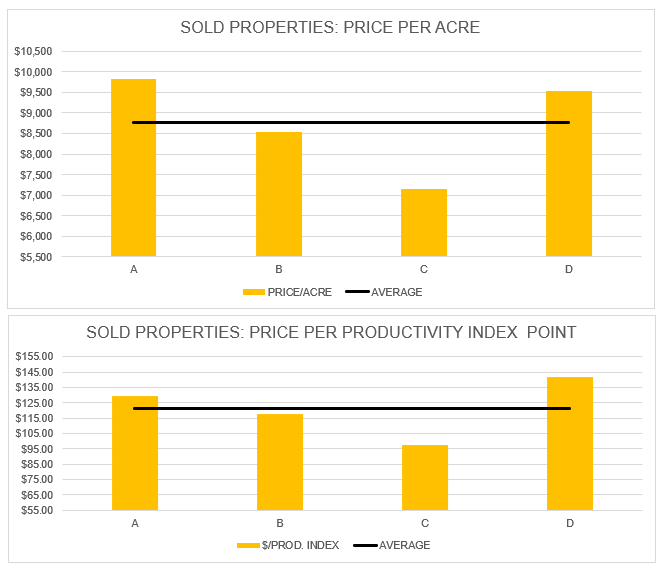
$8,770/acre
Jan. – Dec. 2025*
As high as $9,836/acre
in 2025*
Land Market Commentary & Local Trends
Miami County’s 2025 farmland sales tell a story of steady land values, with sampled transactions from January through December averaging $8,770/acre with an average of $121.51 per productivity index point. At the higher end of the market, farmland sales reached $9,836 per acre.
Since 1977, the Geswein Farm & Land Team has been advising landowners to be stewards of the land and make decisions based on most current, accurate, and relevant data. The information in this report can provide you with a rough estimate of your property’s value; however, understanding the specific characteristics of your property and how they compare to the other sales will provide the most accurate value of your property. Additionally, properties sold by land brokers via auctions or listings consistently outperformed individual to individual transactions and properties sold by traditional home realtors.
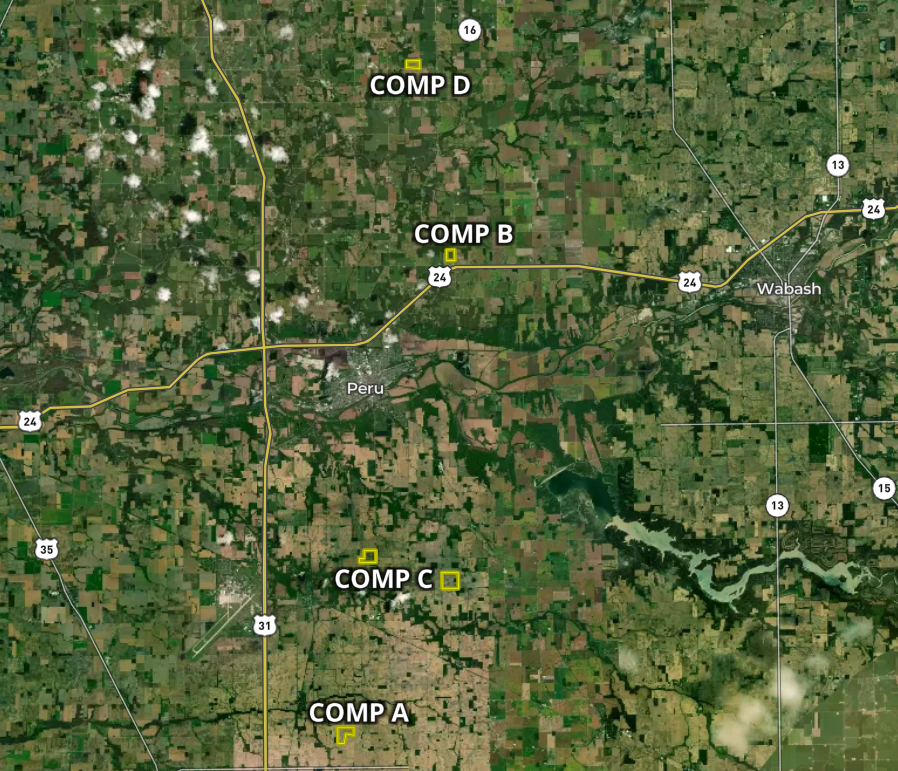
By The Numbers

History & Background of Miami County, Indiana
County Seat: Peru
Townships: Allen / Butler / Clay / Deer Creek / Erie / Harrison / Jackson / Jefferson / Perry / Peru / Pipe Creek / Richland / Union / Washington
History: Organized in 1834; named after the Miami Indians
Population: 35,674
Cities & Towns: Amboy / Bunker Hill / Converse / Denver / Macy / Peru
Acreage: 238,223
A Closer Look at Miami County’s Farmland Market
Miami County’s farmland market is rooted in a long-standing agricultural tradition, where productive fields, river valleys, and established farming communities help shape the local landscape.
Located in north-central Indiana, Miami County offers a combination of traditional row-crop farmland, livestock operations, wooded acreage, and recreational properties. The Wabash and Eel Rivers contribute to the county’s geography, creating differences in soil characteristics, topography, drainage, and agricultural usability.
Throughout 2025, the farmland market reflected the importance of these individual property characteristics. While productive agricultural ground remained desirable, differences in farm quality and location played an important role in how properties were evaluated.
As 2026 has progressed, Miami County’s farmland market has continued to face the same fundamental question: What makes one farm more attractive to buyers than another?
Agriculture Remains at the Heart of Miami County
Agriculture continues to play an important role in Miami County’s rural economy.
Corn and soybeans are prominent throughout the county, while livestock production, hay, and other agricultural activities contribute to its farming diversity. Communities such as Peru, Denver, Bunker Hill, and Converse are surrounded by agricultural areas where farming remains a familiar part of everyday life.
For established producers, acquiring additional farmland can provide opportunities to expand an operation, improve equipment efficiency, or consolidate acreage closer to existing farms.
This makes neighboring farmers particularly important buyers when productive ground becomes available.
Unlike counties where significant suburban expansion influences large portions of the land market, much of Miami County’s agricultural acreage continues to be evaluated primarily for its farming potential and long-term productivity.
The Wabash River Adds Character to the Land
One of Miami County’s distinguishing features is its relationship with the Wabash River and surrounding waterways.
The Wabash and Eel River corridors contribute to a landscape that includes productive cropland, river-bottom acreage, wooded areas, and recreational properties.
For farmland buyers, these characteristics can create meaningful differences between properties.
Some farms offer large, efficiently configured fields that are well suited for modern agricultural equipment. Others may contain rolling terrain, wooded sections, flood-prone acreage, or drainage considerations that affect the amount of usable farmland.
These differences are important because agricultural buyers are generally focused on more than total acreage. They want to understand how consistently a property can produce crops and how efficiently it can be operated.
For Miami County landowners, soil productivity, drainage, tillable acreage, and overall farmability remain important considerations when evaluating agricultural property.
According to the USDA National Agricultural Statistics Service (NASS), the following crop statistics have been reported for Miami County, Indiana.
The 2022 Ag Census for Miami County, Indiana, reported the following crop statistics:
Number of farms: 613
Land in farms (acres): 201,899
Average farm size (acres): 329
Total market value of products sold: $269,146,000
Government payments: $1,590,000
Farm-related income: $7,706,000
Total farm production expenses: $199,084,000
Net cash farm income: $79,358,000
What We’ve Seen in Miami County’s Farmland Markert Throughout 2026
As 2026 has unfolded, the broader farmland market has continued adjusting to an environment where agricultural buyers must carefully consider operating costs, commodity prices, financing, and long-term profitability.
For Miami County, these conditions reinforce the importance of individual farm characteristics.
Properties with productive soils, effective drainage, good road access, and efficient field configurations are generally better positioned to attract agricultural interest. Farms that require additional improvements or contain substantial non-tillable acreage may receive closer scrutiny.
Local producers also have to consider how a potential purchase fits into their existing operation. A neighboring tract may offer operational advantages that a similarly productive farm several miles away cannot provide.
Rather than assuming every acre carries the same market appeal, buyers have reason to focus on the agricultural usefulness and long-term potential of each property.
The defining theme for 2026 is careful evaluation, with productivity and practical farm management remaining central to purchasing decisions.
Grissom Air Reserve Base: A Unique Part of Miami County’s Economy
Miami County has an economic feature that sets it apart from many neighboring agricultural counties: Grissom Air Reserve Base.
Located near Bunker Hill, Grissom is an important regional employer and economic contributor. The surrounding Grissom Aeroplex also supports aviation-related businesses, commercial activity, and opportunities for industrial development.
While most of Miami County’s farmland continues to serve agricultural purposes, properties located near major transportation corridors, established infrastructure, or employment centers may have additional considerations beyond crop production.
The county’s connections to U.S. 31 and U.S. 24 further contribute to its accessibility and economic opportunities.
For landowners, these features make location an important consideration, particularly when evaluating properties near established commercial or industrial areas.
A Local Issue to Watch: Farmland and Solar Development
One of the most notable land-use discussions in Miami County during 2026 has involved proposed limits on acreage devoted to utility-scale solar development.
County officials have been considering amendments to the local solar energy ordinance that would establish acreage limitations for solar farm energy systems.
The proposal reflects an effort to balance renewable energy opportunities with the preservation of agricultural land, rural character, and long-term land-use planning.
For Miami County landowners, this discussion is especially relevant because large-scale solar development can introduce an alternative use for agricultural acreage.
While traditional farming remains central to the county’s rural economy, decisions about solar development could influence how certain properties are evaluated and used in the future.
The outcome of these discussions will be worth watching as Miami County continues balancing agricultural preservation with new economic opportunities.
Miami County’s Local Pulse
A Strong Agricultural Foundation
Miami County continues to benefit from established farming operations and a rural landscape where corn, soybeans, and livestock remain important. Local producers and neighboring farmers are natural sources of demand for available agricultural ground.
Rivers, Recreation, and Rural Land
The Wabash and Eel Rivers, along with nearby recreational resources such as Mississinewa Lake, contribute to the county’s diverse landscape. Properties containing woods, waterways, or recreational features may attract buyers with interests beyond traditional crop production.
Grissom’s Economic Influence
Grissom Air Reserve Base and the surrounding Aeroplex contribute to Miami County’s employment and development opportunities. Their presence adds an economic dimension that distinguishes Miami County from more exclusively agricultural areas.
Farmland Preservation Is Part of the 2026 Conversation
The county’s consideration of solar acreage limitations and ongoing comprehensive planning efforts highlight the importance of balancing agricultural land use with future development.
What Could Shape the Rest of 2026?
As 2026 moves toward its conclusion, Miami County’s farmland market will likely remain focused on agricultural productivity, operational efficiency, and long-term ownership value.
Local farmers will continue watching for opportunities to expand their operations, while buyers are likely to remain selective about drainage, soil quality, field configuration, and property condition.
At the same time, ongoing land-use discussions surrounding solar development and future county planning could introduce additional considerations for certain properties.
For landowners, understanding both the agricultural strengths of their property and the surrounding land-use environment will remain important.
Looking Ahead
Miami County’s farmland market is shaped by more than its agricultural acreage alone.
Its rivers, established farming communities, recreational resources, and unique economic connection to Grissom Air Reserve Base all contribute to the county’s rural land market.
As 2026 continues, productive and well-maintained farmland should remain attractive to agricultural buyers, particularly when it offers opportunities for efficient operation and long-term ownership.
For Miami County landowners, the key takeaway is that a farm’s value is closely connected to how well the land performs, how it fits into the surrounding agricultural community, and the opportunities it may offer for the future.
Sources / Citations:
Source 1:
“United States Department of Agriculture.” USDA, www.nass.usda.gov/Statistics_by_State/Indiana/Publications/County_Estimates/index.php#:~:text=Access%20Quick%20Stats%20Lite,to%20NASS%20Surveys%20and%20Programs. Accessed 5 October 2026.
Source 2:
“USDA.” 2022 Census of Agriculture County Profile, www.nass.usda.gov/Publications/AgCensus/2022/Online_Resources/County_Profiles/Indiana/cp18103.pdf. Accessed 5 October 2026.
*The transaction and land sales data/information contained in this report was obtained from publicly available sources and sales disclosures deemed accurate and reliable but not guaranteed, no liability for accuracy, errors or omissions is assumed by Geswein Farm & Land Realty, LLC
Thinking About Selling?
Need Advice?
With our full-time experienced team, you’ll get our ‘boots on the ground’ work ethic paired with the latest in digital technology & national marketing reach – for best-in-class service and results.
Because you deserve more value.
Contact Us