


Montgomery County, Indiana
2026 Land Sales Report
In Montgomery County, Indiana, farmland values remained strong throughout 2025, reflecting continued demand for quality ground, though the sharp acceleration seen in previous years has started to slow. Looking toward 2026, land values appear poised for a more balanced market, shaped by economic conditions, borrowing costs, and increased caution among buyers.
If you’d like to get specific land values on your own property or a farm near you for 2026, please contact Johnny Klemme today at (765) 427-1619.
Average Price of Land*
$12,356/acre
Jan. – Dec. 2025*
As high as $17,014/acre
in 2025*
Land Market Commentary & Local Trends
From January through December 2025, our sampled Montgomery County farmland data showed an average value of $12,356 per acre, with land averaging $145.62 per productivity index point. While these figures reflect a strong overall market, top-tier tracts proved buyers were willing to pay a premium, with select sales reaching as high as $17,014 per acre – highlighting the continued demand for high-quality farmland in the county.
Since 1977, the Geswein Farm & Land Team has been advising landowners to be stewards of the land and make decisions based on most current, accurate, and relevant data. The information in this report can provide you with a rough estimate of your property’s value; however, understanding the specific characteristics of your property and how they compare to the other sales will provide the most accurate value of your property. Additionally, properties sold by land brokers via auctions or listings consistently outperformed individual to individual transactions and properties sold by traditional home realtors.
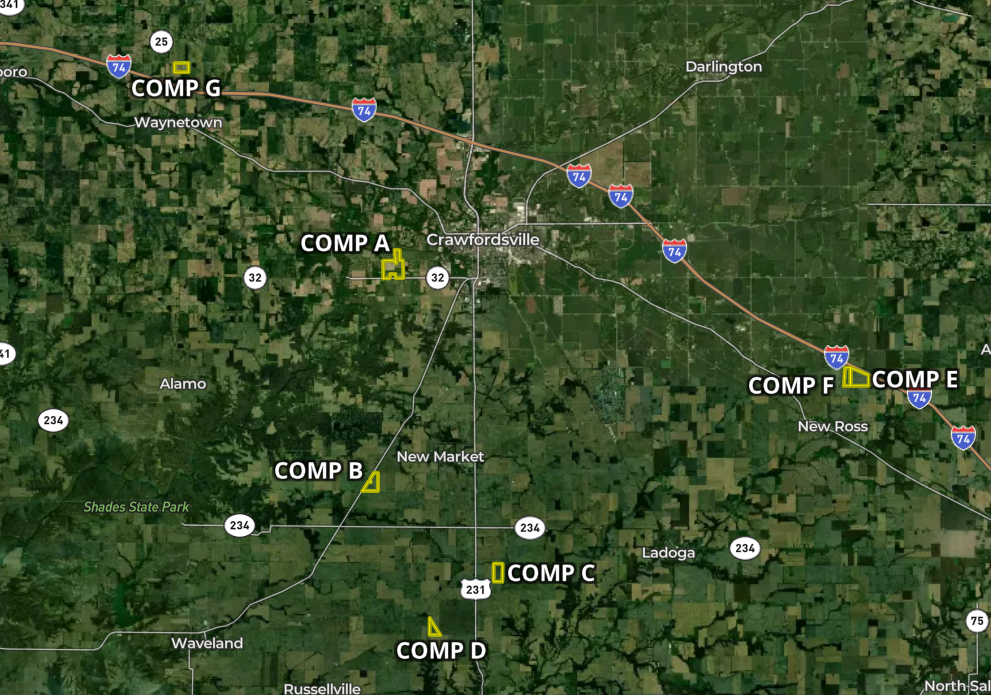
By The Numbers
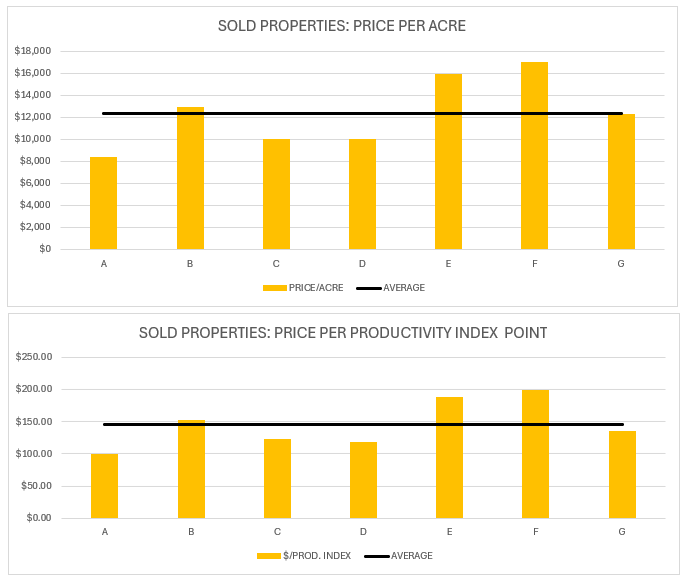
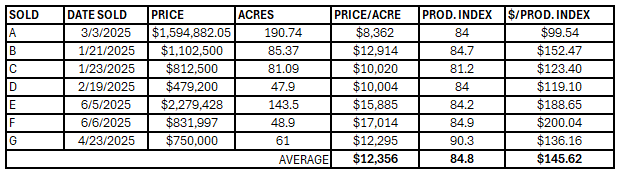
What Changed from 2025 to 2026?
In Montgomery County, Indiana, farmland values remained resilient throughout 2025, the market increasingly reflected a transition away from the rapid acceleration seen in prior years and toward a more disciplined, quality-driven environment. While demand for farmland remained fundamentally strong, rising financing costs, tighter operating margins, and more selective buyer behavior began shaping how different classes of land were valued as the market progressed.
Compared to 2024, one of the clearest shifts in Montgomery County was the growing emphasis buyers placed on operational efficiency and long-term productivity rather than broad-based appreciation alone. The average farmland values reinforced that the county continues to support strong agricultural fundamentals. However, the standout sales illustrated that premium-quality farms with superior soils, strong drainage, and desirable layouts continued to command significant competition.
Rather than all land rising equally, 2025 increasingly became a market where quality, location, and farm efficiency mattered more than ever. Heading into 2026, Montgomery County appears positioned for continued stability, though future appreciation may depend more on scarcity of high-quality listings and broader economic conditions than the aggressive market momentum of previous years.
Market Activity & Pricing
Recent Land.com data suggests Montgomery County remains one of the more active land markets in western Indiana, with nearly $47 million in land currently marketed for sale across roughly 810 acres. This level of market activity highlights a county with meaningful land turnover and broad buyer interest, though inventory composition can vary significantly depending on property type, development potential, and agricultural quality.
Crawfordsville currently represents the county’s most concentrated area for active land listings, reflecting both its role as the county seat and its importance as a regional economic center. Montgomery County spans approximately 505 square miles, making it the 12th largest county in Indiana, and its location along major transportation corridors continues to support a diverse mix of agricultural, residential, and investment-driven land demand.
News & More for 2026
Montgomery County’s 2026 ag story is one of big numbers, big recognition, and big questions about what the future of local farming will look like. From record‑setting land sales to innovative young producers and kids gearing up for the 4‑H fair, agriculture is very much at the center of county life this year.
In January, Montgomery County caught statewide attention when a 764‑acre farm that was originally slated for auction instead sold in a private deal for $11.52 million, working out to about $15,100 per acre. Nearly all of the tract—roughly 750 acres—was contiguous cropland with a strong soil rating, and the sellers were two local families who ultimately chose to sell to an investor rather than a neighboring operator. The farm sale was brokered by Johnny Klemme, CAI, and Auctioneer at Geswein Farm and Land. For farmers, that transaction crystallized several under‑the‑surface concerns: whether local growers can still realistically compete for land, how long longtime families will keep owning the ground, and what investor ownership will mean for cash rents and community ties. At the same time, recent land value reports show Montgomery County as a core row‑crop county where corn and soybeans dominate, with an average farm size around 388 acres and more than 650 farms still operating, which underscores how pivotal any large sale is for local structure.
Even as big checks change hands, the county is celebrating families who have dug in for the long haul. The Clouser and Gentry farms have been recognized at the state level with Hoosier Homestead Awards for more than 100 and 150 years of continuous family ownership, highlighting just how deep some roots run in this part of Indiana. Farm Credit Mid‑America’s 2026 Forward Thinker Award went to Matt and Rachel Stine, a Montgomery County couple who built Oak Hill Tree Farm, a choose‑and‑cut Christmas tree operation that has become both an agritourism draw and an educational bridge between town and country. The Stines have dramatically scaled their row‑crop acreage—from about 30 acres to more than 1,400—while layering in pumpkins and other enterprises to manage the long production cycles and cash‑flow demands of specialty crops. Their story offers a local blueprint for how younger producers might blend grain, specialty, and direct‑to‑consumer enterprises to stay viable in a high‑priced land environment.
2026 is also a year when agriculture is front‑and‑center for kids and the broader community. Purdue Extension’s Montgomery County office is already promoting the July 10–15 county 4‑H fair, along with the 2026 Quality Livestock Care classes that are now a standard expectation for youth with animal projects. Conservation education starts early here, and recent coverage has highlighted how Montgomery County fourth graders are getting hands‑on lessons in soil and water stewardship, equipping the next generation of landowners and voters with a working understanding of why conservation practices matter. On the statewide stage, Montgomery County’s visibility will get another boost at the 2026 Indiana State Fair, where the Featured Farmers program includes local operations such as Sennett Cattle—representing beef, corn, and soybeans—as well as Promise Keeper Farms, which showcases lavender as a niche crop, giving fairgoers a glimpse of both traditional and diversified agriculture from the county.
Taken together, the year’s news paints a county at a crossroads. On one side are eight‑figure land deals and investor buyers that raise questions about access and control; on the other are century farms, innovative young producers, and schoolchildren learning conservation basics in local fields. For an agricultural publication, Montgomery County in 2026 offers a vivid case study in how a classic Indiana farm community tries to balance capital and continuity, growth and heritage—acre by acre, family by family.
Overview of Montgomery County Agriculture
Montgomery County’s farmland market is shaped by a combination of productive row-crop agriculture, strong transportation access, and regional economic diversity. Premium farmland is typically defined by high soil productivity, efficient field shape, dependable drainage, and access to established agricultural infrastructure. Farms with flatter topography, larger contiguous acreage, and strong corn & soybean production capabilities often command the strongest prices, particularly when local operators or investors are competing for expansion opportunities.
The county’s agricultural geography benefits from productive tillable acreage, but value variation can be more pronounced than in some neighboring counties due to differences in land use pressure, parcel fragmentation, and proximity to Crawfordsville and transportation routes such as Interstate 74. In some areas, location can create additional value through development or transitional potential beyond pure agricultural productivity.
Average or lower-tier farmland in Montgomery County may include smaller or more fragmented tracts, less consistent drainage, lower productivity soils, or parcels with mixed-use characteristics that reduce pure row-crop competitiveness. As a result, Montgomery County’s market increasingly reflects multiple layers: premium agricultural land tied to production, transitional land influenced by location, and average farmland priced more conservatively based on operational limitations.
Local Pulse: What’s Happening in Montgomery County Beyond the Farm?
While agriculture remains central to Montgomery County’s identity, the county’s broader economic and community developments continue shaping how landowners view long-term opportunity, investment, and rural stability.
Hot topics and local watchpoints in 2025-2026 include:
Crawfordsville & Industrial Expansion
Crawfordsville continues to serve as an economic anchor for Montgomery County, with ongoing attention surrounding manufacturing growth, logistics activity, and industrial investment. As employers expand and infrastructure improves, surrounding rural areas may continue seeing increased interest tied to accessibility and long-term growth potential.
Interstate 74 & Transportation Influence
Montgomery County’s location along Interstate 74 remains one of its strategic advantages. Transportation access continues supporting both agriculture and broader economic activity, particularly for operations tied to grain movement, distribution, and regional commerce.
Rural Housing & Small-Town Growth
Like many west-central Indiana counties, Montgomery County has seen ongoing conversations surrounding housing availability, rural community development, and workforce retention. While not experiencing suburban expansion on the scale of metro counties, gradual community growth still influences how some landowners evaluate future land use and property demand.
Farm Transition & Estate Planning
As farmland values remain historically strong, more families are focusing on succession planning, ownership transition, and long-term land strategy. For some landowners, current market conditions are creating important conversations around whether to hold, sell, expand, or transition acreage to the next generation
Commodity Prices & Input Costs
Even in a relatively stable land market, local producers continue watching fertilizer prices, equipment costs, interest rates, and grain markets closely. These factors may not always shift land values immediately, but they strongly influence buyer confidence and expansion appetite throughout the county.
In Montgomery County, the “local pulse” is less about rapid transformation and more about balancing agricultural tradition with steady economic evolution. The county continues to benefit from a strong farming base, but infrastructure, industry, and regional connectivity are increasingly becoming part of the long-term conversation as well.
History & Background of Montgomery County, Indiana: Home of Beautiful Shades State Park
County Seat: Crawfordsville
Townships: Brown / Clark / Coal Creek / Franklin / Madison / Ripley / Scott / Sugar Creek / Union / Walnut / Wayne
History: Organized in 1822 and named for Revolutionary War hero, Major General Richard Montgomery
Population: 38,273
Cities & Towns: Alamo / Crawfordsville / Darlington / Ladoga / Linden / New Market / New Richmond / New Ross / Waveland / Waynetown / Wingate
Acreage: 322,956
Montgomery County Agriculture Snapshot
Much of the foundational agricultural and demographic data for Montgomery County comes from the USDA Census of Agriculture, which us updated on a five-year cycle. Because of this, the information serves as a long-term structural benchmark rather than an annual reflection of market fluctuations.
Montgomery County’s agricultural base remains an important component of its land market identity, with row-crop farming continuing to anchor much of the county’s rural economy. This structural consistency helps explain why highly productive farmland remains competitive even as broader economic conditions evolve.
When paired with current sale trends, USDA data provides helpful context for understanding not just what the county produces, but how that productivity continues to influence buyer demand and land valuation.
The 2022 Ag Census for Montgomery County, Indiana, reported the following crop statistics:
Number of farms: 651
Land in farms (acres): 252,762
Average farm size (acres): 388
Total market value of products sold: $235,467,000
Government payments: $1,696,000
Farm-related income: $11,601,000
Total farm production expenses: $158,770,000
Net cash farm income: $89,993,000
What Landowners Should Watch in 2026
As Montgomery County moves into 2026, landowners should closely monitor the intersection of borrowing costs, commodity economics, and local land supply. While the county remains fundamentally supported by strong agricultural demand, the market is increasingly shifting toward strategic selectivity rather than broad competition across all land types. One of the key trends to watch will be how Montgomery County’s unique balance of agricultural productivity and location-based land demand influences pricing tiers. Premium tillable farms are expected to remain relatively resilient due to limited supply and consistent operator demand, particularly where strong soils and efficient acreage align. However, average farmland and transitional tracts may experience greater pricing variability depending on interest rates, development appetite, and local inventory conditions.
2026 Market Scenarios
Looking ahead, Montgomery County may see several possible market paths:
If interest rates soften: Premium tillable land and well-positioned investment properties could see stronger competition and renewed value support.
If crop margins tighten: Buyers may become increasingly selective, reinforcing stronger premiums for top-tier farms while average tracts face flatter pricing.
If listing inventory expands: Greater supply may create more negotiating leverage for buyers, particularly in transitional or non-premium land categories.
Overall, 2026 is likely to reward preparation, quality, and positioning over broad market momentum. For Montgomery County landowners, understanding where a property fits within the evolving hierarchy of premium, average, or transitional land may become more important than ever as the market continues to mature.
Sources / Citations:
Source 1:
“United States Department of Agriculture.” USDA, www.nass.usda.gov/Statistics_by_State/Indiana/Publications/County_Estimates/index.php#:~:text=Access%20Quick%20Stats%20Lite,to%20NASS%20Surveys%20and%20Programs. Accessed 8 May 2026.
Source 2:
“USDA.” 2022 Census of Agriculture County Profile, www.nass.usda.gov/Publications/AgCensus/2022/Online_Resources/County_Profiles/Indiana/cp18107.pdf. Accessed 8 May 2026.
*The transaction and land sales data/information contained in this report was obtained from publicly available sources and sales disclosures deemed accurate and reliable but not guaranteed, no liability for accuracy, errors or omissions is assumed by Geswein Farm & Land Realty, LLC
Thinking About Selling?
Need Advice?
With our full-time experienced team, you’ll get our ‘boots on the ground’ work ethic paired with the latest in digital technology & national marketing reach – for best-in-class service and results.
Because you deserve more value.
Contact Us