


Newton County, Indiana
2026 Land Sales Report
Newton County farmland remained well supported throughout 2025, with buyers continuing to show interest in quality agricultural ground. As 2026 unfolds, the market appears to be settling into a steadier pace with less emphasis on rapid price growth.
If you’d like to get specific land values on your own property or a farm near you for 2026, please contact Craig Stevenson today at (574) 870-4383.
Average Price of Land*
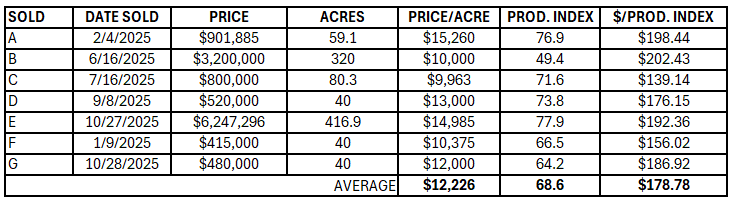
$12,226/acre
Jan. – Dec. 2025*
As high as $15,260/acre
in 2025*
Land Market Commentary & Local Trends
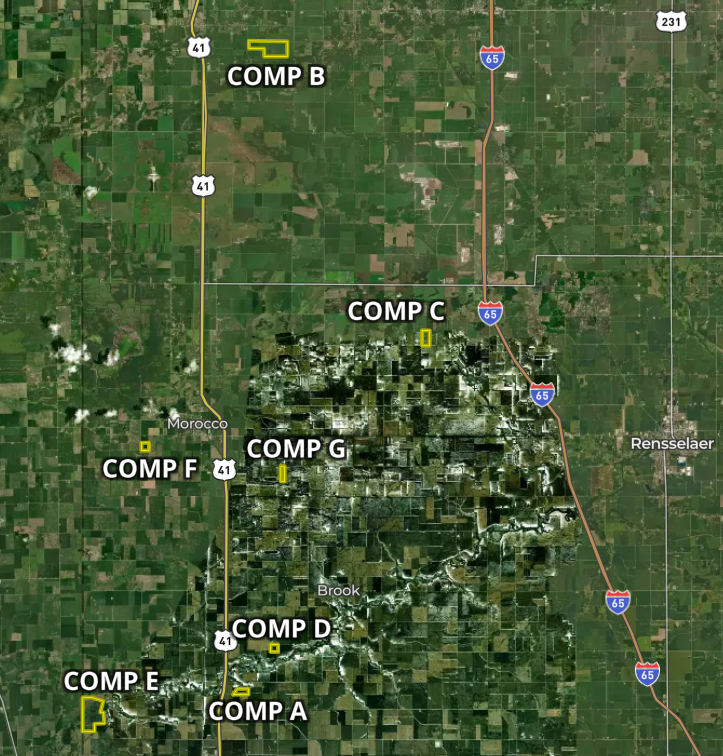
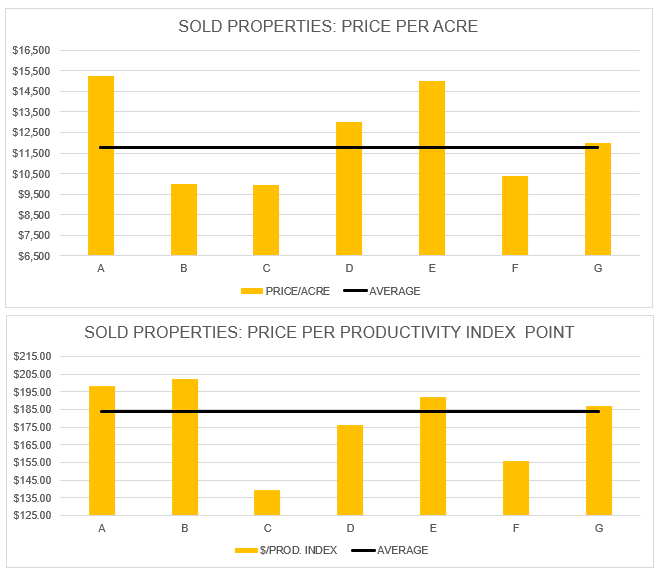
In 2025, Newton County farmland continued to command respectable values, averaging $12,226/acre and $178.78 per productivity index point. The strongest properties pushed the market higher, with sales reaching up to $15,260 per acre.
Since 1977, the Geswein Farm & Land Team has been advising landowners to be stewards of the land and make decisions based on most current, accurate, and relevant data. The information in this report can provide you with a rough estimate of your property’s value; however, understanding the specific characteristics of your property and how they compare to the other sales will provide the most accurate value of your property. Additionally, properties sold by land brokers via auctions or listings consistently outperformed individual to individual transactions and properties sold by traditional home realtors.
By The Numbers
Farmland, Conservation, and Rural Character Shape Newton County
Newton County offers a different perspective on Indiana farmland. Located along the Kankakee River and known for its wide-open agricultural landscape, the county combines productive farming ground with significant natural and conservation areas.
Agriculture remains an important part of Newton County’s identity and economic outlook. At the same time, the county’s wetlands, prairies, wildlife areas, and other natural resources create a land market where agricultural productivity is only one piece of the story. County planning documents specifically recognize agriculture as an important economic asset while also acknowledging the role of conservation, recreation, and other land uses.
That combination gives Newton County a farmland market with its own distinct character.
History & Background of Newton County, Indiana
County Seat: Kentland
Townships: Beaver / Colfax / Grant / Iroquois / Jackson / Jefferson / Lake / Lincoln / McClellan / Washington
History: Created in 1859, named for Sgt. John Newton: hero of the American Revolutionary War.
Population: 14,131
Cities & Towns: Brook / Goodland / Kentland / Morocco / Mount Ayr
Acreage: 257,000
Farming Remains a Major Part of the Landscape
Much of Newton County’s rural landscape is devoted to agriculture, with row-crop production forming the backbone of many local farming operations. Corn and soybeans are important crops, while livestock and other agricultural activities add diversity to the county’s rural economy.
For local producers, farmland is more than an investment. Additional acreage can provide opportunities to expand existing operations, improve field efficiency, or create greater continuity between parcels.
The county’s agricultural community also benefits from local resources such as Purdue Extension, which continues providing agriculture and natural-resource programming to Newton County residents and producers.
According to the USDA National Agricultural Statistics Service (NASS), the following crop statistics have been reported for Newton County, Indiana.
The 2022 Ag Census for Newton County, Indiana, reported the following crop statistics:
Number of farms: 372
Land in farms (acres): 189,934
Average farm size (acres): 511
Total market value of products sold: $442,405,000
Government payments: $1,759,000
Farm-related income: $4,796,000
Total farm production expenses: $278,793,000
Net cash farm income: $170,167,000
A Land Market Influenced by More Than Production
Newton County’s natural landscape creates an interesting contrast within its farmland market.
Areas surrounding the Kankakee River and other natural features include wetlands, prairie, woodland, and wildlife habitat. The county is home to places such as Willow Slough Fish & Wildlife Area and the Kankakee Sands region, which contribute to the area’s conservation and recreational identity.
For agricultural buyers, productive tillable acreage remains the primary consideration. But properties that include recreational, conservation, or natural-resource characteristics may attract a different type of buyer.
This means that two farms with similar acreage can have very different market appeal depending on their soils, drainage, location, improvements, and surrounding land uses.
Drainage and Land Management Matter
Drainage is an especially important consideration when evaluating agricultural property in a county shaped by waterways and low-lying areas.
Farmers and landowners continue to pay close attention to how effectively a property handles water and how drainage infrastructure affects the usability of the ground. Newton County maintains a Drainage Board, with drainage-related meetings and matters continuing to appear on the county’s 2026 schedule.
For farmland buyers, this reinforces the importance of looking beyond soil productivity alone. Drainage systems, field conditions, access, and maintenance can all influence how efficiently acreage can be farmed.
2026 So Far: Quality and Usability Remain Important
The first half of 2026 has continued to show interest in well-positioned Newton County farmland, while buyers remain thoughtful about the properties they pursue.
Local farmers continue to be natural buyers when available acreage can strengthen an existing operation. At the same time, purchasers are paying close attention to productivity, drainage, accessibility, and the overall condition of the farm.
The market is increasingly about finding the right acreage for the right purpose. A highly productive farm may attract strong agricultural demand, while property with a combination of farmland and natural features may appeal to a broader group of buyers.
Newton County’s Agricultural Future
Newton County’s own planning efforts recognize agriculture as an important component of future economic development while also calling for a balance between farming, conservation, recreation, residential uses, and other forms of development.
That balance will remain an important part of the county’s land story. Preserving productive farmland while responsibly managing natural resources can help maintain the characteristics that make Newton County attractive to both farmers and rural landowners.
For landowners, understanding how their property fits into that larger landscape can be increasingly valuable when considering its long-term potential.
What Could Shape the Rest of 2026?
Newton County’s farmland market will likely continue to favor productive and well-managed acreage.
Local farmers will remain attentive to opportunities that improve their existing land base, while drainage, accessibility, and overall farm condition will continue to influence purchasing decisions. Properties that combine agricultural usefulness with additional recreational or natural-resource appeal may also attract interest from a wider range of buyers.
With agriculture and conservation both playing important roles in Newton County, the strongest land opportunities may be those that balance productivity with responsible long-term stewardship.
Newton County Highlights
Agriculture and Conservation Share the Landscape
Newton County’s rural identity is shaped by both working farms and some of northwest Indiana’s notable natural areas, creating a land market with more variety than traditional row-crop acreage alone.
The Kankakee River Adds to the County’s Character
The river and surrounding wetlands and natural areas contribute to Newton County’s recreational and environmental identity while also making drainage and land management important considerations for agricultural properties.
Land Stewardship has Long-Term Importance
With agriculture, conservation, and rural development all represented throughout the county, responsible management will remain important to preserving both farmland productivity and the broader character of Newton County.
Looking Ahead
Newton County enters the second half of 2026 with a farmland market grounded in agriculture but shaped by much more than crop production.
Quality farmland remains valuable to local producers, while the county’s natural resources add another dimension to rural land ownership. As buyers continue to evaluate properties carefully, farms that offer strong productivity, sound management, and long-term usability should remain the most compelling opportunities in the market.
Sources / Citations:
Source 1:
“United States Department of Agriculture.” USDA, www.nass.usda.gov/Statistics_by_State/Indiana/Publications/County_Estimates/index.php#:~:text=Access%20Quick%20Stats%20Lite,to%20NASS%20Surveys%20and%20Programs. Accessed 27 July 2026.
Source 2:
“USDA.” 2022 Census of Agriculture County Profile, www.nass.usda.gov/Publications/AgCensus/2022/Online_Resources/County_Profiles/Indiana/cp18111.pdf. Accessed 27 July 2026.
*The transaction and land sales data/information contained in this report was obtained from publicly available sources and sales disclosures deemed accurate and reliable but not guaranteed, no liability for accuracy, errors or omissions is assumed by Geswein Farm & Land Realty, LLC
Thinking About Selling?
Need Advice?
Get the guidance, service, and professional expertise you deserve.
- Family Farm Advisory for Succession Planning
- Undivided Interests & Tenants in Common
- Farmland Management Decisions
- Auctions & Listing
With our full-time experienced team, you’ll get our ‘boots on the ground’ work ethic paired with the latest in digital technology & national marketing reach – for best-in-class service and results.
Because you deserve more value.
Contact Us