


Porter County, Indiana
2026 Land Sales Report
The Porter County farmland market held its ground in 2025, with productive tracts continuing to draw buyer interest. Looking ahead to 2026, values appear supported by steady demand, even as buyers become more selective.
If you’d like to get specific land values on your own property or a farm near you for 2026, please contact Craig Stevenson today at (574) 870-4383.
Average Price of Land*
$10,345/acre
Jan. – Dec. 2025*
As high as $14,605/acre
in 2025*
Land Market Commentary & Local Trends
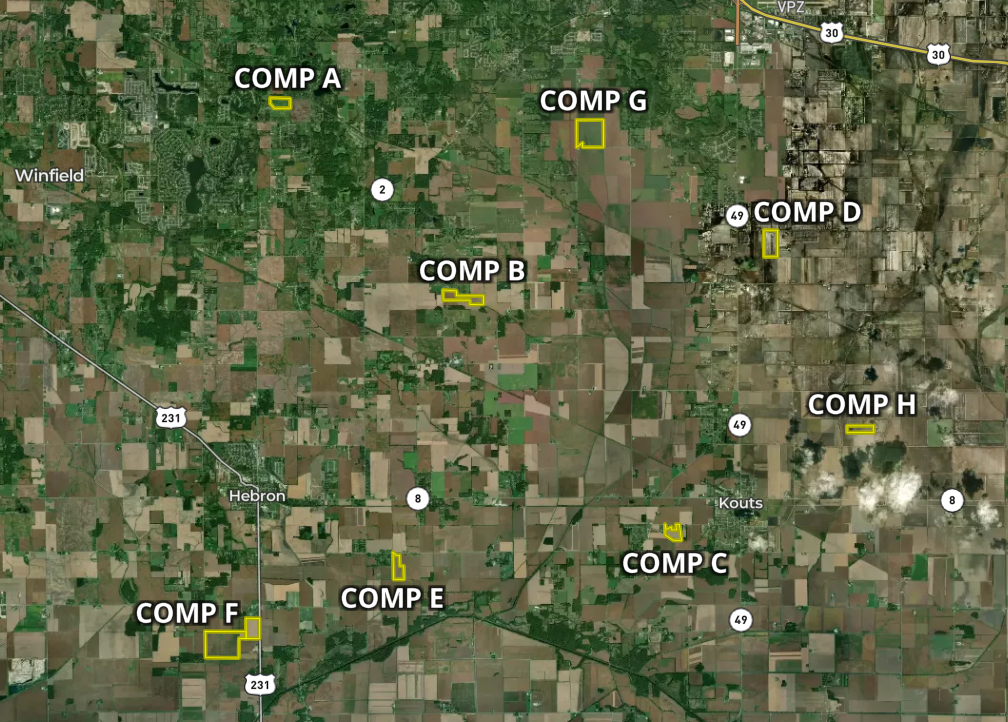
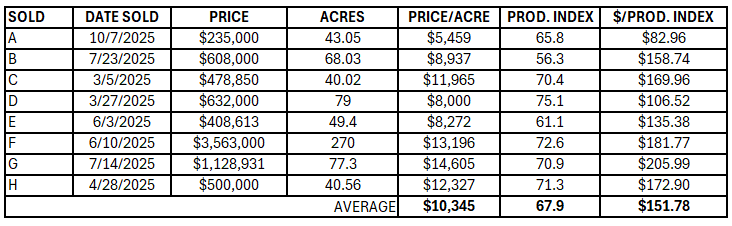
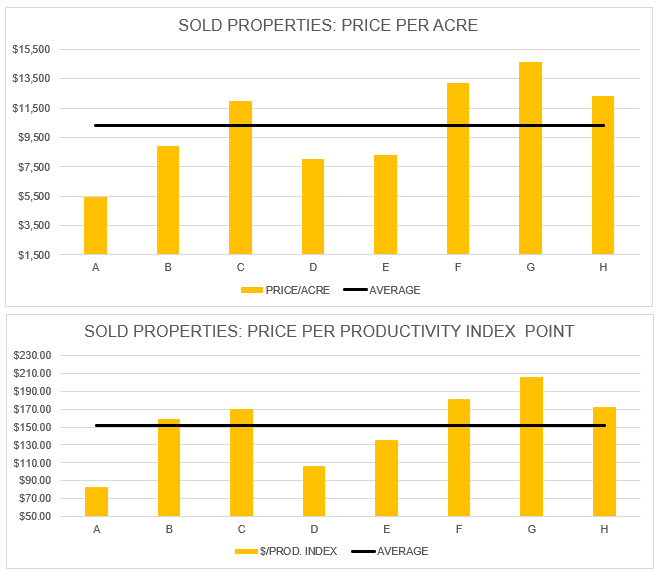
Porter County’s 2025 farmland sales show a solid market, with values averaging $10,345/acre and $151.78 per productivity index point. The strongest properties continued to command a premium, with sales reaching as high as $14,605 per acre.
Since 1977, the Geswein Farm & Land Team has been advising landowners to be stewards of the land and make decisions based on most current, accurate, and relevant data. The information in this report can provide you with a rough estimate of your property’s value; however, understanding the specific characteristics of your property and how they compare to the other sales will provide the most accurate value of your property. Additionally, properties sold by land brokers via auctions or listings consistently outperformed individual to individual transactions and properties sold by traditional home realtors.
By The Numbers
Where Productive Farmland Meets Northwest Indiana Growth
Porter County offers a farmland market with several forces working at once. Agriculture remains an important part of the county’s rural landscape, but its location in Northwest Indiana also places farmland near growing communities, major transportation routes, industrial activity, and the broader Chicago metropolitan market.
That combination gives Porter County a land market that can look very different from a purely agricultural county farther south or east. For working farms, productivity, drainage, access, and field configuration remain important. For properties located closer to developed areas, however, location and potential future uses can become an additional consideration.
The 2025 sales data show continued demand for quality agricultural ground, while the first half of 2026 has provided several examples of how both agricultural fundamentals and development pressures continue influencing the county.
History & Background of Porter County, Indiana
County Seat: Valparaiso
Townships: Boone / Center / Jackson / Liberty / Morgan / Pine / Pleasant / Portage / Porter / Union / Washington / Westchester
History: Founded in 1836; named after Commodore David Porter, a naval hero from the War of 1812
Population: 176,000
Cities & Towns: Beverly Shores / Burns Harbor / Chesterton / Dune Acres / Hebron / Kouts / Ogden Dunes / Porter / Town of Pines / Valparaiso
Acreage: 333,440
Agriculture Still Has a Place in Porter County
Despite the development surrounding portions of the county, agriculture remains an important part of Porter County’s rural identity.
Corn and soybeans are among the primary crops grown throughout the area, while livestock, hay, and other agricultural activities contribute to the diversity of local operations. Many farms are still managed by established producers who have strong ties to the surrounding communities.
For these operators, acquiring additional acreage can be about more than investment. A strategically located farm may allow a producer to expand an existing operation, improve field efficiency, or bring neighboring ground under the same management.
That local demand continues to be an important component of the farmland market.
According to the USDA National Agricultural Statistics Service (NASS), the following crop statistics have been reported for Porter County, Indiana.
The 2022 Ag Census for Porter County, Indiana, reported the following crop statistics:
Number of farms: 462
Land in farms (acres): 122,238
Average farm size (acres): 265
Total market value of products sold: $101,951,000
Government payments: $1,533,000
Farm-related income: $3,290,000
Total farm production expenses: $81,571,000
Net cash farm income: $25,202,000
Location Gives Certain Parcels an Added Dimension
Porter County’s location is one of its biggest distinguishing characteristics.
The county sits within Northwest Indiana’s transportation network, with connections to major highways and the Indiana Toll Road. Its proximity to the Chicago region also contributes to development activity and demand for land beyond traditional agricultural uses.
This does not mean every farm is a development property. Agricultural productivity remains the primary consideration for many buyers. However, when farmland is located near established development, transportation corridors, or growing communities, its location can become an additional factor in how the property is evaluated.
For landowners, understanding the difference between agricultural value and potential alternative land uses can be especially important in Porter County.
A 2026 Farm Sale Gives a Look at Current Demand
One of the more notable examples from 2026 came in April, when a 102-acre Porter County farm sold at auction for approximately $1.49 million.
The property included nearly 98 estimated crop acres, a strong WAPI rating, paved road frontage, and a small amount of CRP acreage. The farm ultimately sold for more than $14,500 per acre.
While one transaction does not define the entire county market, the sale illustrates the continued interest in well-located, highly productive farmland. Characteristics such as crop acreage, productivity, and convenient road access can make a significant difference when quality ground becomes available.
2026 Has Also Brought More Attention to Development
Porter County’s development landscape has remained active through the first half of 2026. County records show continued meetings involving the Development Review Committee and Plan Commission, including subdivision and stormwater-related matters.
That activity matters to farmland owners because development can gradually change the surroundings of agricultural properties.
A farm that is surrounded by other agricultural acreage may be evaluated primarily for its farming potential. As residential, commercial, or industrial uses move closer, however, questions about access, future land use, and development potential can become increasingly relevant.
This is one reason Porter County’s farmland market deserves to be evaluated on a property-by-property basis.
The First Half of 2026: A Selective Market
The broader Indiana farmland market entered 2026 with values still near historically strong levels, although Purdue’s March 2026 outlook noted signs of stabilization and more mixed regional performance. Farm income, commodity prices, and interest rates continued to weigh on buyers’ purchasing power.
In Porter County, those agricultural fundamentals exist alongside the county’s unique development environment.
For farmers, the focus remains on whether a property can perform as productive farmland. For other buyers, location and future land-use possibilities may play a larger role.
That combination has made the first half of 2026 a period where buyers are paying particularly close attention to the details of each property rather than assuming every parcel carries the same market potential.
A County Balancing Farmland and Future Growth
Porter County’s future land market will likely continue to reflect this balance.
Agricultural producers will remain interested in productive farms that can strengthen their existing operations. At the same time, continued residential and commercial growth may increase attention on strategically located agricultural properties.
The proposed Chicago Bears stadium development in Northwest Indiana has also brought additional attention to regional infrastructure and economic development. Although the proposed stadium site is in Hammond, the financing plan involves both Lake and Porter counties, including proposed local tax measures in Porter County.
For farmland owners, these larger regional projects are worth watching because infrastructure investment and economic growth can influence surrounding land markets over time.
What Could Shape Porter County’s Farmland Market From Here?
Porter County’s farmland market is likely to continue being shaped by two distinct forms of demand.
Farmers will continue looking for productive acreage that makes sense within an existing operation, while buyers interested in strategically located land may place greater emphasis on proximity to roads, communities, and future development.
That makes stewardship and location equally important considerations. A well-maintained farm with strong agricultural characteristics can remain highly desirable, while strategically positioned acreage may carry additional interest because of what is happening around it.
Porter County Highlights
Productive Farms Continue to Attract Buyers
The 2026 sale of a quality Porter County farm demonstrates that well-positioned agricultural ground can continue generating strong buyer interest.
Development Remains Part of the Land Conversation
Ongoing subdivision and development review throughout the county shows that land-use change continues to be an important consideration for Porter County property owners.
Northeast Indiana Location Matters
Porter County’s proximity to major transportation routes and the Chicago region gives some agricultural properties considerations that extend beyond traditional farming value.
Agriculture Remains Important
Even with continued development pressure, farming remains a defining part of Porter County’s rural landscape and an important source of local land demand.
Looking Ahead
Porter County enters the second half of 2026 with a farmland market shaped by both agricultural fundamentals and Northwest Indiana growth.
For farmers, productive and efficiently operated acreage remains the priority. For landowners, however, location may increasingly matter just as much as the soil beneath the property.
As development, infrastructure, and agricultural demand continue to intersect, Porter County will remain an interesting county to watch. Its farmland market is not simply about how much a farm can produce today – it is also about where that farm sits within the county’s changing landscape.
Sources / Citations:
Source 1:
“United States Department of Agriculture.” USDA, www.nass.usda.gov/Statistics_by_State/Indiana/Publications/County_Estimates/index.php#:~:text=Access%20Quick%20Stats%20Lite,to%20NASS%20Surveys%20and%20Programs. Accessed 31 July 2026.
Source 2:
“USDA.” 2022 Census of Agriculture County Profile, www.nass.usda.gov/Publications/AgCensus/2022/Online_Resources/County_Profiles/Indiana/cp18127.pdf. Accessed 31 July 2026.
*The transaction and land sales data/information contained in this report was obtained from publicly available sources and sales disclosures deemed accurate and reliable but not guaranteed, no liability for accuracy, errors or omissions is assumed by Geswein Farm & Land Realty, LLC
Thinking About Selling?
Need Advice?
Get the guidance, service, and professional expertise you deserve.
- Family Farm Advisory for Succession Planning
- Undivided Interests & Tenants in Common
- Farmland Management Decisions
- Auctions & Listing
With our full-time experienced team, you’ll get our ‘boots on the ground’ work ethic paired with the latest in digital technology & national marketing reach – for best-in-class service and results.
Because you deserve more value.
Contact Us