


St. Joseph County, Michigan
2026 Land Sales Report
Farmland values across St. Joseph County held firm during 2025, reflecting a healthy agricultural land market. Early trends for 2026 suggest pricing may continue to stabilize while remaining supported by consistent demand.
If you’d like to get specific land values on your own property or a farm near you for 2026, please contact Jason Cackley at (269) 240-3196.
Request a Land Values ReportAverage Price of Land*
$8,481/acre
Jan. – Dec. 2025*
As high as $12,201/acre
in 2025*
Land Market Commentary & Local Trends
The 2025 farmland market in St. Joseph County recorded an average sale price of $8,481 per acre and $137.14 per productivity index point. Top-performing properties continued to command premium prices, reaching as high as $12,201 per acre.
Since 1977, the Geswein Farm & Land Team has been advising landowners to be stewards of the land and make decisions based on most current, accurate, and relevant data. The information in this report can provide you with a rough estimate of your property’s value; however, understanding the specific characteristics of your property and how they compare to the other sales will provide the most accurate value of your property. Additionally, properties sold by land brokers via auctions or listings consistently outperformed individual to individual transactions and properties sold by traditional home realtors.
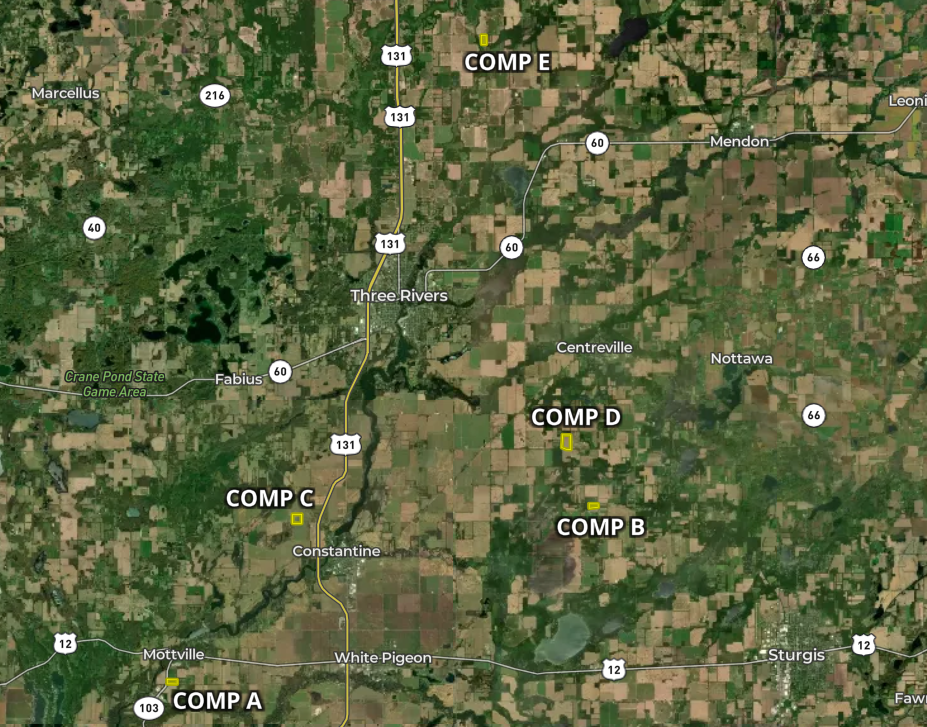
By The Numbers
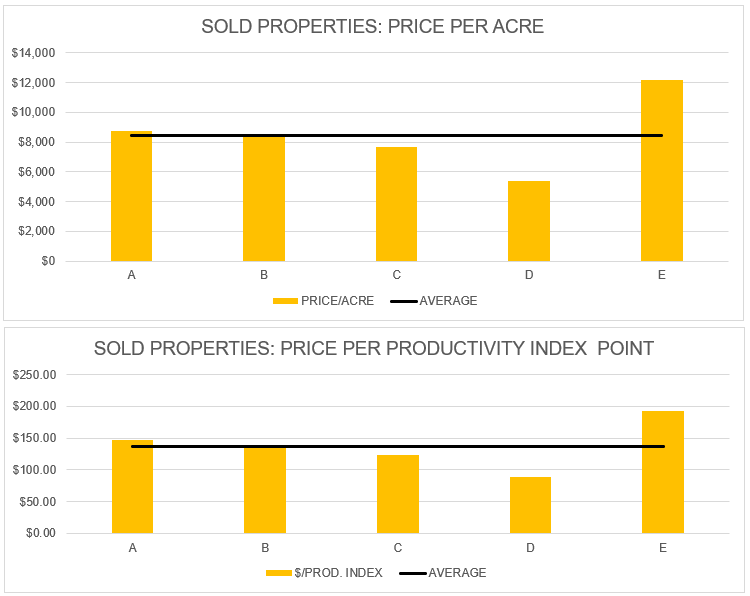
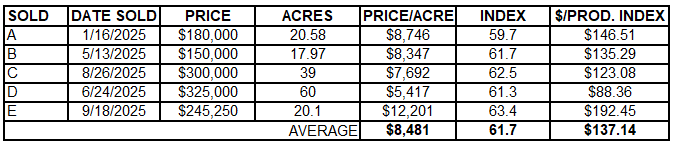
Where Productivity Continues to Drive the Conversation
St. Joseph County has long been recognized as one of southwest Michigan’s strongest agricultural counties, and that reputation remained evident throughout the 2025 farmland market. While buyers across the region became more selective, demand for productive agricultural land continued to be supported by one consistent factor: farms that make economic sense to own and operate.
Rather than chasing acreage alone, buyers focused on long-term farm performance. Properties offering productive soils, efficient field layouts, and strong operational value continued to generate the greatest interest. As the market enters 2026, St. Joseph County remains a place where farmland is still viewed first and foremost as a working asset, making local agricultural fundamentals far more influential than short-term market fluctuations.
A County Built on Production Agriculture
Agriculture has shaped St. Joseph County for generations, and today it remains one of the county’s defining industries. Corn and soybeans account for much of the landscape, supported by wheat, forage crops, seed production, and a well-established dairy and livestock sector. This diverse production base creates year-round agricultural activity and supports a network of grain facilities, equipment dealers, input suppliers, and family farming operations throughout the county.
Unlike counties where farmland values are increasingly influenced by residential growth or recreational demand, St. Joseph County continues to derive much of its strength from active agricultural production. Land is typically evaluated for what it can produce, how efficiently it can be farmed, and how well it complements an existing operation.
This practical approach has helped create a market that remains grounded even as broader economic conditions evolve.
According to the USDA National Agricultural Statistics Service (NASS), the following crop statistics have been reported for St. Joseph County, Michigan.
The 2022 Ag Census for St. Joseph County, Michigan, reported the following crop statistics:
Number of farms: 763
Land in farms (acres): 238,547
Average farm size (acres): 313
Total market value of products sold: $340,210,000
Government payments: $862,000
Farm-related income: $14,530,000
Total farm production expenses: $267,241,000
Net cash farm income: $88,361,000
The Value of Well-Built Farms
One of the defining characteristics of St. Joseph County’s farmland market during 2025 was the continued premium placed on operational efficiency.
The strongest-performing farms were often those with productive soils, good drainage, contiguous acreage, and field configurations that supported modern equipment. Buyers consistently favored properties that could be incorporated into existing operations with minimal changes, allowing them to maximize efficiency while controlling operating costs.
Meanwhile, farms with irregular boundaries, smaller field sizes, drainage limitations, or greater percentages of non-tillable acreage generally attracted a narrower range of buyers. These properties still held agricultural value, but purchasing decisions became increasingly tied to each farm’s individual strengths rather than broad market enthusiasm.
The result was a market that rewarded quality and consistency more than speculation.
Location Creates Opportunity
One advantage unique to St. Joseph County is its geographic position along Michigan’s southern border. The county benefits from strong transportation access and close proximity to northern Indiana, creating a broader regional agricultural marketplace than many Michigan counties experience.
This location allows farmland to attract interest from both Michigan-based operators and producers expanding north from Indiana, depending on the property’s location and characteristics. While local farm families remain the backbone of the market, this regional connectivity helps support competition whenever high-quality farmland becomes available.
For landowners, that means location within the county can influence buyer interest just as much as soil quality or acreage.
History & Background of St. Joseph County, Michigan
County Seat: Centreville
Townships: Burr Oak / Colon / Constantine / Fabius / Fawn River / Florence / Flowerfield / Leonidas / Lockport / Mendon / Mottville / Nottawa / Park / Sherman / Sturgis / White Pigeon
History: Established in 1829; Named after the St. Joseph River.
Population: 61,171
Cities & Towns: Sturgis / Three Rivers / Burr Oak / Centreville / Colon / Constantine / Mendon / White Pigeon / Findley / Leonidas / Mottville / Nottawa / Parkville / Wasepi
Acreage: 320,640
Investing in the Next Generation of Agriculture
Across St. Joseph County, producers continue investing in practices designed to improve long-term productivity. Precision agriculture, improved drainage systems, conservation practices, and equipment modernization have become increasingly common as farms seek greater efficiency while managing input costs.
These investments reflect an important shift within agriculture—not simply maximizing production but maximizing profitability. Buyers entering today’s farmland market are paying close attention to improvements that reduce long-term operating expenses or enhance crop performance over time.
Farms that already support these modern production practices often enter the market with a competitive advantage.
Early 2026: Stability Through Strong Agricultural Demand
The opening months of 2026 suggest that many of the trends established during 2025 remain firmly in place. Productive farmland continues to generate interest, but buyers are taking a measured approach, carefully evaluating each opportunity against current farm economics.
Fortunately, St. Joseph County’s agricultural foundation provides an element of stability. Because local demand is driven largely by active farming operations rather than speculative investment, the market has continued to demonstrate resilience even as financing costs and commodity markets fluctuate.
While individual sales will always reflect the characteristics of each property, the county continues to benefit from a buyer base focused on long-term ownership rather than short-term appreciation.
Agriculture Remains the County’s Competitive Advantage
One of St. Joseph County’s greatest strengths is that agriculture continues to be its competitive advantage rather than simply one component of the local economy.
Generations of family farms, experienced operators, and agricultural businesses have created a landscape where farmland is continually being improved, managed, and reinvested in. This ongoing commitment supports not only crop production but also the long-term stability of the local land market.
As ownership transitions occur over time, these established agricultural networks are expected to remain one of the county’s strongest assets, helping maintain demand for productive farmland well into the future.
Looking Beyond the Numbers
As 2026 unfolds, St. Joseph County landowners may find that the market is becoming increasingly property specific. The broad appreciation experienced during previous years has evolved into a market where buyers spend more time evaluating the strengths of each individual farm before making purchasing decisions.
Productive soils, efficient field layouts, dependable drainage, and modern farm improvements are likely to remain among the characteristics that separate the strongest-performing properties from the rest of the market. At the same time, the county’s proximity to both Michigan and Indiana agricultural regions should continue supporting a healthy pool of qualified buyers whenever desirable farmland becomes available.
Perhaps the biggest story moving forward is not whether farmland remains valuable – it does – but rather that buyers are becoming increasingly intentional about where they choose to invest.
Final Thoughts
St. Joseph County continues to represent one of southwest Michigan’s strongest production agriculture markets. Its farmland values remain supported by productive soils, an experienced farming community, and a regional agricultural economy that extends well beyond county lines.
While today’s buyers are more selective than they were during the rapid appreciation of previous years, the county’s long-term outlook remains closely tied to the qualities that have defined it for generations: productive land, efficient farming operations, and a commitment to agriculture as both a business and a way of life.
For landowners, those fundamentals continue to provide a strong foundation as the farmland market moves through 2026.
Sources / Citations:
Source 1:
“United States Department of Agriculture.” USDA, www.nass.usda.gov/Statistics_by_State/Michigan/Publications/County_Estimates/index.php#:~:text=Access%20Quick%20Stats%20Lite,to%20NASS%20Surveys%20and%20Programs. Accessed 23 June 2026.
Source 2:
“USDA.” 2022 Census of Agriculture County Profile, www.nass.usda.gov/Publications/AgCensus/2022/Online_Resources/County_Profiles/michigan/cp26149.pdf. Accessed 23 June 2026.
*The transaction and land sales data/information contained in this report was obtained from publicly available sources and sales disclosures deemed accurate and reliable but not guaranteed, no liability for accuracy, errors or omissions is assumed by Geswein Farm & Land Realty, LLC
Thinking About Selling?
Need Advice?
Get the guidance, service, and professional expertise you deserve.
- Family Farm Advisory for Succession Planning
- Undivided Interests & Tenants in Common
- Farmland Management Decisions
- Auctions & Listing
With our full-time experienced team, you’ll get our ‘boots on the ground’ work ethic paired with the latest in digital technology & national marketing reach – for best-in-class service and results.
Because you deserve more value.
Contact Us