


Tippecanoe County, Indiana
2026 Land Sales Report
After several years of strong gains, Tippecanoe County farmland values continued rising through 2025, though at a slower, more measured pace, with early 2026 indicators pointing toward a more balanced market where demand remains steady, but buyers are increasingly selective. Tippecanoe County farmland values in 2026 are being shaped by zoning, solar policy, road planning, development pressure, and agricultural demand. Here is what landowners should know before selling, leasing, or transitioning farmland.
If you’d like to get specific land values on your own property or a farm near you for 2026, please contact Johnny Klemme today at (765) 427-1619.
Average Price of Land*
$15,151/acre
Jan. – Dec. 2026*
As high as $17,821/acre
in 2025*
Land Market Commentary & Local Trends
Across Tippecanoe County, Indiana, the 2025 sampled farmland sales reflected a strong and competitive market, with values averaging $15,151 per acre and $181.55 per productivity index point. While these figures represent the overall market baseline, select high-quality tracts continued to attract premium pricing, with top-end sales climbing as high as $17,821 per acre – underscoring the continued strength of demand for productive ground in the county. An auction conducted by Johnny Klemme on March 31, 2026 featured a tract of land in Clarks Hill, Indiana that sold for $20,100 per acre.
Since 1977, the Geswein Farm & Land Team has been advising landowners to be stewards of the land and make decisions based on most current, accurate, and relevant data. The information in this report can provide you with a rough estimate of your property’s value; however, understanding the specific characteristics of your property and how they compare to the other sales will provide the most accurate value of your property. Additionally, properties sold by land brokers via auctions or listings consistently outperformed individual to individual transactions and properties sold by traditional home realtors.
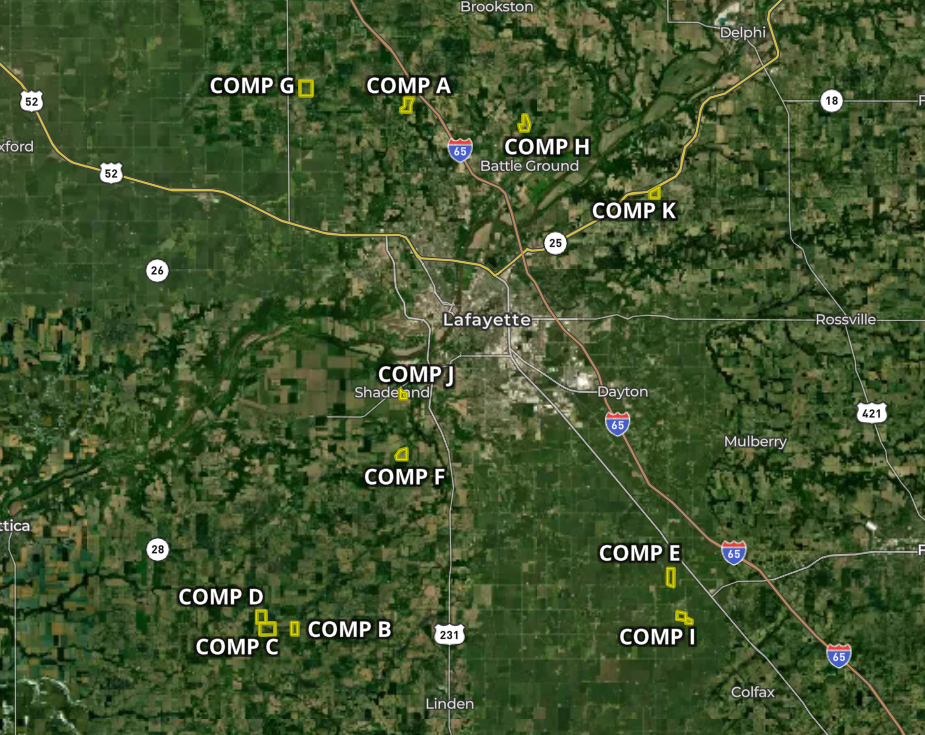
By The Numbers
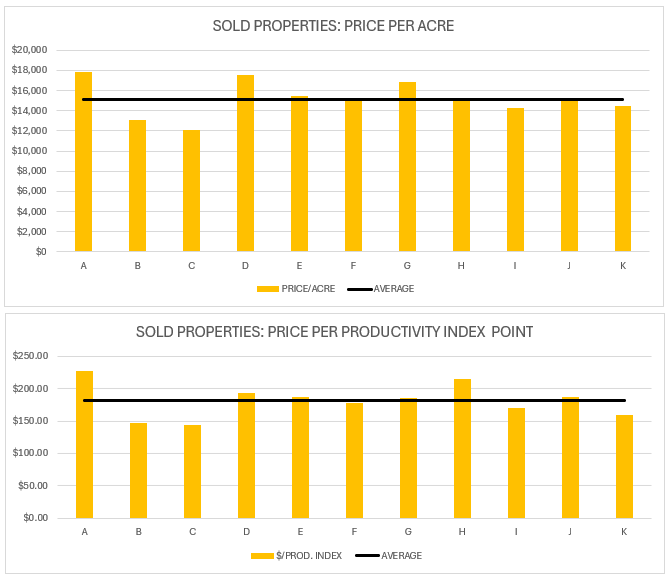
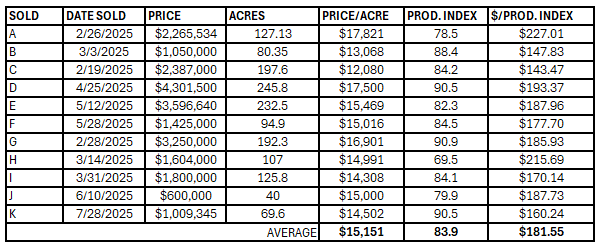
What Changed in 2025 and What’s New in 2026?
In Tippecanoe County, Indiana, farmland values remained exceptionally strong throughout 2025, continuing to rank among the more premium agricultural markets in western Indiana. However, unlike the rapid and often broad appreciation seen in previous years, 2025 increasingly reflected a market shaped by strategic buyer behavior, where land quality, location, and long-term utility played a larger role in pricing than simple scarcity alone.
The average farmland values in Tippecanoe County reinforces the county’s position as one of the stronger-performing farmland markets in the region. Yet the countywide average only tells part of the story. Top-performing sales climbed, illustrating that premium farms with exceptional soils, strong drainage, and desirable access continued to command aggressive bidding.
Compared to 2024, one of the clearest shifts in Tippecanoe County was the increasing divide between high-performing farmland and tracts with limitations tied to size, location, or competing land-use pressures. Heading into 2026, the county appears to be moving less toward broad market escalation and more toward targeted value retention – where the best farms remain highly competitive, but broader market growth may depend more heavily on macroeconomics conditions, development influence, and inventory dynamics.
Why Land Use Matters More Than Ever
Tippecanoe County Farmland Is No Longer Just an Agricultural Asset
In 2026, Tippecanoe County farmland sits at the center of several important land-use conversations. For landowners, these discussions are not just about planning, zoning, or energy policy. They affect land value, future use options, family legacy, and the long-term decision of whether to keep, lease, transition, or sell the farm.
Indiana Farmland Values Remain Strong, But Location Matters
Indiana farmland values continued to show strength heading into 2026. Purdue’s 2025 Farmland Value Survey reported top-quality Indiana farmland at $14,826 per acre, average-quality land at $12,254 per acre, and poor-quality land at $9,761 per acre. But in Tippecanoe County, value is not determined by soil quality alone. Proximity to Lafayette, West Lafayette, Purdue University, major roads, utilities, and growth corridors can create additional demand beyond traditional agricultural value.
The Thoroughfare Plan Can Signal Future Growth
Tippecanoe County’s updated Thoroughfare Plan is one of the most important documents for landowners to understand. It identifies future road classifications, right-of-way needs, and long-term transportation planning. When a rural corridor is planned for future improvement, nearby farms may see increased pressure for residential, commercial, or mixed-use development. On the other hand, areas with lower-intensity road classifications may be more likely to retain their agricultural character.
Solar Policy Is Reshaping the Farmland Conversation
Utility-scale solar remains one of the hottest land-use topics in Tippecanoe County. The county’s revised solar ordinance has focused attention on setbacks, decommissioning standards, and limits on how much farmland can be used for large-scale solar. For landowners, this matters because not every farm that is physically suitable for solar will be economically or legally practical. Setbacks can reduce usable acreage, while decommissioning requirements may help protect the long-term productivity and resale value of the land.
Rezoning Decisions Are Quietly Setting Precedent
Ongoing zoning amendments and individual rezoning petitions also shape farmland value. Each time land moves from agricultural use to residential, commercial, industrial, or transitional use, it can influence surrounding land values, traffic patterns, buyer demand, and neighborhood expectations. For farm families, nearby rezoning activity may be an early indicator of future development pressure.
Key Takeaways for Tippecanoe County Landowners
Land value in 2026 is being shaped by more than commodity prices and cash rent. The highest-value opportunities often depend on location, access, utilities, road planning, zoning, and future land-use demand. Solar leases may create income opportunities, but ordinance limits, setbacks, and restoration requirements must be carefully reviewed. Rezoning activity near your farm may affect both your future sale strategy and your long-term preservation options.
Planning Ahead Protects Both Value and Legacy
Your farm does not exist in a vacuum. Its future value and use options are being shaped by planning meetings, zoning maps, road studies, and ordinance updates happening right now. The most proactive landowners are studying where their land fits within Tippecanoe County’s growth patterns and making decisions before pressure forces their hand.
Whether your goal is to protect a multi-generation farm, explore development potential, evaluate a solar lease, or prepare for a strategic sale or auction, the first step is understanding what your land is truly positioned to become.
If you own farmland in Tippecanoe County and want to better understand its value, use options, and long-term potential, Geswein Farm & Land can help you evaluate the land, the market, and the strategy that best fits your family’s goals.
Market Activity & Pricing
According to Land.com, Tippecanoe County remains one of Indiana’s most active and valuable land markets, with nearly 1,000 acres currently listed for sale and an aggregate market value approaching $110 million. This level of activity places Tippecanoe County among the more prominent counties in Indiana for active land inventory, reflecting both agricultural demand and the county’s broader economic and development significance.
Lafayette currently represents the county’s highest concentration of active land listings, which is not surprising given its role as the county’s economic center and its proximity to expanding infrastructure, Purdue University, and transportation corridors. Tippecanoe County spans approximately 503 square miles, making it the 13th largest county in Indiana, and its location in western Indiana continues to position it as both an agricultural and strategic growth market.
Unlike more purely rural counties, Tippecanoe County’s land market often reflects multiple value influences – including productive row-crop demand, transitional development potential, and location-driven premiums. As a result, pricing can vary more significantly depending on whether land is being valued strictly for agricultural production or for broader investment opportunities.
Overview of Tippecanoe County Agriculture
Tippecanoe County has long been recognized for its productive agricultural base, particularly in corn and soybean production, supported by strong soils, established infrastructure, and access to grain markets. Premium farmland in the county is typically characterized by highly productive soils, dependable drainage, efficient field shape, and proximity to transportation networks that support long-term farm profitability.
Large, contiguous tillable tracts with strong productivity ratings continue to command some of the county’s highest values, especially when paired with location advantages near established markets or infrastructure. In Tippecanoe County, geography can create an especially important pricing distinction: farms that combine top-tier agricultural quality with strategic location may attract both farm operators and investors, sometimes creating pricing premiums beyond agricultural fundamentals alone.
Average or lower-tier farmland may include parcels with fragmented acreage, less efficient layouts, lower drainage quality, or increased competition from non-agricultural land uses that complicate pure row-crop value. In some portions of the county, suburban expansion or transitional pressures can create both opportunity and uncertainty, making land valuation more nuanced than in counties driven almost exclusively by agriculture.
As a result, Tippecanoe County’s farmland market often operates with layered value drivers – where productivity remains critical, but location and future land-use flexibility can also play a meaningful role.
History & Background of Tippecanoe County, Indiana: Home of Purdue University
County Seat: Lafayette
Townships: Fairfield / Jackson / Lauramie / Perry / Randolph / Sheffield / Shelby / Tippecanoe / Union / Wabash / Washington / Wayne / Wea
History: Named for the famous 1811 Battle of Tippecanoe and organized in 1826
Population: 188,717
Cities & Towns: Battle Ground / Clarks Hill / Dayton / Lafayette / Otterbein / Shadeland / West Lafayette / Westpoint
Acreage: 319,294
Tippecanoe County Agriculture Snapshot
Much of the foundational agricultural and demographic data for Tippecanoe County comes from the USDA Census of Agriculture, which is updated every five years. Because of this cycle, the data serves as a structural benchmark that helps landowners and buyers understand the county’s long-term agricultural foundation, while annual sales data provides more immediate insight into current market behavior.
Tippecanoe County’s agricultural identity remains deeply rooted in row-crop production, with strong farming infrastructure continuing to support land demand despite broader shifts in interest rates, commodity cycles, and regional development.
This combination of agricultural productivity and economic diversity helps explain why Tippecanoe County often maintains resilient farmland demand, even as market conditions evolve.
The 2022 Ag Census for Tippecanoe County, Indiana, reported the following crop statistics:
Number of farms: 712
Land in farms (acres): 234,534
Average farm size (acres): 334
Total market value of products sold: $244,176,000
Government payments: $1,631,000
Farm-related income: $9,959,000
Total farm production expenses: $200,408,000
Net cash farm income: $55,357,000
County Crossroads: What’s Shaping Tippecanoe County Beyond the Field Rows?
Tippecanoe County’s farmland market does not operate in a vacuum. While agriculture remains a major force, this county’s unique blend of university influence, infrastructure growth, economic development, and regional expansion creates a broader set of local dynamics than many traditional farm counties experience.
Key developments and community watchpoints in 2025-2026 include:
Purdue University’s Expanding Influence
As Purdue University continues driving research, innovation, and population movement in the Lafayette-West Lafayette area, its presence shapes more than education alone. Workforce growth, housing demand, infrastructure improvements, and business attraction all contribute to broader land-use conversations across portions of the county.
LEAP District & Regional Development Pressure
The ongoing discussions surrounding the larger LEAP (Limitless Exploration/Advanced Pace) innovation and economic development initiatives in nearby central Indiana have heightened regional awareness around water resources, infrastructure planning, and future industrial growth. While Tippecanoe County’s role differs from Boone County or Lebanon, regional planning conversations can still influence how landowners think about long-term positioning, utilities, and development patterns.
Lafayette & West Lafayette Housing Expansion
Continued residential and commercial growth around Lafayette and West Lafayette remains on the county’s defining local trends. As housing, retail, and supporting infrastructure expand outward, certain farmland parcels near growth corridors may increasingly face questions surrounding future land use, zoning, or transitional value.
Transportation, Logistics & State Road Corridors
Tippecanoe County’s transportation infrastructure – including Interstate 65, U.S. 52, and rail connectivity – continues supporting both agricultural efficiency and industrial attractiveness. For farmland owners, proximity to transportation routes can influence not only operational logistics but also strategic value over time.
Water, Utilities & Resource Conversations
As development conversations intensify across greater Indiana, infrastructure capacity, water access, and utility planning are becoming increasingly relevant local issues. In Tippecanoe County, these topics may not impact every landowner equally, but they are becoming a larger part of future-facing land discussions.
In Tippecanoe County, the local pulse is defined by intersection – where farming, research, development, and infrastructure all meet. For landowners, this makes the county especially unique: some properties may remain purely agricultural for generations, while others may increasingly sit near the edge of broader economic transformation.
What Landowners Should Watch in 2026
As Tippecanoe County moves into 2026, landowners should closely monitor the intersection of interest rates, commodity economics, development pressure, and local inventory levels. Because Tippecanoe County’s farmland market is influenced by both agricultural fundamentals and location-based demand, it may respond differently than more purely rural counties if broader economic conditions shift.
Interest rates will remain one of the most important factors affecting transaction pace, particularly for leveraged buyers. At the same time, the county’s combination of premium farmland, strong operator demand, and strategic development corridors may continue to provide pricing resilience – especially for top-tier properties.
2026 Market Scenarios
Looking ahead, several key paths could shape Tippecanoe County’s farmland market:
If borrowing costs ease: Premium tillable farms and strategically located tracts could see renewed competition, particularly where agricultural and investment demand overlap.
If commodity margins tighten: Buyers may become increasingly selective, reinforcing stronger premiums for top-quality land while moderating values on average tracts.
If development activity expands: Certain parcels may see additional pricing support based on location, infrastructure, or transitional potential beyond farming alone.
If listing inventory increases substantially: Buyers may gain more negotiating leverage, particularly on non-premium or fragmented tracts.
Overall, 2026 is likely to a year where Tippecanoe County landowners benefit most from understanding not just what their land produces, but where it sits within the county’s broader hierarchy of productivity, location, and long-term strategic value. In a county where agriculture and growth increasingly intersect, positioning may prove just as important as productivity.
Sources / Citations:
Source 1:
“United States Department of Agriculture.” USDA, www.nass.usda.gov/Statistics_by_State/Indiana/Publications/County_Estimates/index.php#:~:text=Access%20Quick%20Stats%20Lite,to%20NASS%20Surveys%20and%20Programs. Accessed 8 May 2026.
Source 2:
“USDA.” 2022 Census of Agriculture County Profile, www.nass.usda.gov/Publications/AgCensus/2022/Online_Resources/County_Profiles/Indiana/cp18157.pdf. Accessed 8 May 2026.
*The transaction and land sales data/information contained in this report was obtained from publicly available sources and sales disclosures deemed accurate and reliable but not guaranteed, no liability for accuracy, errors or omissions is assumed by Geswein Farm & Land Realty, LLC
Thinking About Selling?
Need Advice?
With our full-time experienced team, you’ll get our ‘boots on the ground’ work ethic paired with the latest in digital technology & national marketing reach – for best-in-class service and results.
Because you deserve more value.
Contact Us