


Tipton County, Indiana
2024 Land Sales Report
Land prices in Tipton County remained strong through 2024. However, the first half of 2025 points to a potential shift toward steadier pricing.
If you’d like to get specific land values on your own property or a farm near you for 2025, please contact Johnny Klemme today at (765) 427-1619
Average Price of Land*
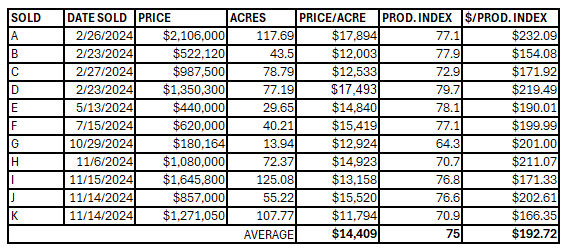
$14,409/acre
Jan. – Dec. 2024*
As high as $17,894/acre
in 2024*
Land Market Commentary & Local Trends
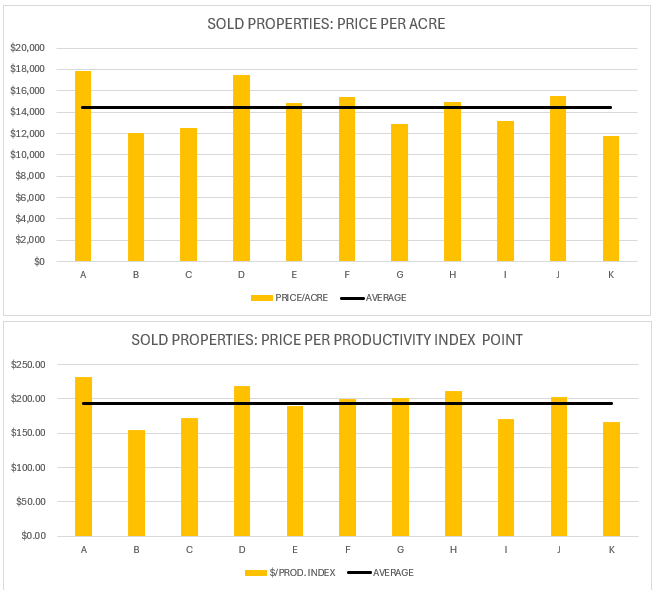
Overall, the average price of farmland was $14,409/acre and the price per productivity index point was $192.72 in 2024 based on the sales data. It is important to note that in 2024 there have been several farmland sales as high as $17,894 per acre.
Since 1977, the Geswein Farm & Land Team has been advising landowners to be stewards of the land and make decisions based on most current, accurate, and relevant data. The information in this report can provide you with a rough estimate of your property’s value; however, understanding the specific characteristics of your property and how they compare to the other sales will provide the most accurate value of your property. Additionally, properties sold by land brokers via auctions or listings consistently outperformed individual to individual transactions and properties sold by traditional home realtors.
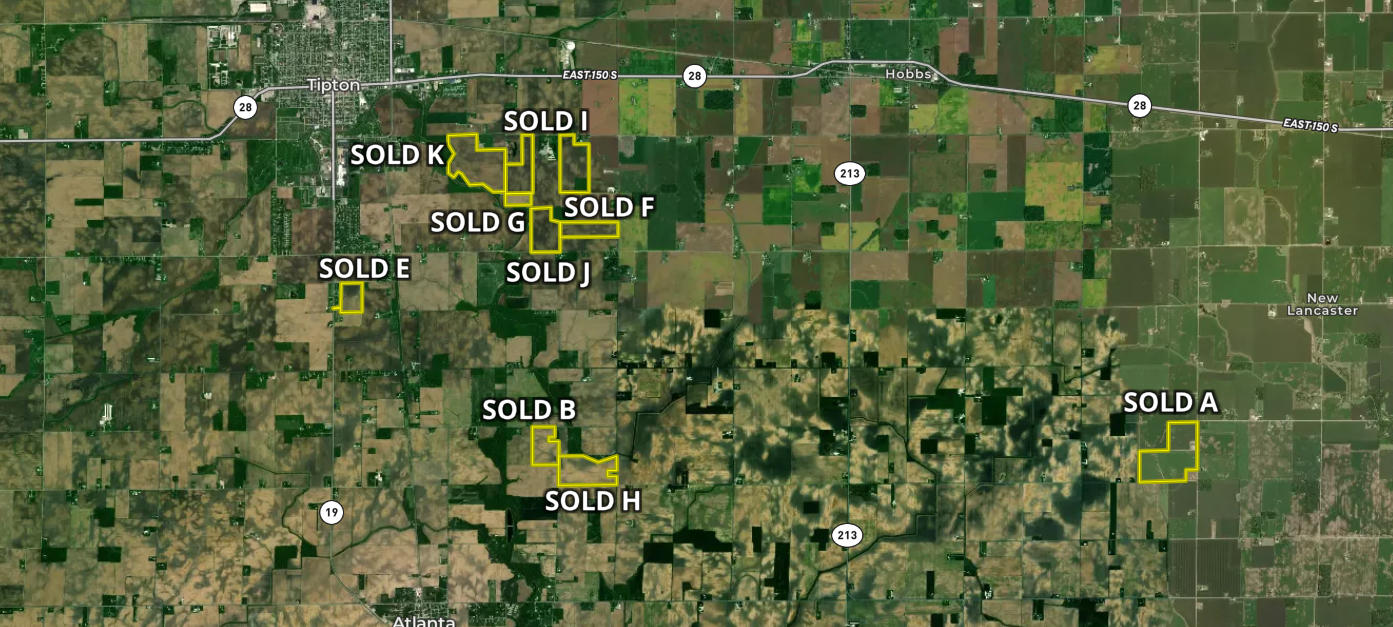
By The Numbers
According to Land.com, nearly 1,000 acres of farmland and rural property were recently listed for sale in Tipton County, with a total value close to $5 million. Interestingly, Tipton County ranks near the bottom – 90th out of Indiana’s 92 counties – when it comes to the total number of acres currently on the market. Still, within the county itself, the town of Tipton had the most listings. Tipton County covers about 260 square miles, making it the 83rd largest county in the state, and it’s located in the central part of Indiana.
The most recent USDA farmland census reveals that Tipton County has approximately 163,401 acres of farmland. The county’s average farm size is around 393 acres, with over 416 farms operating within its borders. Corn and soybeans are the predominant crops, contributing significantly to the local agricultural economy. The census also indicates that the majority of farm operators in Tipton County are family-owned businesses, emphasizing the importance of agriculture to the community’s heritage and economy.
Overview of Tipton County Agriculture
Location and Geography: Tipton County sits in central Indiana (north of Indianapolis), bordered by Howard, Madison, Hamilton, and Grant counties. The terrain is predominantly flat to gently rolling, part of the Central Till Plains, drained by Wildcat Creek and Cicero Creek. Native soils – Miami and Clyde silty loams – support both robust row-crop production and specialty vegetable areas.
Major Crops:
- Corn: Tipton County is a significant producer of corn, which is a staple crop in the region. The fertile soil and favorable growing conditions contribute to high corn yields.
- Soybeans: Alongside corn, soybeans are another dominant crop.
- Vegetables: Tipton County also grows a decent amount of tomatoes for Red Gold, the one stop shop for everything tomato.
Tipton County’s agriculture is driven by large-scale, family-operated farms with roughly 93% of farmland dedicated to harvested cropland. The county benefits from historically rich, fertile soils – especially Miami and Clyde silt loams – ideal for high yields in corn, soybeans, and rotational wheat, with smaller vegetable and orchard operations in select areas. Investments in ag-tech, no-till/cover crops (supported by Purdue Extension), and seed corn production (Pioneer Hi-Bred in Tipton) enhance productivity and land value.
Current State of Corn and Soybean Prices and Their Impact on Farmers
Corn Prices
It is June 2025, and you are likely watching prices closely – and right now, the USDA is projecting a slight dip. The average price for corn in the 2025-2026 marketing year is expected to land around $4.20 per bushel, slightly down from the $4.35 in last year. It is not a huge drop, but it could tighten margins depending on your input costs. With a solid crop and smart marketing, though, there is still opportunity to do well – especially if weather or global supply issues shake up the market later in the season.
Soybean Prices
The soybean market is looking a little stronger than last year. The USDA’s current forecast puts the 2025-2026 average soybean price at $10.25 per bushel, up from $9.95 in 2024-2025. That bump could give some extra room to work with when it comes to marketing your crop. Whether you have locked in prices already or are holding out for better contracts, this projected increase is a reassuring sign of steady demand ahead.
Impact on Farmers
- Income Variability: Lower prices for corn and wheat introduces more income uncertainty for farmers relying heavily on those crops. Even small price shifts can have a big impact on profitability when margins are already thin. While soybeans offer a slight bright spot with a projected price increase, overall revenue may still fluctuate depending on how yields, timing, and local basis play out. Farmers with diversified operations or flexible marketing tools will be better positioned to absorb this variability.
- Cost Management: With prices softening for corn and wheat, cost control becomes even more critical. Farmers who planted early in 2025 may have already faced higher input costs – fertilizer, seed, fuel – due to inflation and residual supply chain disruptions. If market prices remain below expectations at harvest, there may be less room for error. Farmers may need to lean harder on precision practices, input efficiency, and careful capital planning to maintain profitability.
- Market Strategy: The shifting price landscape underscores the importance of flexible and proactive marketing strategies. Farmers will likely benefit from a mix of forward contracts, crop insurance, and futures/options to protect downside risk – especially for corn and wheat. Holding off on pricing too early could also be risky if projected prices keep sliding. Soybean growers may have more leeway to capitalize on upward trends, particularly if they time their sales strategically during seasonal rallies or global demand surges.
- Geopolitical and Environmental Factors: Markets remain highly sensitive to geopolitical events (such as conflict in key grain-exporting regions or changes in trade policy) and weather extremes (droughts or floods). These can shift prices quickly and significantly.
- Long-Term Planning: For long-term strategy, the slight downtrend in corn and wheat prices may encourage some farmers to re-evaluate cropping decisions, consider diversification, or invest in soil health and sustainability practices that offer long-term resilience and potential subsidies.
The current outlook presents both challenges and opportunities. While softening prices for corn and wheat may compress margins, soybeans provide a more stable outlook. Smart cost control, flexible marketing, and awareness of broader forces – like policy shifts or weather volatility – will be key to navigating 2025 successfully and setting up for the future.
History & Background of Tipton County, Indiana
County Seat: Tipton
Townships: Cicero / Jefferson / Liberty / Madison / Prairie / Wildcat
History: Founded in 1844, named for John Tipton: veteran of the Battle of Tipton.
Population: 15,227
Cities & Towns: Kempton / Sharpsville / Tipton / West Elwood / Windfall City
Acreage: 302,720
According to the USDA National Agricultural Statistics Service (NASS), the following crop statistics have been reported for Tipton County, Indiana.
The 2022 Ag Census for Tipton County, Indiana, reported the following crop statistics:
Number of farms: 416
Land in farms (acres): 163,401
Average farm size (acres): 393
Total market value of products sold: $203,027,00
Government payments: $735,000
Farm-related income: $7,028,000
Total farm production expenses: $139,770,000
Net cash farm income: $71,020,000
Sources / Citations:
Source 1:
“United States Department of Agriculture.” USDA, www.nass.usda.gov/Statistics_by_State/Indiana/Publications/County_Estimates/index.php#:~:text=Access%20Quick%20Stats%20Lite,to%20NASS%20Surveys%20and%20Programs. Accessed 16 June 2025.
Source 2:
“USDA.” 2022 Census of Agriculture County Profile, www.nass.usda.gov/Publications/AgCensus/2022/Online_Resources/County_Profiles/Indiana/cp18159.pdf. Accessed 16 June 2025.
*The transaction and land sales data/information contained in this report was obtained from publicly available sources and sales disclosures deemed accurate and reliable but not guaranteed, no liability for accuracy, errors or omissions is assumed by Geswein Farm & Land Realty, LLC
Thinking About Selling?
Need Advice?
Get the guidance, service, and professional expertise you deserve.
- Family Farm Advisory for Succession Planning
- Undivided Interests & Tenants in Common
- Farmland Management Decisions
- Auctions & Listing
With our full-time experienced team, you’ll get our ‘boots on the ground’ work ethic paired with the latest in digital technology & national marketing reach – for best-in-class service and results.
Because you deserve more value.
Contact Us