


Van Buren County, Michigan
2026 Land Sales Report
For Van Buren County farmland, 2025 was more about consistency than big jumps in value, especially for quality ground. Early 2026 activity suggests a market that’s still healthy, just not as aggressive as it’s been.
If you’d like to get specific land values on your own property or a farm near you for 2026, please contact Jason Cackley at (269) 240-3196.
Request a Land Values ReportAverage Price of Land*
$8,151/acre
Jan. – Dec. 2025*
As high as $9,871/acre
in 2025*
Land Market Commentary & Local Trends
In Van Buren County, 2025 farmland sales averaged $8,151 per acre, and the typical productivity-adjusted value was $162.25 per point. Premium farms continued to bring strong interest, with highs reaching $9,871 per acre.
Since 1977, the Geswein Farm & Land Team has been advising landowners to be stewards of the land and make decisions based on most current, accurate, and relevant data. The information in this report can provide you with a rough estimate of your property’s value; however, understanding the specific characteristics of your property and how they compare to the other sales will provide the most accurate value of your property. Additionally, properties sold by land brokers via auctions or listings consistently outperformed individual to individual transactions and properties sold by traditional home realtors.
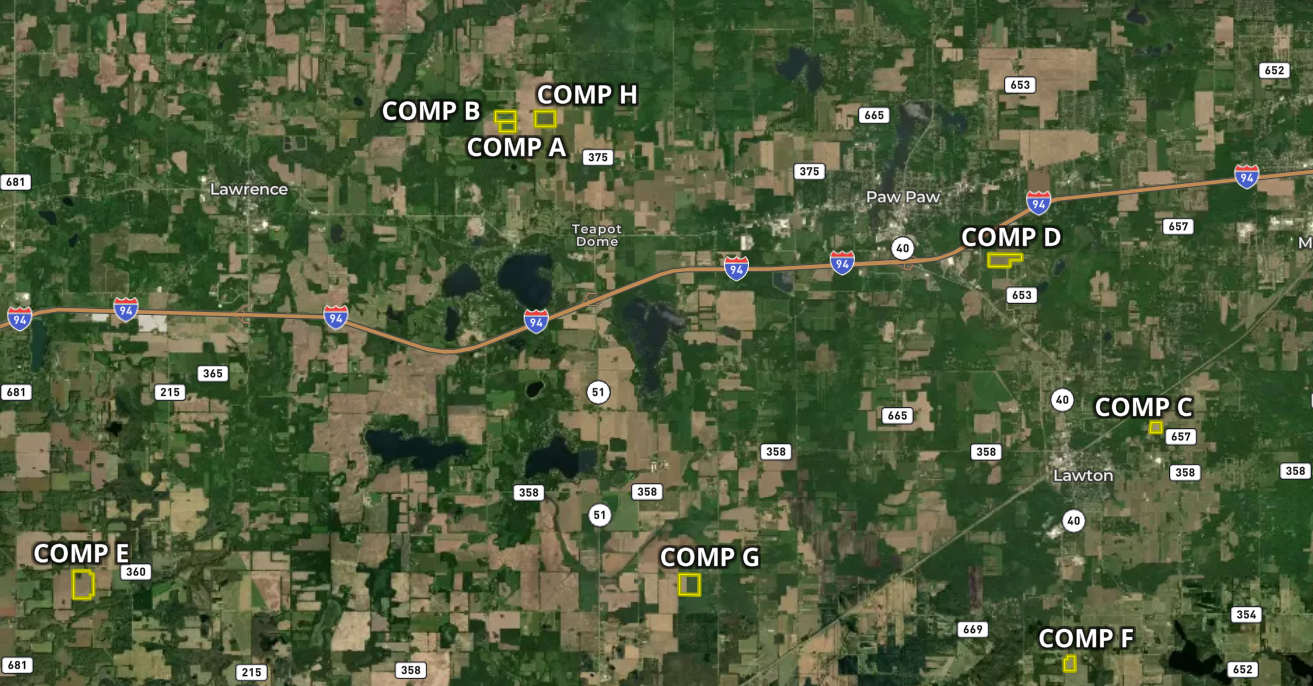
By The Numbers
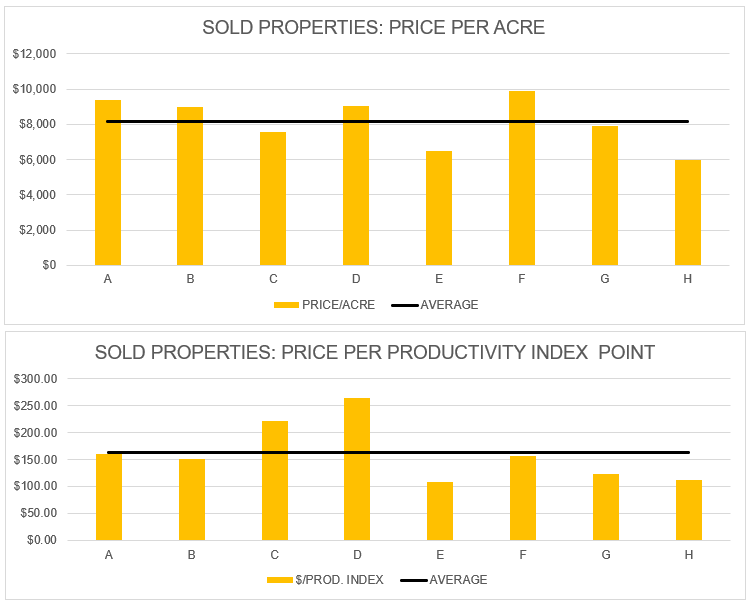
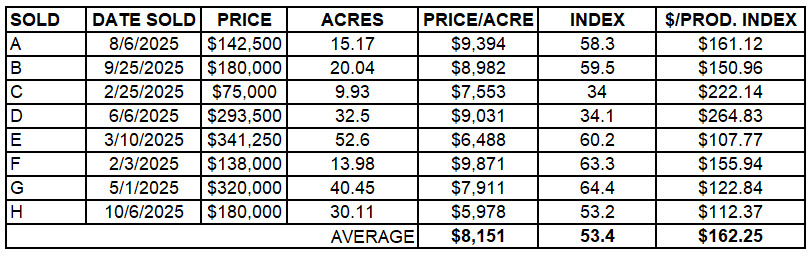
History & Background of Van Buren County, Michigan
County Seat: Paw Paw
Townships: Almena / Antwerp / Arlington / Bangor / Bloomingdale / Columbia / Covert / Decatur / Geneva / Hamilton / Hartford / Keeler / Lawrence / Paw Paw / Pine Grove / Porter / Waverly / Charter Township of South Haven
History: Established in 1829; Named after Martin Van Buren, who served as U.S. Secretary of State and later as President.
Population: 75,587
Cities & Towns: Bangor / Gobles / Hartford / South Haven / Bloomingdale / Breedsville / Decatur / Lawrence / Lawton / Mattawan / Paw Paw
Acreage: 388,480
A County Where Agriculture and Lake Influence Intersect
Van Buren County’s farmland market in 2025 reflected a unique blend of strong agricultural roots and external land-use influence tied to its location along Lake Michigan’s shoreline and tourism corridor. While agriculture remains the foundation of rural land value, the county does not operate in isolation. Seasonal demand, recreational appeal, and proximity to lake-effect communities all contribute to a land market that behaves slightly differently than more inland row-crop counties.
Throughout 2025, buyers remained interested in productive farmland, but pricing and competition often varied depending on location, accessibility, and potential non-agricultural appeal. As 2026 begins, Van Buren County continues to stand out as a place where farmland value is shaped by more than just crop production alone.
Agriculture Rooted in Diversity and Specialty Production
Van Buren County supports one of the more diverse agricultural profiles in southwest Michigan. Traditional row crops such as corn and soybeans remain important, but they share the landscape with a strong presence of specialty agriculture, including fruit production, vineyards, vegetables, and other high-value crops.
This agricultural diversity is influenced heavily by the county’s proximity to Lake Michigan, which moderates temperatures and creates microclimates favorable for specialty crop production. As a result, certain areas of the county support farming systems that differ significantly from the broader Midwest row-crop model.
Livestock production and forage-based farming also play a role in the local agricultural economy, further broadening the range of operations that depend on farmland throughout the county. This mix of agricultural uses creates a land market where value is not defined by a single crop type, but rather by how well a property fits into a specific farming system.
According to the USDA National Agricultural Statistics Service (NASS), the following crop statistics have been reported for Van Buren County, Michigan.
The 2022 Ag Census for Van Buren County, Michigan, reported the following crop statistics:
Number of farms: 838
Land in farms (acres): 131,486
Average farm size (acres): 157
Total market value of products sold: $262,267,000
Government payments: $7,053,000
Farm-related income: $11,297,000
Total farm production expenses: $211,229,000
Net cash farm income: $69,388,000
Not All Land Competes on the Same Playing Field
One of the defining characteristics of Van Buren County’s farmland market is the way location influences value beyond soil productivity alone.
Highly productive tillable tracts with strong access and efficient field layouts continue to attract steady agricultural demand, particularly from established farm operators. These properties are evaluated primarily on their ability to support consistent production and long-term operational efficiency.
However, parcels located closer to lakeshore communities, recreational corridors, or areas with stronger non-agricultural interest often experience a different type of demand. These properties may attract a broader buyer pool, including recreational users or buyers seeking rural residential potential in addition to agricultural use.
This dual influence creates a more layered market structure than is typically seen in purely production-focused counties.
Specialty Crops and Microclimates Shape Agricultural Value
Van Buren County’s agricultural identity is strongly influenced by its ability to support specialty crop production. Lake Michigan’s moderating effect on temperatures creates growing conditions that allow for fruit production, vineyards, and other higher-value agricultural systems that are less common in inland counties.
This specialization adds depth to the farmland market because not all acreage is interchangeable. Some tracts carry additional value based on their suitability for perennial crops or specialty agricultural systems that require specific soil and climate conditions.
As a result, farmland in Van Buren County is often evaluated not just on current row-crop productivity, but on its potential flexibility across different agricultural uses. That versatility can be a key driver of long-term value.
Rural Land Use Pressure Adds Another Layer of Demand
In addition to agricultural demand, Van Buren County continues to experience influence from broader rural land-use trends tied to its location within western Michigan’s tourism and lake-adjacent region.
While agriculture remains the dominant land use, certain areas of the county may attract interest for rural residential development, seasonal properties, or recreational land use. This does not replace the agricultural market, but it does create situations where farmland may be evaluated differently depending on proximity to population centers or recreational destinations.
For landowners, this means that location can sometimes carry as much influence as soil quality when determining how a property is viewed by potential buyers.
Early 2026: A Market Balancing Agriculture and Alternative Demand
Early trends into 2026 suggest that Van Buren County continues to operate within a balanced but evolving land market. Agricultural buyers remain active, particularly for well-located, productive farmland that fits into existing farm operations. However, buyer interest is increasingly segmented based on property type and location.
High-quality agricultural tracts continue to see the strongest farm-based demand, while properties with recreational or transitional potential may attract a broader mix of buyers. This dual-market dynamic is expected to remain an important theme as the year progresses.
Overall, the county appears to be in a phase where farmland is still fundamentally agricultural, but where alternative land-use considerations are becoming more visible in certain areas.
What Van Buren County Landowners Should Keep in Mind in 2026
As the farmland market continues through 2026, Van Buren County landowners may want to pay close attention to several key factors shaping local conditions.
First, agricultural productivity and farm efficiency remain the primary drivers of value for most tillable acreage. Well-maintained farms with strong soils, good drainage, and efficient layouts are expected to continue attracting consistent demand from active operators.
Second, location within the county plays an increasingly important role. Properties closer to lakeshore influence, recreational areas, or growing rural communities may experience broader buyer interest beyond traditional agricultural users.
Third, specialty crop suitability continues to be a unique value factor. Land that supports fruit production, vineyards, or other high-value agricultural systems may trade differently than standard row-crop ground.
Finally, inventory levels and ownership transitions will remain important. As with many Michigan counties, the availability of quality farmland often has a direct impact on competition and pricing behavior.
Final Thoughts
Van Buren County stands out as one of southwest Michigan’s more dynamic farmland markets due to its combination of productive agriculture, specialty crop potential, and location-driven land-use influences.
While agriculture remains the foundation of land value, the county’s proximity to Lake Michigan and associated development and recreational pressures create a more layered market than many inland farming regions. This makes each property highly dependent on its specific characteristics, rather than being driven by a single market narrative.
As 2026 unfolds, Van Buren County farmland will continue to be shaped by this balance between production agriculture and broader land-use demand – making it one of the more nuanced agricultural markets in the region.
Sources / Citations:
Source 1:
“United States Department of Agriculture.” USDA, www.nass.usda.gov/Statistics_by_State/Michigan/Publications/County_Estimates/index.php#:~:text=Access%20Quick%20Stats%20Lite,to%20NASS%20Surveys%20and%20Programs. Accessed 23 June 2026.
Source 2:
“USDA.” 2022 Census of Agriculture County Profile, www.nass.usda.gov/Publications/AgCensus/2022/Online_Resources/County_Profiles/michigan/cp26159.pdf. Accessed 23 June 2026.
*The transaction and land sales data/information contained in this report was obtained from publicly available sources and sales disclosures deemed accurate and reliable but not guaranteed, no liability for accuracy, errors or omissions is assumed by Geswein Farm & Land Realty, LLC
Thinking About Selling?
Need Advice?
Get the guidance, service, and professional expertise you deserve.
- Family Farm Advisory for Succession Planning
- Undivided Interests & Tenants in Common
- Farmland Management Decisions
- Auctions & Listing
With our full-time experienced team, you’ll get our ‘boots on the ground’ work ethic paired with the latest in digital technology & national marketing reach – for best-in-class service and results.
Because you deserve more value.
Contact Us