


Wells County, Indiana
2026 Land Sales Report
Wells County farmland remained a strong investment throughout 2025, with quality tracts continuing to attract competitive interest. Heading into 2026, the market appears stable, with buyers remaining engaged while taking a closer look at individual property characteristics.
If you’d like to get specific land values on your own property or a farm near you for 2026, please contact Brock Solmos at (574) 360-5520.
Request a Land Values ReportAverage Price of Land*
$13,539/acre
Jan. – Dec. 2025*
As high as $17,131/acre
in 2025*
Land Market Commentary & Local Trends
Wells County farmland maintained strong momentum in 2025, with average sales totaling $13,539 per acre and $198.62 per productivity index point. The upper end of the market remained competitive, with exceptional tracts selling for as much as $17,131 per acre.
Since 1977, the Geswein Farm & Land Team has been advising landowners to be stewards of the land and make decisions based on most current, accurate, and relevant data. The information in this report can provide you with a rough estimate of your property’s value; however, understanding the specific characteristics of your property and how they compare to the other sales will provide the most accurate value of your property. Additionally, properties sold by land brokers via auctions or listings consistently outperformed individual to individual transactions and properties sold by traditional home realtors.
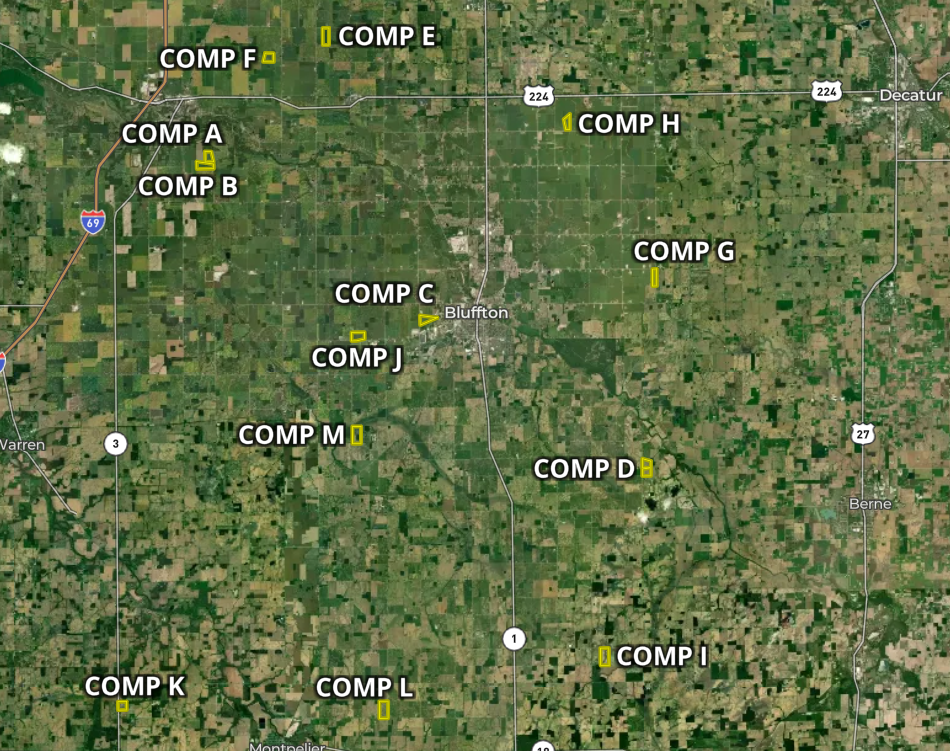
By The Numbers
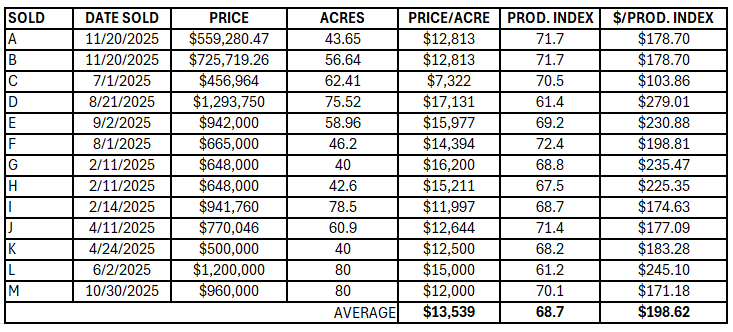
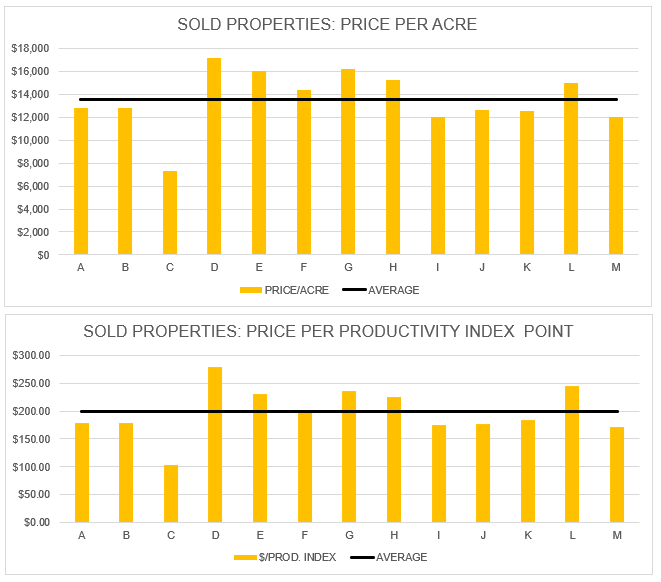
A Community Where Agriculture Continues to Shape the Landscape
Wells County remains a strong example of the agricultural tradition that defines northeast Indiana. With a landscape shaped by generations of farmers, productive acreage, and close-knit rural communities, agriculture continues to serve as one of the county’s most important economic foundations.
Unlike areas where farmland demand is heavily influenced by major development trends, Wells County’s market remains closely connected to agricultural performance and long-term land ownership. Buyers continue to evaluate properties based on productivity, efficiency, and the ability to support successful farming operations.
Throughout 2025, farmland buyers remained focused on acquiring quality acreage while becoming more intentional about the properties they pursued. That same trend has continued into 2026, with strong interest remaining for well-managed farms and careful evaluation becoming a larger part of the purchasing process.
Farming Remains the Heart of Wells County
Agriculture continues to define much of Wells County’s rural landscape. The county supports a mix of corn and soybean production, livestock operations, forage production, and diversified family farms.
Many operations throughout the county have been built over multiple generations, creating a strong agricultural culture centered around stewardship and responsible land management. Local producers continue investing in improved practices, technology, and efficiency to maintain long-term productivity.
The combination of experienced farmers, established infrastructure, and strong agricultural connections helps support continued confidence in Wells County farmland.
History & Background of Wells County, Indiana
County Seat: Bluffton
Townships: Harrison / Jefferson / Lancaster / Chester / Jackson / Liberty / Madison / Union / Wabash
History: Established in 1837; Named for William A. Wells, a notable figure in the Northwest Indian Wars.
Population: 28,180
Cities & Towns: Bluffton / Markle / Ossian / Poneto / Uniondale / Vera Cruz / Zanesville
Acreage: 236,600
What Buyers Are Looking for in Today’s Market
As farmland markets have become more balanced, buyers are paying closer attention to the characteristics that separate exceptional farms from average properties.
In Wells County, farms with productive soils, dependable drainage, good road access, and efficient field layouts continue receiving the strongest interest. These characteristics allow operators to maximize equipment efficiency and improve long-term performance.
Buyers are also considering factors such as maintenance history, improvements, and overall farm condition. Properties that have been well cared for often provide greater confidence and fewer unknowns for purchasers.
The current market continues rewarding quality, preparation, and strong management.
Rural Strength with Regional Connections
2026 So Far: A More Thoughtful Farmland Market
The first half of 2026 has continued the shift toward a more measured farmland environment.
Local operators remain active buyers, particularly when opportunities arise to expand acreage, improve efficiency, or add strategically located farms to existing operations. However, buyers are approaching purchases with greater attention to financial performance and long-term sustainability.
Quality farms continue to stand out. Properties with strong production histories, good management, and desirable characteristics are attracting the most attention, while buyers are taking additional time to evaluate farms requiring improvements or additional investment.
The market remains active, but decisions are being made with more discipline and long-term focus.
What Could Influence Wells County Land Decisions Moving Forward?
As 2026 continues, Wells County’s farmland market will likely remain focused on quality, stewardship, and long-term value.
Local producers will continue watching for opportunities to expand existing operations, while buyers will remain selective about properties with strong productivity, good management, and efficient layouts. Farms that have been well cared for and offer reliable agricultural potential are expected to remain the most attractive in the marketplace.
Wells County Highlights
Generations of Farming Continue to Shape the County
xx
Farm operations, agricultural businesses, equipment providers, and service industries all contribute to the strength of Wells County’s rural economy. The success of local producers continues to have a broader impact throughout the county.
Rural Communities Maintain Their Identity
Wells County continues balancing growth with preservation of its agricultural roots. The county’s combination of open farmland, established communities, and strong local connections remains one of its defining strengths.
Final Thoughts
Sources / Citations:
Source 1:
“United States Department of Agriculture.” USDA, www.nass.usda.gov/Statistics_by_State/Indiana/Publications/County_Estimates/index.php#:~:text=Access%20Quick%20Stats%20Lite,to%20NASS%20Surveys%20and%20Programs. Accessed 13 July 2026.
Source 2:
“USDA.” 2022 Census of Agriculture County Profile, www.nass.usda.gov/Publications/AgCensus/2022/Online_Resources/County_Profiles/Indiana/cp18179.pdf. Accessed 13 July 2026.
*The transaction and land sales data/information contained in this report was obtained from publicly available sources and sales disclosures deemed accurate and reliable but not guaranteed, no liability for accuracy, errors or omissions is assumed by Geswein Farm & Land Realty, LLC
Thinking About Selling?
Need Advice?
Get the guidance, service, and professional expertise you deserve.
- Family Farm Advisory for Succession Planning
- Undivided Interests & Tenants in Common
- Farmland Management Decisions
- Auctions & Listing
With our full-time experienced team, you’ll get our ‘boots on the ground’ work ethic paired with the latest in digital technology & national marketing reach – for best-in-class service and results.
Because you deserve more value.
Contact Us