


White County, Indiana
2024 Land Sales Report
In White County, Indiana, land values continued their upward trend into 2024, but early 2025 data suggests the market is beginning to stabilize after several strong years.
If you’d like to get specific land values on your own property or a farm near you for 2025, please contact Craig Stevenson today at (574) 870-4383
Average Price of Land*
Avg. $11,975/acre
Jan.- Dec. 2024*
As High as $14,633/acre
in 2024*
Land Market Commentary & Local Trends by Craig Stevenson
Overall, the average price of farmland was $11,975/acre and the average price per productivity index point was $180.34 in 2024 based on the below sampled data. In 2024, we have seen farmland prices in White County as high as $14,633 per acre.
Since 1977, the Geswein Farm & Land Team has been advising farmland landowners, and investors to make decisions based on most current, accurate, and relevant data and farming or agronomic practices in management. The information in the report and data set below can provide you with a rough estimate of your property’s value; however, understanding the specific characteristics of your property and how they compare to the other sales will provide the most accurate value of your land. Additionally, properties sold by land brokers via auctions or listings consistently outperformed individual to individual transactions and properties sold by traditional home realtors.
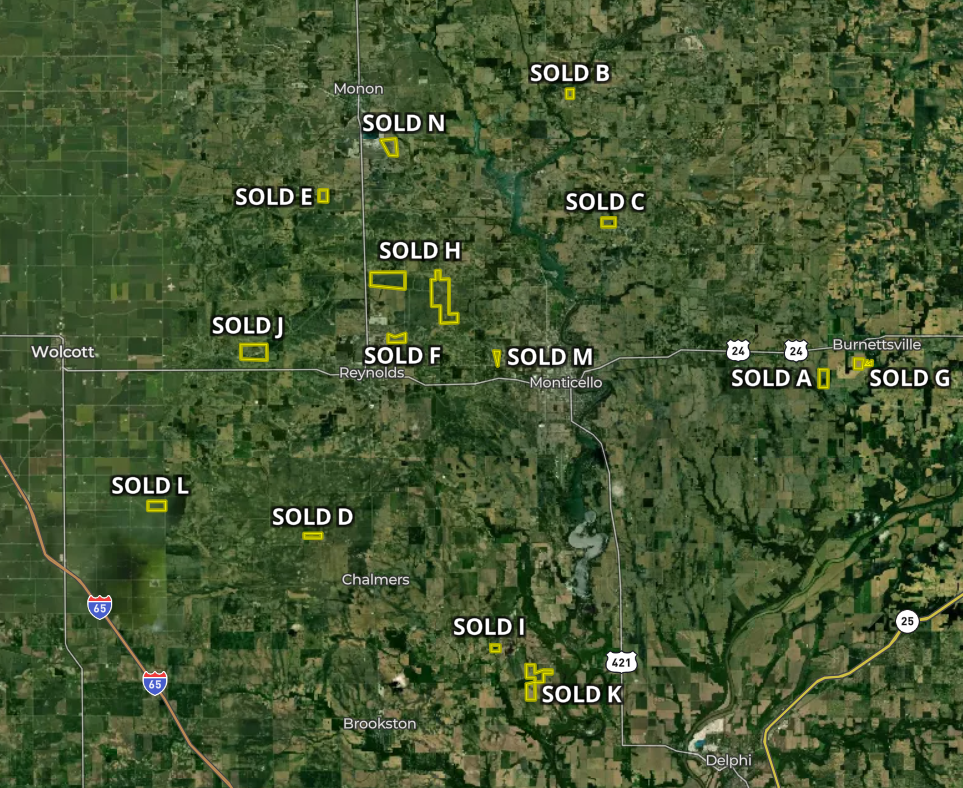
By The Numbers
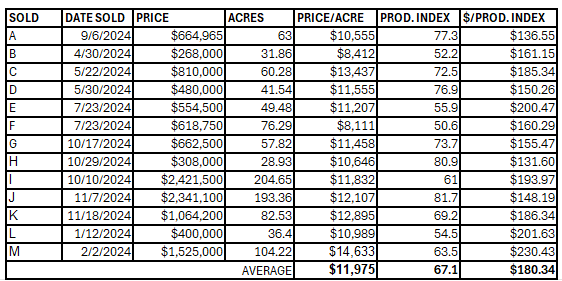
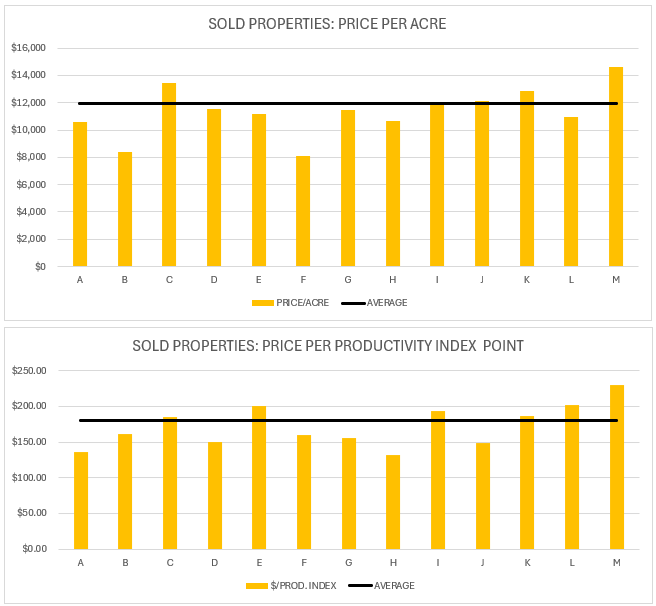
Key Factors that affect farmland value in White County include:
- Location
- Presence of Wind Turbines
- Presence of Pattern Tile or Tile Systems for Drainage
- Presence of Pivot Irrigation Systems
- High Soil Productivity Indexes (WAPI and NCCPI)
- Proximity to Grain Markets or Storage
- Yield & Fertility Histories
- Historical Farm Management Plans / Crop Plan History
According to Land.com, about 1,000 acres of land went up for sale in White County, Indiana, with listings totaling nearly $31 million in value. That puts White County at 40th among all Indiana counties for the amount of land currently on the market. The most listings were found around Monticello, which makes sense given its central role in the county. Covering 508 square miles, White County is actually one of the ten largest counties in the state and is located in Indiana’s north western region.
Other factors to note that may affect farmland values in White County include soil quality, water availability, and climatic conditions, which are essential for cropland productivity. Proximity to grain markets and transportation infrastructure, such as highways and railroads, also significantly impact land values by facilitating easier access to buyers and suppliers. Additionally, land-use regulations, zoning laws, and the presence of conservation programs (CRP or EQIP, etc) can either enhance or restrict the potential uses of farmland, thus affecting its value. Economic trends, such as commodity prices and interest rates, play a crucial role in determining land demand and investment returns. Currently we see very few farms for sale, and continued growth in the demand for farmland – thus supporting strong prices despite higher interest rate headwinds. The historical productivity of the land and technological advancements in farming practices can further influence the desirability and valuation of farmland in White County.
The most recent USDA farmland census reveals that White County encompasses approximately x acres of farmland. With an average farm size of about 528 acres and around 577 farms in operation, the county is a significant player in Indiana’s agricultural landscape. Corn and soybeans dominate as the primary crops, substantially bolstering the local agricultural economy. The census also highlights that 87 farm operators in White County are family-owned businesses, underscoring the critical role of agriculture in the community’s heritage and economy.
Key analytics from the USDA census provide a deeper understanding of White County’s agricultural dynamics. The average farm size of 528 acres suggests a mix of small to medium-sized farming operations, which can influence efficiency and scalability in agricultural practices. The dominance of corn and soybeans indicates a reliance on crop rotation strategies, which can enhance soil health and productivity but also make the local economy vulnerable to fluctuations in commodity prices.
- The prevalence of family-owned farms highlights the significance of generational farming knowledge and community-oriented business practices.
- These family operations often face unique challenges, such as succession planning and access to capital, which can impact long-term sustainability.
Additionally, the data on farmland distribution and usage can inform policy decisions, investment strategies, and resource allocation to support the agricultural sector’s growth and resilience in White County.
Overview of White County Agriculture
Location and Geography: White County, Indiana sits in the northwest part of the state, featuring low, rolling hills dominated by agriculture and urban areas, with the Tippecanoe River flowing south through its center.
Major Crops:
- Corn: Grown extensively across White County, corn is used for livestock feed, ethanol production, and grain exports, thriving in the county’s fertile Midwestern soils.
- Soybeans: A key rotational crop, soybeans are valued for their versatility in oil, animal feed, and food products, and are widely planted alongside corn.
- Winter Wheat: Typically grown as a secondary or rotational crop, winter wheat supports soil health and provides an additional harvest outside the primary growing season.
History & Background of White County, Indiana
County Seat: Monticello
Townships: Big Creek / Cass / Honey Creek / Jackson / Liberty / Lincoln / Monon / Prairie / Princeton / Round Grove / Union / West Point
History: Named after Colonel Isaac White, who fought in the historic Battle of Tippecanoe
Population: 24.69K
Cities & Towns: Brookston / Burnettsville / Chalmers / Monon / Monticello / Reynolds / Wolcott
Acreage: 325,395
According to the USDA National Agricultural Statistics Service (NASS), the following crop statistics have been reported for White County, Indiana.
The 2022 Ag Census for White County, Indiana, reported the following crop statistics:.
Number of farms: 577
Land in farms (acres):304,558
Average farm size (acres): 528
Total market value of products sold: $439,323,000
Government payments: $2,319,000
Farm-related income: $9,643,000
Total farm production expenses: $290,177,000
Net cash farm income: $161,108,000
Sources / Citations:
Source 1:
“United States Department of Agriculture.” USDA, www.nass.usda.gov/Statistics_by_State/Indiana/Publications/County_Estimates/index.php#:~:text=Access%20Quick%20Stats%20Lite,to%20NASS%20Surveys%20and%20Programs. Accessed 16 June 2025.
Source 2:
“USDA.” 2022 Census of Agriculture County Profile, https://www.nass.usda.gov/Publications/AgCensus/2022/Online_Resources/County_Profiles/Indiana/cp18181.pdf Accessed 16 June 2025.
*The transaction and land sales data/information contained in this report was obtained from publicly available sources and sales disclosures deemed accurate and reliable but not guaranteed, no liability for accuracy, errors or omissions is assumed by Geswein Farm & Land Realty, LLC
Thinking About Selling? Unsure what to do about the family farm?
Need Advice?
Get the guidance, service, and professional expertise you deserve.
With our full-time experienced team, you’ll get our ‘boots on the ground’ work ethic paired with the latest in digital technology & national marketing reach – for best-in-class service and results.
Because you deserve more value.
Contact Us