


Will County, Illinois
2026 Land Sales Report
Will County farmland values remained elevated through 2025, continuing the trend of strong pricing across high-quality agricultural ground. As 2026 develops, early indicators suggest a gradual shift toward more stable market conditions.
If you’d like to get specific land values on your own property or a farm near you for 2026, please contact Jeremy Thompson at (815) 351-5572.
Request a Land Values ReportAverage Price of Land*
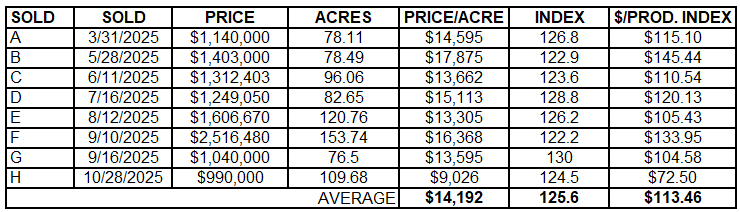
$14,192/acre
Jan. – Dec. 2025*
As high as $17,875/acre
in 2025*
Land Market Commentary & Local Trends
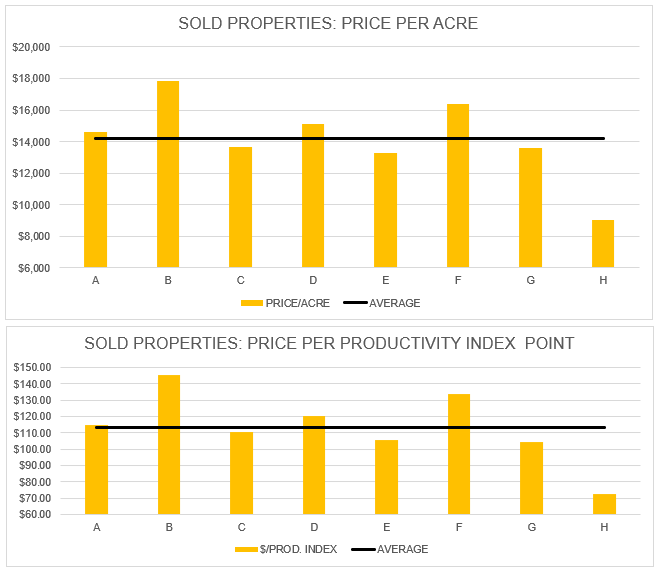
In 2025, Will County farmland maintained consistent value strength, averaging $14,192 per acre and $113.46 per productivity index point. The strongest sales reflected continued demand, reaching as high as $17,875 per acre.
Since 1977, the Geswein Farm & Land Team has been advising landowners to be stewards of the land and make decisions based on most current, accurate, and relevant data. The information in this report can provide you with a rough estimate of your property’s value; however, understanding the specific characteristics of your property and how they compare to the other sales will provide the most accurate value of your property. Additionally, properties sold by land brokers via auctions or listings consistently outperformed individual to individual transactions and properties sold by traditional home realtors.
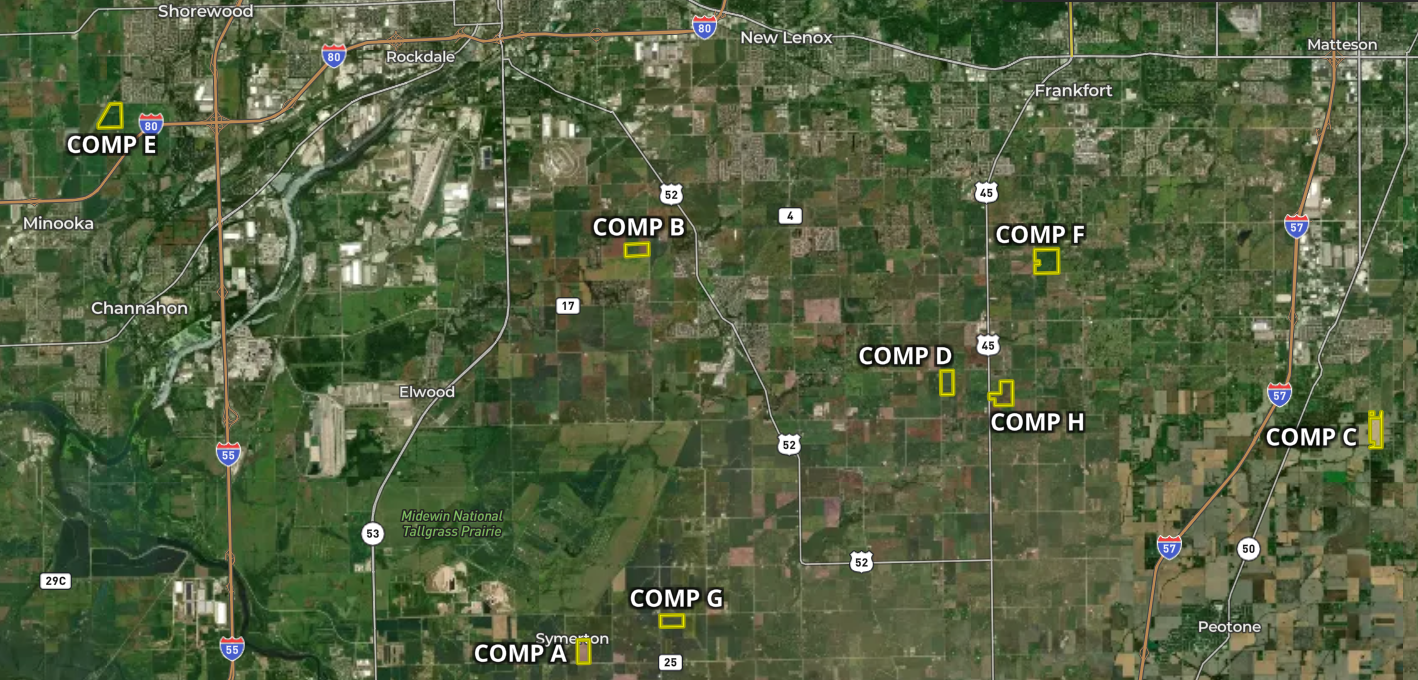
By The Numbers
Will County’s farmland market in 2025 continued to reflect one of the most complex land environments in Illinois. Unlike more remote agricultural counties, Will County sits directly within the influence zone of the Chicago metropolitan area, and that proximity continues to shape how farmland is valued, purchased, and held.
Throughout 2025, demand for farmland remained steady, but buyer behavior became increasingly selective. Agricultural productivity still served as the foundation of value, yet location and potential alternative land uses continued to influence pricing expectations in certain parts of the county.
Rather than a uniform farmland market, Will County operates as a layered one – where top-performing agricultural tracts, transitional acreage, and development-influenced parcels can all behave differently depending on location.
According to the USDA National Agricultural Statistics Service (NASS), the following crop statistics have been reported for Will County, Illinois.
The 2022 Ag Census for Will County, Illinois, reported the following crop statistics:
Number of farms: 780
Land in farms (acres): 241,269
Average farm size (acres): 309
Total market value of products sold: $234,726,000
Government payments: $3,210,000
Farm-related income: $10,100,000
Total farm production expenses: $159,636,000
Net cash farm income: $88,400,000
Agriculture in a High-Growth Region
Despite intense regional development pressure, Will County remains an active and productive agricultural county. Large areas of row-crop production continue to operate at a high level, supported by strong soils, established farming operations, and well-developed rural infrastructure.
However, what makes Will County distinct is that agriculture shares the landscape with one of the fastest-growing corridors in the Midwest. This creates a land market where buyers often evaluate parcels through multiple lenses at once.
In 2025, farmland purchasers consistently considered:
Soil productivity and yield consistency
Drainage systems and field efficiency
Proximity to transportation infrastructure and highways
Long-term agricultural viability versus alternative uses
Location within growth-affected submarkets
This dual perspective means that farmland value in Will County is rarely based on agriculture alone – it is often shaped by both production and potential.
A Market Influenced by Location as Much as Land Quality
One of the defining trends in 2025 was the clear separation between strictly agricultural value and location-influenced pricing.
High-quality farmland continued to attract strong interest from operators focused on long-term production. These buyers prioritized efficiency, drainage, and soil performance, with an emphasis on maintaining strong farming operations.
At the same time, parcels located closer to expanding suburban corridors or infrastructure improvements often drew additional attention due to their long-term development potential. Even when currently farmed, these properties can carry added strategic value in the eyes of certain buyers.
This creates a dynamic where two similar farms in different parts of the county may experience very different market behavior.
xx
History & Background of Will County, Illinois
County Seat: Joliet
Townships: Channahon / Crete / Custer / DuPage / Florence / Frankfort / Green Garden / Homer / Jackson / Joliet / Lockport / Manhattan / Monee / New Lenox / Peotone / Plainfield / Reed / Troy / Washington / Wesley / Wheatland / Will / Wilmington / Wilton
History: Established in 1836; Formed from parts of Cook and Iroquois Counties, and named in honor of Conrad Will, a key figure in early Illinois governance.
Population: 700,728
Cities & Towns: Joliet / Aurora / Braidwood / Crest Hill / Lockport / Wilmington / Naperville / Beecher / Bolingbrook / Channahon / Crete / Diamond / Elwood / Frankfort / Godley / Homer Glen / Lemont / Manhattan / Minooka / Mokena / Monee / New Lenox / Orland Park / Oswego / Park Forest / Peotone / Plainfield / Rockdale / Romeoville / Sauk Village / Shorewood / Stegar / Symerton / Tinley Park / University Park / Woodridge
Acreage: 535,680
Agricultural Strength Remains the Foundation
Even with external pressures, agriculture remains central to Will County’s identity and land use. Row-crop farming continues across much of the county, supported by experienced operators and strong agricultural infrastructure.
The most consistent drivers of farmland value in purely agricultural areas include: soil quality & consistency, drainage & water management systems, field size & operational efficiency, accessibility for equipment and logistics, and long-term yield potential.
For these tracts, value remains closely tied to farm performance rather than outside influences.
Community and Development Influence Across the County
Western and Northern Growth Corridors
Areas closer to the Chicago metro edge continue to experience steady residential, commercial, and infrastructure expansion. These growth corridors remain important in shaping long-term land expectations.
Strong Agricultural Core in Southern Areas
Southern portions of Will County maintain a stronger agricultural identity, with large-scale farming operations remaining the dominant land use. These areas tend to behave more like traditional Illinois farmland markets.
Transportation and Logistics Advantage
Will County’s extensive highway, rail, and logistics infrastructure continues to be one of its defining economic strengths. This accessibility supports both agriculture and broader economic development across the region.
Ongoing Land Use Conversations
As development pressure continues, land use planning and preservation discussions remain active throughout the county. Balancing growth with agricultural preservation is an ongoing theme among landowners, communities, and local governments.
Early 2026 Market Activity: What’s Emerging
The first months of 2026 have continued many of the patterns established in 2025, particularly the selective nature of buyer demand.
While interest in farmland remains strong, buyers are approaching opportunities with greater discipline and a clearer focus on long-term value. High-quality agricultural tracts continue to attract competitive attention, especially when located in areas with strong farming infrastructure and minimal transition pressure.
Early 2026 trends include:
Continued demand for productive farmland in agricultural zones
Strong competition for well-maintained, efficient farms
Ongoing influence of location on pricing behavior
Selective but steady buyer participation
Limited availability of high-quality listings in key areas
Overall, the market remains active, but increasingly segmented based on both agricultural and locational characteristics.
Key Factors to Watch Through the Rest of 2026
Several important influences are expected to shape Will County’s farmland market moving forward: expansion of suburban & industrial development, commodity prices & farm profitability, interest rate & financing conditions, farmland inventory availability, and infrastructure & transportation projects.
In Will County, development pressure is often just as important as agricultural economics when evaluating long-term land value trends. Even small shifts in zoning, infrastructure, or demand for non-agricultural land use can influence market behavior.
Final Thoughts
Will County’s farmland market in 2025 continued to reflect its unique position within Illinois agriculture. While strong farming operations remain at the core of land value, the county’s proximity to Chicago introduces additional layers of complexity not seen in most agricultural markets.
Early 2026 trends suggest that this dual-market dynamic is continuing. Buyers remain active but selective, with strong demand for productive farmland and continued attention to location-driven potential.
As the year progresses, Will County is likely to remain one of the most closely watched farmland markets in Illinois – where agriculture, infrastructure, and long-term development pressures all intersect.
Sources / Citations:
Source 1:
“United States Department of Agriculture.” USDA, www.nass.usda.gov/Statistics_by_State/Illinois/Publications/County_Estimates/index.php#:~:text=Access%20Quick%20Stats%20Lite,to%20NASS%20Surveys%20and%20Programs. Accessed 16 June 2026.
Source 2:
“USDA.” 2022 Census of Agriculture County Profile, www.nass.usda.gov/Publications/AgCensus/2022/Online_Resources/County_Profiles/Illinois/cp17197.pdf. Accessed 16 June 2026.
*The transaction and land sales data/information contained in this report was obtained from publicly available sources and sales disclosures deemed accurate and reliable but not guaranteed, no liability for accuracy, errors or omissions is assumed by Geswein Farm & Land Realty, LLC
Thinking About Selling?
Need Advice?
Get the guidance, service, and professional expertise you deserve.
- Family Farm Advisory for Succession Planning
- Undivided Interests & Tenants in Common
- Farmland Management Decisions
- Auctions & Listing
With our full-time experienced team, you’ll get our ‘boots on the ground’ work ethic paired with the latest in digital technology & national marketing reach – for best-in-class service and results.
Because you deserve more value.
Contact Us